AI Agents in Industrial Automation: The New Industry Standard
Estimated reading time: 7 minutes
- Transitioning from rigid, script-based logic to autonomous, goal-oriented AI agents.
- The vital necessity of ISA/IEC 62443 standards in securing connected factory floors.
- How digital twins serve as a safety sandbox for AI reasoning and simulation.
- The shift toward private AI infrastructure to solve latency and data privacy concerns.
- Implementing human-centric automation to avoid the technical “automation trap.”
- From Rigid Scripts to Self-Orchestrating Systems
- The Critical Role of ISA/IEC 62443 Cybersecurity
- Bridging the Gap with Digital Twins and AI
- The Necessity of Private AI Infrastructure
- Designing Human-Centric Automation
- Industrial AI Cybersecurity and Resilience
- Scaling AI Agents Across the Enterprise
- The Future of “Lights-Out” Operations
- Frequently Asked Questions
- Sources
The industrial world is currently witnessing a massive shift. For decades, factories relied on rigid, deterministic scripts to manage production. These systems followed strict logic gates and required manual intervention for any variation. Today, the rise of AI agents in industrial automation is changing the fundamental architecture of the factory floor. These autonomous systems do not just follow instructions; they plan, reason, and execute complex workflows.
This transition marks the end of simple automation and the beginning of true industrial autonomy. Companies are moving away from centralized control toward decentralized, agentic intelligence. Synthetic Labs is at the forefront of this evolution, helping enterprises deploy the private infrastructure needed to support these advanced models. As global competition intensifies, understanding how to integrate AI agents in industrial automation has become a strategic necessity for every CTO and operations leader.
From Rigid Scripts to Self-Orchestrating Systems
Traditional industrial automation operates on a “if-this-then-that” logic. Engineers spend months writing specific code for PLCs (Programmable Logic Controllers). However, these scripts are brittle. If a sensor reports an unexpected value, the entire line might shut down. This rigidity creates significant downtime and limits the flexibility of manufacturing plants.
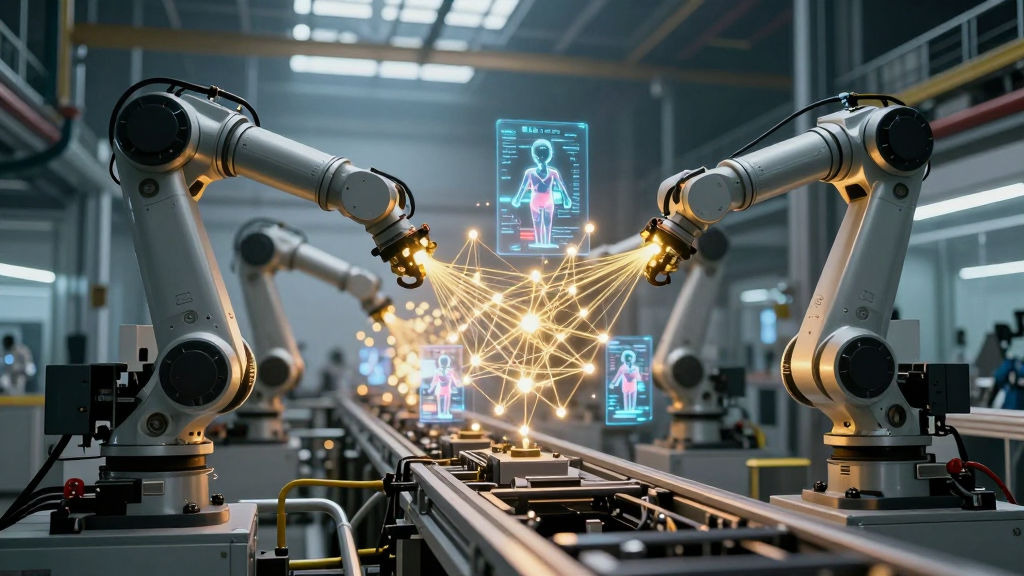
Conversely, AI agents use Large Language Models (LLMs) and specialized reasoning engines to handle ambiguity. Instead of a fixed script, an agent receives a high-level goal, such as “optimize throughput while maintaining temperature within safety margins.” The agent then orchestrates the necessary sub-tasks. It queries various sensors, adjusts valve timings, and coordinates with robotic arms in real-time.
Furthermore, these agents can interface directly with legacy systems via API gateways. They act as a cognitive layer that sits above the existing SCADA (Supervisory Control and Data Acquisition) systems. As a result, companies can modernize their operations without replacing every piece of physical hardware. This approach provides a faster return on investment and reduces the risk of massive mechanical overhauls.
The Critical Role of ISA/IEC 62443 Cybersecurity
As factories become more connected, the attack surface grows exponentially. Integrating AI agents into operational technology (OT) requires a rigorous security framework. This is where ISA/IEC 62443 cybersecurity standards become essential. This international standard provides a roadmap for securing industrial automation and control systems.
One primary concept within ISA/IEC 62443 cybersecurity is the “zones and conduits” model. Security teams must segment the network into distinct zones based on risk levels. For example, a robotic assembly zone should have limited access to the general office network. AI agents must operate within these defined boundaries to prevent lateral movement by malicious actors.
Consequently, every AI agent needs a strong digital identity. You must implement the principle of least privilege. This means an agent should only have the permissions necessary to perform its specific task. If an agent is designed for predictive maintenance, it should not have the power to alter safety-critical setpoints on a furnace. By following these protocols, manufacturers can leverage advanced AI without compromising the safety of their workers or the integrity of their data.
Bridging the Gap with Digital Twins and AI
A digital twin is a virtual representation of a physical asset or system. In the past, these were often static models used for offline simulation. However, the convergence of digital twins and AI has created a dynamic feedback loop that powers agentic systems. Today, digital twins consume real-time telemetry from thousands of sensors across the plant.
AI agents use these digital twins as a sandbox. Before an agent makes a change to a physical process, it can simulate the outcome in the virtual twin. For instance, if an agent wants to increase the speed of a conveyor belt, it first checks the digital twin to see how the change affects the motor’s lifespan. This simulation layer adds a critical level of safety and predictability.
Moreover, the combination of digital twins and AI enables sophisticated anomaly detection. The system compares the live performance of a machine against its “ideal” digital twin. If the real-world performance deviates even slightly, the AI agent flags a potential failure. According to recent insights from Automation.com – Industrial AI Trends, this real-time synchronization is the cornerstone of modern predictive maintenance.
The Necessity of Private AI Infrastructure
Most consumer-grade AI models run in the public cloud. However, industrial environments have unique requirements for latency, reliability, and privacy. A factory cannot wait for a cloud server in another country to process a safety-critical command. Therefore, building a robust private AI infrastructure is the only viable path forward for most manufacturers.
By hosting models locally or at the edge, companies eliminate latency issues. This ensures that AI agents can react to physical events in milliseconds. Furthermore, a private setup keeps sensitive production data within the company firewall. This is particularly important for trade secrets, proprietary chemical formulas, and sensitive logistics data.
At Synthetic Labs, we advocate for a modular stack. This usually includes a local vector database, a model gateway, and a high-performance compute cluster. Enterprises should focus on implementing private AI control planes to manage these distributed resources. A well-designed control plane allows you to update models and monitor agent performance across multiple facilities from a single interface.
Designing Human-Centric Automation
There is a common fear that AI will replace every human worker in the factory. However, the most successful implementations actually focus on human-centric automation. This philosophy views AI as a tool to augment human capability rather than a direct replacement for headcount. When companies use AI solely to cut costs, they often fall into the “automation trap.”
The automation trap occurs when a system becomes so complex and autonomous that humans lose the ability to intervene during a crisis. If a company fires all its domain experts and relies entirely on AI, a single system failure can lead to catastrophic downtime. Conversely, human-centric automation keeps experts in the loop. The AI handles the repetitive, data-heavy tasks, while the human focuses on high-level judgment and complex problem-solving.
For example, an AI agent might identify a subtle vibration in a turbine. Instead of just shutting the machine down, the agent presents the data to a senior engineer. The agent provides several possible causes and a recommended repair plan. The engineer then makes the final decision based on years of experience. This collaborative approach increases the demand for skilled workers who understand both the machinery and the AI tools.
Industrial AI Cybersecurity and Resilience
Security in the age of AI goes beyond traditional firewalls. We must now consider industrial AI cybersecurity as a specialized field. This involves protecting the models themselves from adversarial attacks. An attacker might try to “poison” the training data or provide “prompt injections” to manipulate an agent’s behavior.
To combat these threats, organizations must implement model-level monitoring. You should log every decision an AI agent makes and compare it against expected behavior. If an agent starts recommending illogical actions, the system should automatically revert to a safe, deterministic mode. This fail-safe mechanism is vital for maintaining production continuity.
Furthermore, companies must ensure that their enterprise autonomy architecture 2026 includes robust backup systems. If the AI layer is compromised, the base-level PLC logic must still be able to operate the factory in a “limp home” mode. Resilience is not just about preventing attacks; it is about how quickly you can recover when something goes wrong.
Scaling AI Agents Across the Enterprise
Once a pilot program succeeds on a single production line, the challenge becomes scaling. Moving from one agent to a fleet of hundreds requires a standardized platform. You cannot treat every AI deployment as a bespoke science project. Instead, you need a repeatable process for training, deploying, and auditing agents.
One effective strategy is to create a library of specialized agents. One agent might be an expert in energy optimization, while another specializes in quality control via computer vision. These agents can then communicate with each other via a central “orchestrator” agent. This multi-agent system mimics a human management structure, where different departments coordinate to achieve a common goal.
As you scale, the quality of your underlying data becomes the primary bottleneck. Agents are only as good as the information they can access. Therefore, invest in high-quality data labeling and automated data pipelines. Clean, structured data is the fuel that allows AI agents in industrial automation to perform at their peak.
The Future of “Lights-Out” Operations
The ultimate vision for many manufacturers is the “lights-out” factory. This refers to a facility that can run for long periods without any human presence on-site. While we are still far from this reality for complex manufacturing, AI agents are bringing us closer. These systems can manage routine operations, handle minor faults, and optimize energy usage autonomously.
However, the path to lights-out operations is paved with standards and certifications. Systems must meet the highest levels of safety and security before they are allowed to operate without supervision. Following the ISA/IEC 62443 cybersecurity framework is not just about safety; it is a prerequisite for achieving full autonomy.
In the coming years, we expect to see the “Agentic Plant Manager.” This will be a high-level AI system that oversees dozens of sub-agents. It will balance production schedules, supply chain fluctuations, and maintenance needs in real-time. The human role will shift from “operator” to “architect,” designing the goals and constraints that the AI must follow.
The integration of AI agents in industrial automation represents a paradigm shift in how we build and manage physical systems. By moving beyond rigid scripts, companies can unlock new levels of efficiency and resilience. However, this journey requires a strong focus on ISA/IEC 62443 cybersecurity and a commitment to human-centric automation.
To succeed, enterprises must invest in private AI infrastructure and leverage the power of digital twins and AI. Those who embrace these technologies today will be the leaders of the industrial landscape tomorrow. The goal is not just to automate tasks, but to create intelligent, self-orchestrating systems that can adapt to an ever-changing world.
Subscribe for weekly AI insights as we continue to explore the boundaries of generative media and private infrastructure.
Frequently Asked Questions
- What is the difference between traditional automation and AI agents?
- Traditional automation follows fixed, programmed logic. AI agents use reasoning and language models to handle new situations and plan multi-step tasks to reach a goal.
- How does ISA/IEC 62443 apply to AI agents?
- It provides a framework for network segmentation and security zones. This ensures that AI agents have limited access to sensitive systems and helps prevent cyberattacks from spreading.
- Why do I need private AI infrastructure for my factory?
- Private infrastructure reduces latency, ensures 100% uptime, and protects sensitive production data from being exposed to the public cloud.
- Will AI agents replace factory workers?
- AI agents are best used in a human-centric way. They take over repetitive data analysis, allowing human experts to focus on complex troubleshooting and strategic decision-making.