
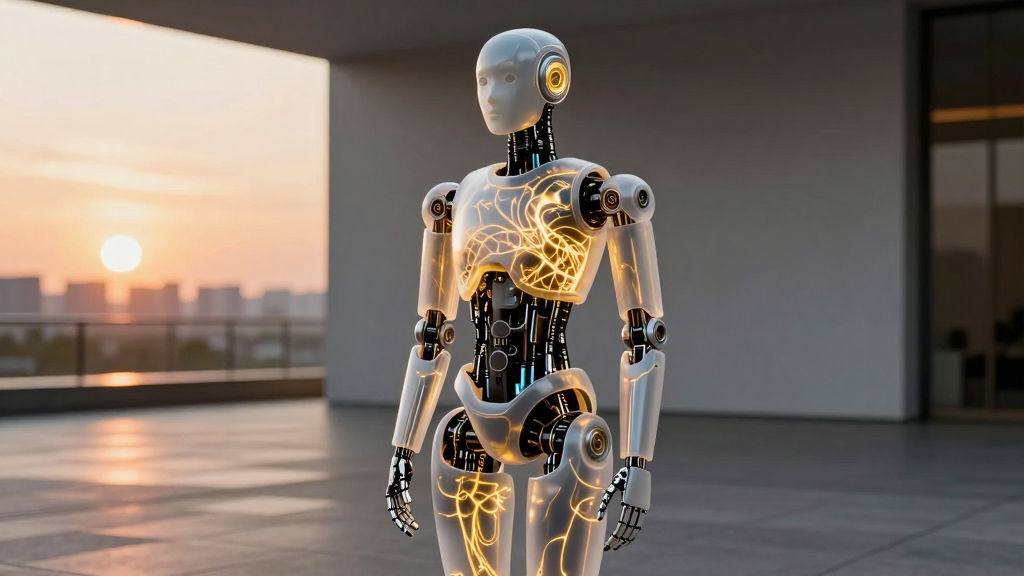
Top AI Breakthroughs 2026: The Era of Physical Intelligence
Estimated reading time: 7 minutes
- Embodied AI: Transitioning from digital chatbots to physical systems like NVIDIA Alpamayo and LG CLOiD.
- Efficient Reasoning: The rise of compact, high-performance models like Falcon-H1R 7B that challenge the “bigger is better” philosophy.
- Scientific Acceleration: AI is revolutionizing healthcare with EKG diagnostics and climate science through DeepMind’s GenCast.
- Quantum Integration: Microsoft’s use of logical qubits to accelerate molecular modeling and drug discovery.
- NVIDIA Alpamayo and the Chain-of-Thought Driving Revolution
- The Power of the AlpaSim Simulator
- LG CLOiD: Bringing Learning Robots Into the Home
- Solving Labor Shortages with Domestic Automation
- Falcon-H1R 7B: The Rise of Efficient Compact Models
- Why Task-Optimized Models Win
- Nemotron Speech ASR: Redefining Real-Time Voice Interaction
- Privacy-Focused Enterprise Voice Solutions
- University of Michigan’s EKG AI: Life-Saving Diagnostics
- Democratizing Cardiac Screening
- Google DeepMind GenCast: Predicting Extreme Weather
- Boosting Global Climate Resilience
- Microsoft’s Quantum-AI Hybrids and Molecular Modeling
- Bridging the Gap in Pharma and Chemistry
- The On-Device AI Surge and Data Privacy
- Enhancing Predictive Maintenance
- Strategic Implications for Innovation Teams
- Conclusion
- Frequently Asked Questions
- Sources
The landscape of artificial intelligence is shifting from digital chatbots to embodied systems that interact with the real world. As we navigate the early months of the year, several AI breakthroughs in 2026 are already redefining how industries operate and how humans live. We are moving past the era of mere text generation and entering a phase defined by physical reasoning and scientific acceleration.
These advancements represent more than just incremental updates. Specifically, they signal a transition toward “agentic” systems capable of independent action and complex problem-solving. For founders and CTOs, staying ahead means understanding these technical shifts today.
NVIDIA Alpamayo and the Chain-of-Thought Driving Revolution
Autonomous driving has long faced the “long-tail” problem. This refers to the infinite number of unpredictable scenarios that occur on real roads. However, NVIDIA’s new Alpamayo model addresses this challenge directly. Alpamayo is a 10-billion-parameter Vision-Language-Action (VLA) model that introduces chain-of-thought reasoning to the driver’s seat.
Standard autonomous systems often rely on pattern matching. In contrast, Alpamayo “reasons” through its environment. It analyzes visual data, predicts potential risks, and plans actions using a logical sequence. For example, if a ball rolls into the street, the model anticipates a child might follow. Consequently, the vehicle slows down before a human or a traditional sensor would even react.
The Power of the AlpaSim Simulator
Testing these high-stakes models requires massive amounts of data. NVIDIA paired Alpamayo with the AlpaSim simulator. This platform creates high-fidelity virtual environments for training. Remarkably, AlpaSim has reduced validation variance by 83% for virtual training.
This reduction means that simulation results now mirror real-world performance more closely than ever. As a result, developers can deploy Level 4 autonomy faster without the risks associated with early-stage public road testing. This breakthrough is essential for making autonomous transport safe and scalable for daily commutes.
LG CLOiD: Bringing Learning Robots Into the Home
While NVIDIA focuses on the road, LG Electronics is transforming the home. The LG CLOiD robot represents the first generation of truly learning smart home robots. Powered by the NVIDIA Jetson Thor platform, CLOiD utilizes virtual behavior simulation before it ever steps foot in a consumer’s house.
Most previous home robots followed rigid, pre-programmed paths. However, CLOiD uses edge AI to adapt to dynamic environments in real-time. For instance, it can recognize a spilled liquid and determine the best cleaning method based on the floor type. Furthermore, it manages home security by identifying unusual patterns in the household.
Solving Labor Shortages with Domestic Automation
The rise of CLOiD addresses growing labor shortages in the domestic sector. Because it is powered by Jetson Thor, the robot processes data locally. This “AI-native” approach ensures that the robot functions without a constant cloud connection. Consequently, users enjoy faster response times and enhanced privacy. This model of NVIDIA powering industrial AI automation has finally reached the consumer living room.
Falcon-H1R 7B: The Rise of Efficient Compact Models
For years, the industry followed a “bigger is better” philosophy regarding model size. The Technology Innovation Institute (TII) has challenged this trend with Falcon-H1R 7B. This model is a Transformer-Mamba hybrid that delivers elite performance at a staggering 1,500 tokens per second.
Falcon-H1R 7B achieved an 88.1% score on the AIME-24 math benchmark. Additionally, it scored 68.6% on the LCB v6 coding benchmark. These figures outpace models that are ten times its size. This efficiency is largely due to DeepConf, a reasoning framework that ensures the model only provides answers it is “confident” in.
Why Task-Optimized Models Win
Startups and edge robotics companies are moving away from massive, expensive LLMs. Instead, they prefer small reasoning AI models that offer low energy use and high speed. Specifically, Falcon-H1R 7B allows developers to run high-level logic on local hardware. This shift democratizes access to elite AI, allowing smaller players to compete with tech giants.
Nemotron Speech ASR: Redefining Real-Time Voice Interaction
Communication is the most natural way for humans to interact with machines. NVIDIA’s Nemotron Speech ASR (Automated Speech Recognition) is a breakthrough that makes this interaction seamless. It is currently available as a NIM microservice, allowing for easy integration into existing enterprise stacks.
The technical specifications are impressive. Nemotron Speech ASR processes audio 10x faster than legacy systems. Therefore, it enables real-time captions and in-car commands that feel instantaneous. In a world where latency kills user experience, this 10x speed gain is a game-changer for voice-activated apps.
Privacy-Focused Enterprise Voice Solutions
Enterprises often hesitate to use cloud-based voice services due to data security concerns. However, Nemotron can be deployed on the edge. This means sensitive conversations stay within the company’s private network. By prioritizing low-latency and security, NVIDIA has set a new standard for human-AI interaction in professional settings.
University of Michigan’s EKG AI: Life-Saving Diagnostics
Medical technology is seeing some of the most profound AI breakthroughs in 2026. Researchers at the University of Michigan have developed an AI system that detects heart disease in seconds. By analyzing 10-second EKG strips, the AI can diagnose coronary microvascular dysfunction (CMVD).
Previously, diagnosing CMVD required invasive imaging and expensive hospital stays. Now, the AI system identifies the disease with 98% accuracy. It achieves this by leveraging protein dynamics insights, similar to those found in AlphaFold 3.
Democratizing Cardiac Screening
This technology has the potential to save millions of lives globally. Because it only requires a standard EKG machine and an AI software layer, it can be deployed in rural clinics and developing nations. Consequently, advanced cardiac screening is no longer limited to high-end medical centers. This is a prime example of how AI can bypass traditional infrastructure hurdles to deliver immediate value.
Google DeepMind GenCast: Predicting Extreme Weather
Climate change has made weather patterns increasingly volatile. In response, Google DeepMind launched GenCast, a generative AI model for medium-range weather forecasting. Traditional meteorological models are computationally expensive and sometimes slow to update.
GenCast, however, uses generative techniques to provide probabilistic predictions. For example, it can predict the exact path of a heatwave or a storm with much higher accuracy than legacy systems. Furthermore, it operates at a fraction of the compute cost of traditional models.
Boosting Global Climate Resilience
Accurate weather data is critical for supply chains, agriculture, and disaster prep. By using GenCast, businesses can better manage their resources before a storm hits. This efficiency helps mitigate the economic impact of extreme weather events. As we look at what’s next in AI for 2026, generative science models like GenCast stand out as vital tools for survival.
Microsoft’s Quantum-AI Hybrids and Molecular Modeling
The integration of quantum computing and artificial intelligence is no longer a distant dream. Microsoft has successfully paired quantum systems with AI supercomputers to unlock breakthroughs in material science. The key to this success lies in logical qubits.
Logical qubits are error-corrected versions of the fragile physical qubits found in early quantum computers. By using these stable units, Microsoft can simulate molecular interactions with perfect precision. This capability is accelerating drug discovery at a pace previously thought impossible.
Bridging the Gap in Pharma and Chemistry
The pharmaceutical industry is the primary beneficiary of this hybrid approach. Traditionally, discovering a new material or drug took a decade. Now, the combination of quantum precision and AI speed reduces that timeline to months. Microsoft, in partnership with IBM and AMD, is creating a new ecosystem for scientific discovery that transcends the limits of classical computing.
The On-Device AI Surge and Data Privacy
Privacy is becoming the central theme of the 2026 AI landscape. There is a massive shift toward on-device AI for mobile phones and IoT devices. This movement is driven by hardware like the NVIDIA Jetson Thor and increasingly compact, efficient models.
When AI runs on the device, user data never leaves the hardware. Consequently, this enhances security and ensures that features like real-time translation work even without an internet connection. For enterprises, this is a critical component of building private AI infrastructure that complies with strict data sovereignty laws.
Enhancing Predictive Maintenance
In the industrial sector, on-device AI enables predictive maintenance in remote locations. For instance, a sensor on an oil rig can analyze vibration data locally to predict a failure. Because it doesn’t rely on the cloud, the response is immediate. This reliability is essential for preventing environmental disasters and maintaining operational efficiency.
Strategic Implications for Innovation Teams
The AI breakthroughs in 2026 show that the barrier between the digital and physical worlds is dissolving. CTOs and innovation leads must rethink their strategies. It is no longer enough to simply “use AI” for writing emails or summarizing documents.
Instead, companies should look at how these advancements can optimize their core physical or scientific processes. Whether it is using DeepConf reasoning for better decision-making or deploying VLA models in robotics, the opportunities are vast. The winners of this era will be those who integrate AI into the very fabric of their physical operations.
Conclusion
The year 2026 marks a turning point for artificial intelligence. We have moved from simple generative models to complex systems capable of physical reasoning, scientific discovery, and real-time interaction. From NVIDIA Alpamayo’s driving logic to Microsoft’s logical qubits, the boundaries of what is possible are expanding daily.
These AI breakthroughs in 2026 emphasize three core themes: efficiency, privacy, and physical action. As models become smaller and smarter, they become more accessible to everyone. Simultaneously, the focus on on-device processing ensures that our digital future remains secure.
At Synthetic Labs, we continue to track these developments to help you build the infrastructure of tomorrow. Stay informed and stay ahead.
Subscribe for weekly AI insights and deep dives into the technologies shaping our world.
Frequently Asked Questions
- What is NVIDIA Alpamayo?
- NVIDIA Alpamayo is a 10-billion-parameter Vision-Language-Action (VLA) model. It uses chain-of-thought reasoning to improve the safety and decision-making of autonomous vehicles in complex road scenarios.
- How does Falcon-H1R 7B differ from other AI models?
- It is a Transformer-Mamba hybrid model. This architecture allows it to process up to 1,500 tokens per second while maintaining elite performance in math and coding, despite its relatively small size.
- What are logical qubits in quantum computing?
- Logical qubits are error-corrected units of quantum information. They are much more stable than physical qubits, allowing for precise simulations in fields like drug discovery and material science.
- Is GenCast better than traditional weather models?
- GenCast provides probabilistic forecasts with higher accuracy for extreme weather events. Furthermore, it requires significantly less computational power than traditional meteorological systems.
- Why is on-device AI becoming more popular?
- On-device AI offers better privacy because data remains on the hardware. It also allows for lower latency and functionality in areas with poor internet connectivity.