
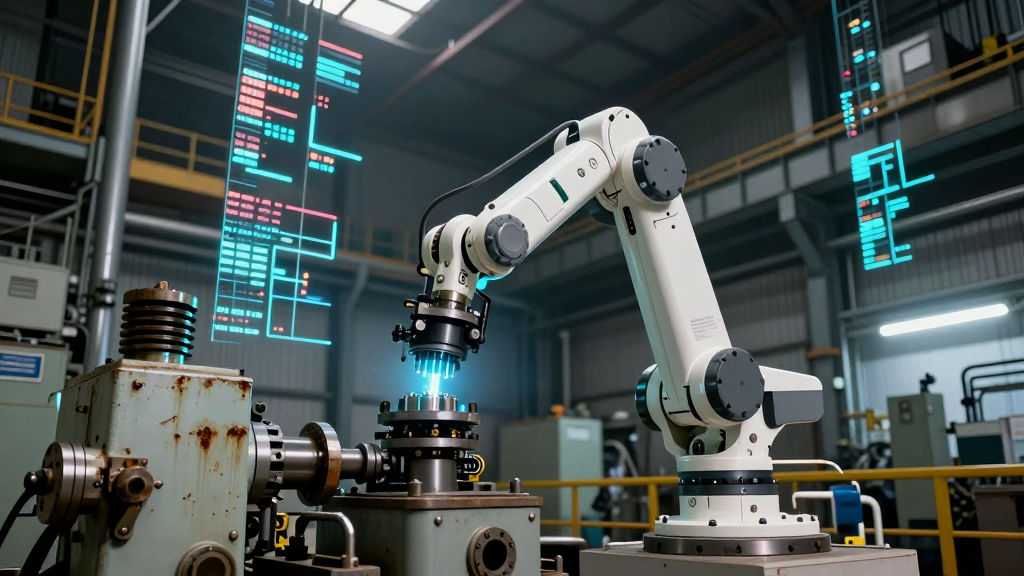
AI Automation in Manufacturing: Why 80% of Factories Lag
Estimated reading time: 7 minutes
- Despite the hype, nearly 80% of U.S. manufacturing facilities operate without any automation.
- Legacy equipment and environmental noise create significant technical hurdles for AI deployment.
- Private AI infrastructure is emerging as the preferred solution for data security and real-time processing.
- Successful automation strategies focus on workforce augmentation and clear ROI-driven use cases.
- The Massive Reality Gap in Industrial Automation
- Technical Blockers: Why Real-World AI is Difficult
- The Data Capture Dilemma
- The Rise of Private AI Infrastructure
- Moving Toward Multimodal AI Robotics
- ROI and the Business Case for Automation
- Addressing Automation Anxiety and the Workforce
- Effective Retraining Strategies
- Scaling Beyond Pilot Mode
- Conclusion
The dream of the fully autonomous “lights-out” factory has dominated headlines for a decade. However, a startling reality check recently emerged from the front lines of industrial technology. Despite the relentless hype surrounding generative models, nearly 80% of U.S. manufacturing facilities still operate with zero automation. This massive gap suggests that while AI dominates the boardroom, it hasn’t yet mastered the factory floor.
Bridging this divide is the next great frontier for industrial leaders and technology providers. Current data shows that only 29% of manufacturers utilize AI or machine learning at a network level. Furthermore, just 24% have successfully deployed generative AI in their daily operations. Understanding AI automation in manufacturing requires looking past the marketing demos to see why real-world deployment remains so difficult.
The Massive Reality Gap in Industrial Automation
The industrial sector currently faces a profound contradiction between potential and practice. Global industrial robot installations reached a staggering 542,000 units in 2024. Nevertheless, these numbers concentrate in a handful of high-tech hubs rather than the broader manufacturing landscape. Brian Gerkey, CTO of Intrinsic, recently noted that the vast majority of facilities still rely on manual processes.
This stagnation persists because integrating new technology into legacy environments is notoriously complex. Most factories operate with equipment that predates the modern internet era. Consequently, connecting a 20-year-old hydraulic press to a cutting-edge neural network is not a simple software update. It requires a fundamental overhaul of physical and digital infrastructure that many small-to-mid-sized players cannot yet afford.
Early adopters who have crossed this chasm are already reaping significant rewards. These companies report productivity gains between 10% and 20% through targeted AI implementations. They focus on specific high-value use cases like demand forecasting and automated quality control. As a result, the competitive gap between automated and manual factories is widening every day.
Technical Blockers: Why Real-World AI is Difficult
Deploying AI in a controlled digital environment is significantly easier than deploying it in a noisy factory. In a warehouse, variables like lighting, dust, and human movement create “noise” that confuses standard machine learning models. Therefore, developers must build systems that are resilient to environmental fluctuations. This level of robustness is often missing from off-the-shelf AI solutions.
Another major hurdle is the lack of standardized interfaces between different robotic systems. Most manufacturers use hardware from multiple vendors, each with proprietary communication protocols. Integrating these “silos” into a unified AI-driven workflow is a nightmare for most engineering teams. Without an open robotics stack, scaling automation across a diverse facility remains a high-cost endeavor.
Furthermore, the integration of Operational Technology (OT) and Information Technology (IT) remains a friction point. OT teams prioritize safety and uptime, while IT teams focus on data throughput and security. Balancing these competing interests requires a nuanced approach to system architecture. For a deeper look at how industrial leaders navigate these shifts, see our analysis of Siemens AI automation evolution.
The Data Capture Dilemma
Modern AI models are data-hungry, yet most factory data remains “trapped” in isolated sensors.
- Many sensors lack the bandwidth to export high-frequency data for analysis.
- Data formats vary wildly between different machine brands and ages.
- Legacy logging systems often overwrite valuable historical data too quickly.
- Cleaning “messy” sensor data for ML training requires specialized expertise.
The Rise of Private AI Infrastructure
Privacy and intellectual property are the lifeblood of competitive manufacturing. Most factory owners are understandably hesitant to send proprietary production data to public cloud providers. Consequently, we are seeing a significant shift toward private AI infrastructure in the industrial sector. This approach allows companies to process data locally without risking exposure to external competitors.
On-premise hardware ensures that sensitive trade secrets stay within the four walls of the factory. Additionally, private infrastructure reduces the latency issues that plague cloud-based systems. In a high-speed assembly line, a millisecond of lag can lead to a catastrophic mechanical failure. Local processing via edge computing provides the real-time responsiveness necessary for safe physical automation.
Building these systems involves more than just buying servers; it requires a dedicated strategy for model hosting and security. Many firms are now adopting self-hosted LLMs and air-gapped environments to protect their operational integrity. You can explore more on this in our guide to designing secure air-gapped private AI infrastructure.
Moving Toward Multimodal AI Robotics
The next wave of industrial robotics adoption will likely be driven by multimodal perception. Traditional robots are often “blind” or follow rigid, pre-programmed paths. In contrast, next-gen systems use vision, force sensing, and language processing to understand their surroundings. This allows them to adapt to changes in the production line without manual reconfiguration.
Multimodal models enable robots to perform complex tasks like picking unsorted items from a bin. Previously, this required highly specific programming for every possible object shape. Now, AI-powered vision systems can identify and grasp objects they have never seen before. This flexibility is essential for “high-mix, low-volume” manufacturing where products change frequently.
However, moving these multimodal systems from simulation to reality remains a bottleneck. The “domain gap” between a digital training environment and a greasy factory floor is often wide. Therefore, engineers must use synthetic data and reinforcement learning to bridge this divide. Only through rigorous testing can these smarter robots achieve the reliability required for production.
ROI and the Business Case for Automation
For many executives, the hesitation to automate stems from uncertain Return on Investment (ROI). Automation requires high upfront capital expenditure (CAPEX) with a timeline that may span years. In an era of fluctuating interest rates, many firms prefer to stick with flexible, manual labor. To counter this, AI providers must demonstrate clear, short-term wins in specific departments.
Quality control is often the best place to start. Traditional manual inspection is prone to human error and fatigue. By implementing computer vision systems, factories can catch defects with near-100% accuracy in real-time. This reduces waste and prevents costly product recalls, providing a direct boost to the bottom line.
Another high-ROI area is predictive maintenance. AI can analyze vibration and temperature data to predict when a machine is about to fail. Consequently, maintenance teams can fix issues during scheduled downtime rather than reacting to an emergency. This proactive approach saves thousands of dollars in lost production time and emergency repair costs.
Addressing Automation Anxiety and the Workforce
The fear of job displacement is a significant social and organizational barrier. Workers often view new robots as competitors rather than tools, leading to resistance on the shop floor. This “automation anxiety” can sabotage even the most technically sound deployment. Therefore, successful companies prioritize transparent communication and workforce retraining programs.
The reality of AI-driven workforce transformation is often more about augmentation than replacement. Robots take over the “3Ds”: tasks that are Dull, Dirty, or Dangerous. This frees up human workers to focus on complex problem-solving and machine supervision. Instead of losing jobs, many workers find themselves promoted to higher-paying technical roles.
To manage this transition, leaders must develop a comprehensive strategy for organizational change. This involves mapping out which roles will change and what new skills the workforce will need. For a framework on how to handle this, refer to our guide to AI workforce planning. Education is the most effective tool for turning skeptics into champions of automation.
Effective Retraining Strategies
- Offer certifications in robotics maintenance and AI supervision.
- Create “pilot teams” of workers to test and refine new systems.
- Highlight safety improvements as a primary benefit of new technology.
- Link automation benchmarks to employee performance bonuses.
Scaling Beyond Pilot Mode
The biggest challenge facing AI automation in manufacturing is moving from a single pilot to a factory-wide rollout. Many companies get stuck in “pilot purgatory,” where they have several successful small projects but no cohesive strategy. Scaling requires a robust data backbone and a standardized approach to model deployment.
To scale effectively, manufacturers need a centralized AI enablement platform. This platform should manage model versions, monitor performance, and ensure security across multiple production lines. Without this orchestration layer, the complexity of managing dozens of individual AI tools becomes unmanageable. Standardization is the only path to true industrial-scale automation.
Finally, government incentives and industry partnerships will play a crucial role. Collaborative research and tax credits can lower the barrier to entry for smaller manufacturers. As the ecosystem matures, we expect to see more “turnkey” AI solutions that require less custom engineering. This democratization of technology will be the key to reaching the 80% of factories currently left behind.
Conclusion
The gap between AI hype and industrial reality is a massive opportunity for those ready to lead. While 80% of U.S. factories remain unautomated, the early adopters are already securing a competitive advantage. Success in this space requires more than just buying the latest robot; it demands a strategic focus on AI automation in manufacturing, private infrastructure, and workforce development.
The journey from pilot mode to full-scale automation is complex but necessary. By addressing technical blockers, prioritizing data security, and empowering the workforce, manufacturers can finally realize the promise of Industry 4.0. The “lights-out” factory may still be years away for most, but the foundations are being laid today by forward-thinking innovators.
Subscribe for weekly AI insights to stay ahead of the curve in industrial automation and private infrastructure.
FAQ
- Why is 80% of U.S. manufacturing still not automated?
- The primary reasons include the high cost of legacy equipment integration, a lack of standardized robotics interfaces, and a shortage of specialized technical talent. Many small-to-mid-sized manufacturers also struggle with the high upfront capital costs and uncertain ROI timelines.
- How does private AI infrastructure help manufacturers?
- Private AI allows factories to process sensitive production data locally. This protects intellectual property, ensures data privacy, and reduces latency, which is critical for real-time safety and control on the factory floor.
- Will AI automation replace human factory workers?
- While AI automates repetitive and dangerous tasks, it often creates a need for new, higher-skilled roles. The focus is shifting toward “augmentation,” where humans supervise and maintain AI systems rather than performing manual labor.
- What are the first steps to implementing AI in a factory?
- Most experts recommend starting with high-ROI, low-risk use cases like predictive maintenance or automated quality control. Once these pilots show success, companies can build the data infrastructure needed to scale across the entire facility.