
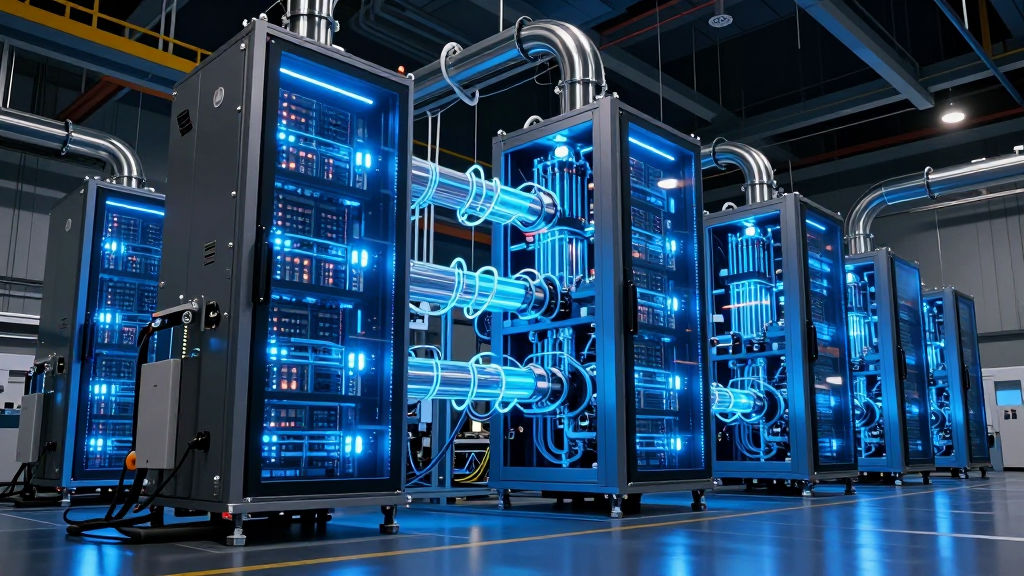
Scaling the Future: The NVIDIA Rubin Platform and AI Superfactories
Estimated reading time: 7 minutes
- Transition from individual accelerators to fully integrated “AI Superfactories” for trillion-parameter reasoning.
- Introduction of the Vera CPU and HBM4 memory delivering a massive 22 TB/s of aggregate bandwidth.
- Breakthroughs in networking with Spectrum-X Ethernet Photonics providing 5x better power efficiency.
- Deployment of rack-scale systems like Microsoft Fairwater to redefine enterprise ROI and private AI infrastructure.
- The Architectural Leap Beyond Blackwell
- Solving the Memory Wall with HBM4 Memory Bandwidth
- The Vera CPU: Custom Silicon for AI Orchestration
- Networking Evolution: Spectrum-X Ethernet Photonics
- BlueField-4: The Infrastructure Processor for Agentic AI
- Microsoft Fairwater and the Rise of Superfactories
- Reliability and the Second-Generation RAS Engine
- Transformer Engine 6.0 and NVFP4 Precision
- Modular Design and Rapid Deployment
- The Economic Impact on Enterprise AI
- Conclusion: Preparing for the Rubin Era
- FAQ
- Sources
The landscape of artificial intelligence changed permanently at CES 2026. NVIDIA unveiled the NVIDIA Rubin platform, marking a decisive shift from individual accelerators to fully integrated “AI Superfactories.” This architecture represents the most significant leap in data center compute power since the original H100. Consequently, enterprise leaders must now rethink how they build and scale their private infrastructure to keep pace with these advancements.
The NVIDIA Rubin platform does not simply offer a faster chip for training models. Instead, it provides a comprehensive blueprint for the next decade of agentic AI and trillion-parameter reasoning. By integrating custom silicon, advanced photonics, and massive memory bandwidth, NVIDIA has created a system that addresses the most stubborn bottlenecks in modern computing. For founders and CTOs, understanding this shift is essential for maintaining a competitive edge in an increasingly automated world.
The Architectural Leap Beyond Blackwell
Many industry observers expected a modest iteration following the Blackwell generation. However, the Rubin architecture introduces a fundamental redesign of how data moves through a cluster. NVIDIA has optimized every component to work in perfect synchronicity. This design philosophy ensures that the GPU never waits for data, which has historically been the primary cause of inefficiency in large-scale deployments.
The platform utilizes the new Vera CPU and BlueField-4 DPU to manage complex workloads. Furthermore, the integration of Spectrum-X Ethernet Photonics allows for unprecedented communication speeds between nodes. As companies move toward private AI infrastructure, the ability to orchestrate these components becomes a major operational advantage. Rubin is not just a processor; it is the central nervous system of the modern enterprise.
Solving the Memory Wall with HBM4 Memory Bandwidth
One of the most impressive features of the Rubin GPU is its memory subsystem. The HBM4 memory bandwidth GPU technology delivers a staggering 22 TB/s of aggregate bandwidth. Specifically, each GPU features 288 GB of HBM4 memory. This massive capacity allows the system to handle the long-context windows required for advanced reasoning tasks.
Memory bottlenecks have long frustrated researchers working on large-scale generative models. When a model runs out of fast memory, performance drops significantly. Consequently, the Rubin platform enables high-batch mixture-of-experts (MoE) execution without the usual latency penalties. In addition, this bandwidth supports the real-time processing of multimodal data streams, which is vital for industrial automation and robotics.
The Vera CPU: Custom Silicon for AI Orchestration
For the first time, NVIDIA has introduced a dedicated CPU designed specifically to feed the Rubin GPU clusters. The Vera CPU custom silicon AI chip features 88 custom-designed “Olympus” cores. These cores handle the complex control logic and data orchestration that generic ARM or x86 processors often struggle with during AI workloads.
By using custom silicon, NVIDIA can ensure that the CPU and GPU share a unified memory architecture. This tight integration reduces the energy overhead of moving data between different parts of the system. Moreover, this efficiency addresses the growing AI energy infrastructure challenges facing global data centers. The Vera CPU acts as the conductor, ensuring every GPU cycle is utilized effectively.
Networking Evolution: Spectrum-X Ethernet Photonics
Traditional copper cabling is reaching its physical limits in terms of speed and power consumption. To solve this, the Rubin platform introduces Spectrum-X Ethernet Photonics datacenter technology. This transition to light-based communication provides a 5x improvement in power efficiency compared to previous networking standards.
Optical interconnects allow for much longer cable runs without signal degradation. As a result, engineers can design larger, more flexible data center layouts. This networking stack also features specialized hardware for handling the “bursty” traffic patterns typical of AI training. In contrast to standard web traffic, AI workloads require massive, synchronized data transfers. Spectrum-X ensures these bursts do not lead to network congestion or packet loss.
BlueField-4: The Infrastructure Processor for Agentic AI
Security and isolation are critical when deploying multi-tenant AI environments. The BlueField-4 DPU infrastructure processor plays a vital role here by offloading management tasks from the main compute chips. It combines a 64-core Grace CPU with ConnectX-9 networking capabilities.
This DPU handles encryption, storage virtualization, and telemetry in real-time. Specifically, it enables the secure, bare-metal deployments that enterprise clients demand. By offloading these “taxing” tasks to the BlueField-4, the Rubin GPUs remain free to focus entirely on computation. Therefore, organizations can achieve higher hardware utilization rates while maintaining a robust security posture.
Microsoft Fairwater and the Rise of Superfactories
The scale of Rubin is best exemplified by the Microsoft Fairwater AI superfactories initiative. Microsoft is currently deploying Vera Rubin NVL72 rack-scale systems across its global Azure infrastructure. These superfactories are designed to house hundreds of thousands of interconnected superchips.
According to Microsoft’s strategic AI datacenter planning enables seamless, large-scale NVIDIA Rubin deployments, these deployments enable seamless, large-scale AI operations. This partnership signals that the Rubin platform is ready for immediate enterprise adoption. For companies relying on cloud-based AI, this infrastructure provides the backbone for the next generation of generative applications. Consequently, the “Superfactory” model is becoming the standard for sovereign and corporate AI clouds.
Reliability and the Second-Generation RAS Engine
Running thousands of GPUs simultaneously increases the statistical likelihood of hardware failure. To combat this, NVIDIA integrated a second-generation Reliability, Availability, and Serviceability (RAS) engine into the Rubin platform. This engine performs continuous health checks across the GPU, CPU, and NVLink fabric.
The RAS engine can predict potential failures before they occur. Furthermore, it allows for autonomous recovery, where the system can reroute data around a failing component without stopping the entire training job. This level of resilience is essential for mission-critical applications. As businesses become more dependent on AI for daily operations, uptime becomes just as important as raw performance.
Transformer Engine 6.0 and NVFP4 Precision
Efficiency is not only about hardware; it is also about how the software uses that hardware. The Rubin platform features Transformer Engine 6.0, which introduces NVFP4 ultra-low precision training. This new numerical format allows models to run with significantly less memory and compute power.
NVFP4 provides a bridge between high-accuracy training and high-speed inference. In addition, the hardware-software co-design ensures that there is no meaningful loss in model accuracy when using these lower-precision formats. This innovation is a primary driver behind the massive reduction in inference costs. Specifically, it allows smaller enterprises to run sophisticated models that were previously cost-prohibitive.
Modular Design and Rapid Deployment
Speed to market is a competitive necessity in the AI sector. NVIDIA addressed this by moving to a modular, cable-free tray design for Rubin racks. This structural change allows for 18x faster assembly compared to the Blackwell generation.
Technicians can swap out modules or scale up clusters with minimal downtime. For data center operators, this modularity reduces the complexity of maintenance. Moreover, the standardized “liquid-cooled” racks ensure that these high-density systems stay within safe thermal limits. As a result, enterprises can deploy Rubin-based infrastructure in weeks rather than months.
The Economic Impact on Enterprise AI
The Rubin platform fundamentally changes the ROI math for generative AI. By drastically reducing the energy and hardware footprint required for a given workload, NVIDIA has lowered the barrier to entry. Organizations can now achieve higher throughput with fewer racks.
This efficiency directly impacts the bottom line. Furthermore, the ability to run long-context reasoning models locally reduces reliance on expensive third-party APIs. In contrast to earlier generations, Rubin makes “private-first” AI a viable economic strategy for mid-sized companies. This shift will likely accelerate the adoption of custom-trained models across various industries.
Conclusion: Preparing for the Rubin Era
The NVIDIA Rubin platform represents a paradigm shift in how we perceive computing. By moving toward a holistic “Superfactory” approach, NVIDIA has solved many of the infrastructure challenges that hampered previous AI deployments. From HBM4 memory bandwidth to the specialized Vera CPU, every component serves a specific purpose in the AI lifecycle.
For Synthetic Labs and our partners, this hardware provides the foundation for the next wave of automation. The integration of Spectrum-X photonics and BlueField-4 DPUs ensures that these systems are not only fast but also secure and efficient. As we move further into 2026, the enterprises that embrace this architectural shift will be the ones that define the future of the industry.
Subscribe for weekly AI insights and stay ahead of the technology curve.
FAQ
- What is the NVIDIA Rubin platform?
- The Rubin platform is NVIDIA’s next-generation AI infrastructure, featuring new GPUs, the Vera CPU, and advanced networking designed for large-scale AI “Superfactories.”
- How does HBM4 memory benefit AI models?
- HBM4 provides up to 22 TB/s of bandwidth, which is essential for handling large-context windows and high-speed reasoning in generative AI models.
- What is the role of the Vera CPU?
- The Vera CPU is a custom silicon chip with 88 cores designed to orchestrate data flow and manage the high-speed requirements of Rubin GPU clusters.
- Why is Spectrum-X Ethernet Photonics important?
- It uses light instead of electricity to move data, resulting in 5x better power efficiency and faster communication across massive data center networks.
- When will the Rubin platform be available?
- Major cloud providers like Microsoft and CoreWeave are expected to begin large-scale deployments of Rubin-based systems throughout 2026.
Sources
- NVIDIA Rubin SSD NAND shortage prediction
- NVIDIA Vera Rubin: Nine Hardware, Cloud Companies Build Out Ecosystem
- NVIDIA Touts Rubin Platform, Production Hardware Advances
- Inside the NVIDIA Rubin Platform: Six New Chips, One AI Supercomputer
- NVIDIA Rubin Platform News
- NVIDIA DGX SuperPOD: Rubin
- Microsoft’s strategic AI datacenter planning enables seamless, large-scale NVIDIA Rubin deployments
- NVIDIA Rubin Keynote
- At CES, NVIDIA Rubin and AMD Helios Made Memory the Future of AI