
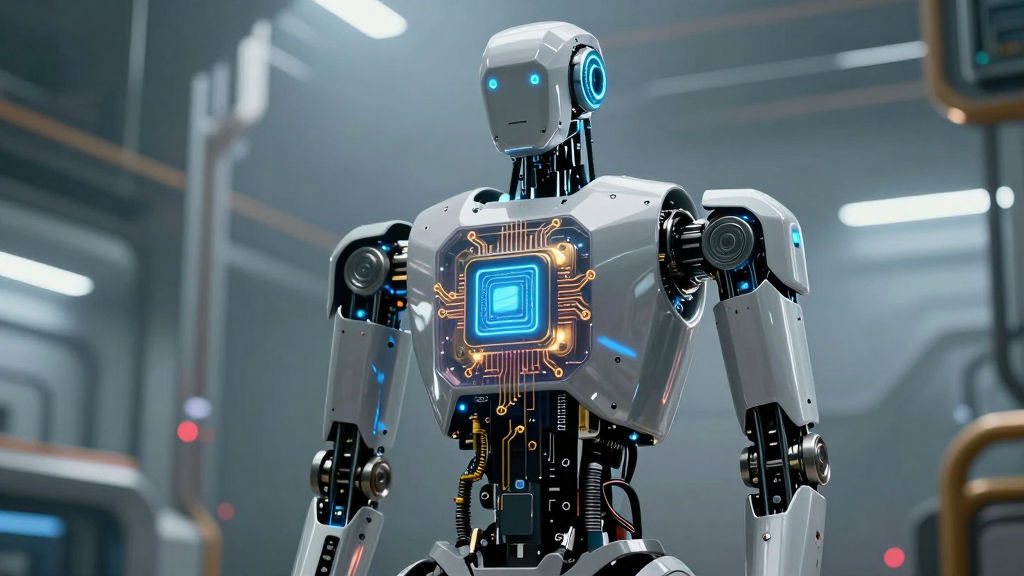
Qualcomm Dragonwing IQ10: The Future of Physical AI Edge Deployment
Estimated reading time: 7 minutes
- Physical AI Transition: Intelligence is moving from screens to the tangible world via specialized edge hardware like the Qualcomm Dragonwing IQ10.
- Edge Performance: Localized inference allows for sub-10ms latency, critical for safety in industrial and medical robotics.
- Tactile Innovation: New processors from AMD and Intel are enabling robots to “feel” their environment through advanced sensor fusion.
- Economic Shift: A “physical capital boom” is driving a transition from software-based growth to robotic-driven GDP expansion.
- The Shift Toward Physical AI Edge Deployment
- Qualcomm Dragonwing IQ10: Real-Time Reactions
- AMD P100 and X100: Tactile Humanoids Arrive
- Intel Core Ultra Series 3 in Medical Robotics
- NVIDIA Alpamayo VLA Models: Reasoning at Scale
- Hybrid World Models and Physical Reasoning
- Healthcare Innovations: Autonomous Surgical Arms
- Economic Impacts and Hardware Bottlenecks
- Scaling Physical Intelligence via Sensor Fusion
- Conclusion
- FAQ
The digital era of artificial intelligence is rapidly transitioning into a physical one. For years, we have interacted with AI through screens and text boxes. However, the announcements at CES 2026 signify a massive shift toward “Physical AI.” This movement focuses on bringing intelligence into the tangible world through robotics and edge computing. Central to this evolution is the Qualcomm Dragonwing IQ10, a specialized system-on-chip (SoC) designed to handle the heavy lifting of real-world interactions without relying on the cloud.
As industries seek more autonomy, the demand for physical AI edge deployment has skyrocketed. Companies no longer want to wait for a round-trip to a data center. Instead, they require local inference that can react to a human’s movement or a mechanical failure in milliseconds. Consequently, the hardware powering these machines must be more efficient and powerful than ever before. In this article, we will explore how new silicon from Qualcomm, AMD, and Intel is reshaping the industrial landscape.
The Shift Toward Physical AI Edge Deployment
For many enterprises, the cloud has been a double-edged sword. While it offers massive computing power, it introduces latency and security risks. In a factory setting, even a 100-millisecond delay can result in a collision or a ruined product. This is why physical AI edge deployment is becoming the standard for modern automation. By processing data directly on the device, robots can function with a level of autonomy that was previously impossible.
Furthermore, physical AI requires more than just processing power. It requires a deep understanding of physics, tactile feedback, and spatial awareness. Modern models are no longer just predicting the next word in a sentence. Specifically, they are now predicting the amount of force needed to pick up a fragile glass or the trajectory of a moving forklift. This transition requires a fundamental rethink of both software and hardware architectures.
Many organizations are already seeing the benefits of shifting away from centralized intelligence. For example, small reasoning AI models have shown that localized intelligence can often outperform massive, generalized models in specific tasks. When you apply this logic to a robotic arm or a delivery drone, the efficiency gains are enormous. As a result, the industry is moving toward a decentralized “micro-intelligence” model.
Qualcomm Dragonwing IQ10: Real-Time Reactions
At the heart of this hardware revolution is the Qualcomm Dragonwing IQ10. Unveiled as a powerhouse for industrial robotics, this SoC features an 18-core Oryon CPU. According to early benchmarks, this provides five times the performance of previous generations. More importantly, it includes a Hexagon NPU specifically tuned for on-device AI inference. This combination allows for latency levels under 10ms, which is critical for safety-critical environments.
Why does 10ms matter so much? In a dynamic factory, conditions change instantly. A human might walk into a robot’s path, or a part might slip on a conveyor belt. Because the Dragonwing IQ10 handles these calculations locally, the robot can adjust its grip or halt its movement immediately. This capability slashes operational costs by 30% to 50% for manufacturers by reducing the need for expensive cloud infrastructure.
Additionally, the Dragonwing IQ10 supports advanced tactile feedback systems. This means robots are not just seeing their environment; they are feeling it. Through sensor fusion, the chip processes data from hundreds of pressure sensors simultaneously. Consequently, this enables a level of dexterity that allows robots to handle complex assembly tasks alongside human workers. This marks a significant milestone in the journey toward true human-robot collaboration.
AMD P100 and X100: Tactile Humanoids Arrive
While Qualcomm focuses on industrial speed, AMD is pushing the boundaries of humanoid precision. The newly released AMD P100 X100 humanoid processors are designed specifically for the GENE.01 bionic platform. These processors excel at sensor fusion, which is the process of combining data from vision, sound, and touch sensors into a single coherent world model.
The GENE.01 humanoid uses a “full-body tactile skin” to sense its surroundings. To manage this influx of data, the AMD P100 uses embedded machine learning for few-shot learning. For instance, if the robot encounters a new type of material, it can learn how to handle it by analyzing vibrations and motion data in real-time. This reduces the time needed for programming and allows for faster deployment in hazardous environments.
Moreover, the shift toward tactile sensing represents a departure from vision-only AI. While cameras are useful, they can be blinded by dust, smoke, or poor lighting. In contrast, tactile sensors provide a constant stream of reliable data. By utilizing the AMD X100 series, developers can build robots that navigate complex spaces by “feeling” their way through. This technology is expected to lead to commercial robot fleets by 2027, transforming precision manufacturing forever.
Intel Core Ultra Series 3 in Medical Robotics
The healthcare sector is also seeing a massive transformation through physical AI edge deployment. Intel has entered the fray with the Intel Core Ultra Series 3 RoBee humanoid. In medical settings, privacy and latency are non-negotiable. Therefore, cloud-based AI is often not a viable option for real-time patient care or surgical assistance.
The RoBee humanoid, powered by Intel’s latest silicon, handles complex tasks like neurological patient monitoring locally. It uses multimodal sensing to track patient movements and even analyze facial expressions for signs of distress. Because the Intel Core Ultra Series 3 offers high throughput for vision and touch data, the robot can respond to emergencies without any cloud-dependent delay.
Furthermore, these processors enable emotion-aware interactions. In a caregiving context, the robot must be more than just a tool; it must be a companion. By processing facial analysis and voice tone locally, RoBee can adjust its behavior to comfort a patient. This blend of technical precision and social intelligence is only possible because of the massive leap in edge processing power provided by Intel.
NVIDIA Alpamayo VLA Models: Reasoning at Scale
Beyond humanoid forms, NVIDIA is redefining how machines reason about the world. The NVIDIA Alpamayo VLA models (Vision-Language-Action) are a breakthrough in autonomous reasoning. Unlike traditional models that follow rigid scripts, VLA models allow machines to understand complex instructions and translate them into physical actions.
These models are being integrated into the Cosmos and Isaac platforms, which power everything from autonomous vehicles to logistics drones. By simulating edge physics, the Alpamayo models allow a drone to “rehearse” a flight path in a digital twin before executing it in the real world. As a result, the machine can predict rare events and avoid accidents that would baffle traditional algorithms.
The potential for these models extends far beyond simple automation. For example, they are being used to accelerate Level 4 autonomy in non-automotive sectors. This includes autonomous surgical arms and complex warehouse sorting systems. By enabling adaptive learning, NVIDIA is helping to unlock a market for physical AI that is estimated to be worth over $1 trillion. This level of private AI infrastructure ensures that companies can keep their proprietary data safe while reaping the benefits of advanced reasoning.
Hybrid World Models and Physical Reasoning
As we look toward the end of 2026, the trend is moving toward hybrid world models. These models combine traditional generative AI with physical reasoning. Instead of just “knowing” facts, these systems “understand” how gravity, friction, and momentum work. They learn from “vibes” — quite literally, the vibrations and sounds of the machines they inhabit.
Projects like the ARC Prize have shown that achieving human-level reasoning in AI requires a departure from simple pattern matching. In the context of the factory floor, this means robots that can diagnose their own mechanical issues by listening to the hum of a motor. By deploying these hybrid models on the edge, manufacturers can reduce rework and downtime by as much as 40%.
Furthermore, these systems use digital twins for constant rehearsal. Every motion a robot makes is first simulated to ensure accuracy. This prevents wear and tear and maximizes the lifespan of expensive hardware. As NVIDIA powers industrial AI automation, we are seeing a convergence of virtual simulation and physical execution that was science fiction only a few years ago.
Healthcare Innovations: Autonomous Surgical Arms
One of the most exciting applications of these technologies is in the operating room. LEM Surgical’s Dynamis platform is a prime example of how the NVIDIA Alpamayo VLA models and Isaac framework are being utilized. These autonomous surgical arms Dynamis use reinforcement learning to perform precise interventions with a level of accuracy that exceeds human capability.
The system relies on real-time force prediction to ensure that the surgical tools do not damage delicate tissues. This requires an incredible amount of processing power, all of which must happen at the edge. By minimizing human error, these robots can scale high-quality surgical care to underserved regions where specialists may not be available.
Consequently, the role of the surgeon is shifting from manual execution to strategic oversight. The robot handles the repetitive and high-precision aspects of the surgery, while the human focuses on the complex decision-making process. This synergy between human and machine is a hallmark of the 2026 tech landscape. As noted by experts at CES, CES 2026: The Year Physical AI Was Born, and healthcare is leading the charge.
Economic Impacts and Hardware Bottlenecks
While the technological progress is staggering, it is not without challenges. SEB analysts have pointed out that a “physical capital boom” is underway. As industries rush to adopt these robots, the demand for semiconductors is hitting record highs. This has led to concerns about hardware bottlenecks that could slow down deployment.
However, the dropping costs of sensors and specialized AI chips like the Qualcomm Dragonwing IQ10 are making mass deployment more feasible. As costs fall, we are seeing a shift in GDP growth from virtual tools to tangible, physical robots. This is a fundamental change in the global economy. We are moving from an era of “software eating the world” to “AI moving the world.”
Investors and founders must navigate this landscape carefully. The companies that win will be those that can integrate hardware and software seamlessly. This requires not only great AI models but also robust private infrastructure to manage them. As the focus shifts to physical AI, the importance of secure, local, and efficient computing cannot be overstated.
Scaling Physical Intelligence via Sensor Fusion
The final piece of the puzzle is scaling. How do we move from a single robot in a lab to thousands of robots in the wild? The answer lies in sensor fusion and few-shot learning. By using chips like the AMD P100 X100 humanoid series, robots can learn from a few examples rather than needing millions of data points.
In a flexible factory, this means you can repurpose a robot for a new task in minutes instead of days. You simply “show” the robot what to do, and its physical reasoning model handles the rest. This adaptability is the key to resilience in a changing global market. Whether it is a labor shortage or a supply chain disruption, physical AI provides the flexibility needed to stay competitive.
Furthermore, the rise of “micro-intelligences” means that every device on the factory floor will eventually have its own specialized AI. Your conveyor belts, your robotic arms, and even your pallets will be able to communicate and coordinate. This level of local coordination reduces the load on the central network and makes the entire system more robust. It is the ultimate expression of physical AI edge deployment.
Conclusion
The transition from virtual AI to Physical AI is the defining trend of 2026. With the Qualcomm Dragonwing IQ10 leading the way in edge processing, we are finally seeing machines that can react and reason in the real world. Whether it is the precision of AMD P100 X100 humanoid systems or the life-saving capabilities of autonomous surgical arms Dynamis, the impact of this technology is profound.
As we move forward, the focus will remain on bringing intelligence closer to the point of action. By prioritizing physical AI edge deployment, enterprises can build faster, safer, and more efficient systems. The era of the “brain in the cloud” is being supplemented by “intelligence in the machine.” At Synthetic Labs, we are committed to helping you navigate this shift with the best in private infrastructure and AI strategy.
Subscribe for weekly AI insights as we continue to track the evolution of physical intelligence and edge computing.
FAQ
- What is the Qualcomm Dragonwing IQ10?
- The Qualcomm Dragonwing IQ10 is a high-performance system-on-chip (SoC) designed for industrial robotics. It features an 18-core Oryon CPU and a Hexagon NPU, enabling real-time AI inference with sub-10ms latency at the edge.
- How does physical AI edge deployment differ from traditional AI?
- Traditional AI often relies on cloud processing, which can introduce latency and privacy concerns. Physical AI edge deployment processes data locally on the device, allowing for immediate reactions and better security in industrial and medical environments.
- What are NVIDIA Alpamayo VLA models?
- Alpamayo VLA (Vision-Language-Action) models are advanced reasoning systems that allow machines to understand complex instructions and translate them into physical movements. They are used in autonomous vehicles, drones, and surgical robotics.
- Why is tactile sensing important for robotics?
- Tactile sensing allows robots to “feel” their environment, providing data that cameras might miss. This is crucial for handling fragile objects, navigating dark or dusty environments, and ensuring safe human-robot collaboration.
- When will commercial humanoid robot fleets be common?
- Based on recent developments from AMD and Generative Bionics at CES 2026, experts predict that commercial-scale humanoid robot fleets will begin to appear in industrial settings by 2027.
Sources
- CES 2026: The Year Physical AI Was Born
- 2026 Tech Predictions: When AI Gets Physical
- Physical AI Trends and Robotics at CES 26
- Physical AI Craze: Automation Trends to Watch
- SEB Forecast: Shift from Virtual to Physical AI
- Universal Robots: Physical AI Predictions for 2026
- Four Physical AI Predictions for 2026 & Beyond