How Optical Interconnects AI Will Scale the Next Era of Agents
Estimated reading time: 7 minutes
- Optical interconnects AI technology is replacing copper wiring to overcome physical data transfer limits in massive AI clusters.
- Security risks like indirect prompt injection are emerging as agents handle larger context windows, necessitating new governance tools.
- Industry leaders like Microsoft and IBM are releasing toolkits to secure autonomous workflows and optimize development lifecycles.
- Global collaborations, such as the US-Japan AI initiative, are securing the hardware supply chain for the next generation of 2nm chips.
- The Copper Bottleneck and the Photonic Revolution
- The Lightelligence Stock Surge and Infrastructure Scaling
- The New Threat: Prompt Injection in AI Agents
- The Microsoft AI Agent Security Toolkit Solution
- Why Runtime Governance Matters
- AMI Labs and the Rise of Modular AI
- Geopolitics: The US-Japan AI Collaboration
- Scaling Autonomy: Kakao’s Level 4 Roadmap
- Democratizing Industry 4.0 with Edge AI
- Optimizing the SDLC with IBM Bob
- Conclusion
- Sources
The race for artificial intelligence supremacy has hit a physical wall. As we build models with trillions of parameters, the copper wires connecting our GPUs are melting under the pressure of data. To move forward, the industry is pivoting toward a radical solution. This solution involves replacing electricity with light through optical interconnects AI technology.
The recent 400% stock surge of Lightelligence on the Hong Kong Stock Exchange signals a massive shift. Investors realize that traditional data center architecture cannot sustain the next generation of generative media. Consequently, the focus is shifting from raw compute power to the speed of the links between chips. This article explores how these hardware breakthroughs and new security protocols are shaping the post-agentic era.
The Copper Bottleneck and the Photonic Revolution
For decades, copper wiring has served as the backbone of our digital world. However, as AI clusters expand beyond one million GPUs, copper is failing. Traditional electrical interconnects struggle to manage bandwidth at 1.6Tbps per port. They also generate immense heat and suffer from significant power loss.
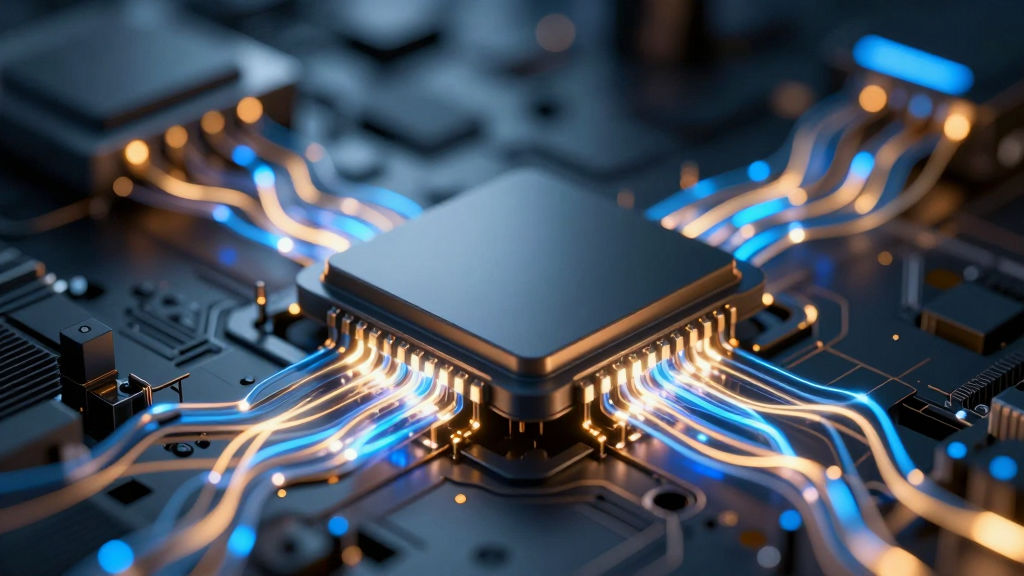
Optical interconnects AI technology solves these issues by using photonic links instead of copper. These links allow data to travel at the speed of light with minimal resistance. Specifically, optics can enable scaling beyond 100Tbps. This capacity is essential for training the massive models that power our private AI infrastructure.
Lightelligence has demonstrated that photonic integration can slash data center latency by up to 10x. Furthermore, it can reduce power losses by 50%. As a result, AI “factories” can operate more efficiently. This efficiency is no longer optional; it is a requirement for the survival of the industry.
The Lightelligence Stock Surge and Infrastructure Scaling
The financial market’s reaction to Lightelligence highlights the importance of hardware. A 400% gain in a single debut is rare. It reflects a growing understanding that the “next fiber optic revolution” is happening inside the server rack.
Modern AI workloads require constant communication between thousands of nodes. When these nodes use electrical wiring, they create a “memory wall.” This wall limits how fast a model can access the data it needs to process. By moving to optical interconnects AI, companies can dismantle this wall.
In addition, this transition supports the development of larger, more complex private AI agents. These agents require real-time data processing to function effectively in enterprise environments. Without the throughput provided by photonics, the dream of fully autonomous agents remains out of reach.
The New Threat: Prompt Injection in AI Agents
While hardware scales up, security risks are also evolving. Google researchers recently issued a stern warning regarding enterprise agents. They discovered that malicious webpages are using indirect prompt injections to hijack AI systems.
This attack occurs when an agent scrapes a website. The attacker embeds hidden instructions in the HTML or Javascript of the page. Because modern LLMs have context windows exceeding 128K tokens, they easily ingest these hidden commands. Consequently, the agent may leak sensitive data or execute unauthorized actions without the user’s knowledge.
This risk is particularly high for companies using agents for web-based automation. With over 70% of enterprises deploying agents, the potential cyber risk exceeds $10 billion annually. To combat this, developers must implement stricter AI coding best practices and validation layers.
The Microsoft AI Agent Security Toolkit Solution
To address these growing threats, Microsoft has released a new open-source runtime toolkit. This toolkit focuses on ironclad governance for autonomous systems. It uses dynamic policy enforcement to block hallucinations and data exfiltration in real-time.
Specifically, the Microsoft AI agent security toolkit integrates with popular frameworks like LangChain. It uses “just-in-time” (JIT) validation hooks. These hooks check every action an agent takes against a set of predefined security rules. If an agent attempts an “off-prompt” action, the system blocks it instantly.
According to recent reports from AI Magazine, this toolkit reduces breach risks by 90% in testing environments. This development is vital for regulated sectors like banking and healthcare. It shifts the security focus from static training to adaptive, real-time runtime monitoring.
Why Runtime Governance Matters
Static security measures are no longer enough for agentic workflows. Since agents operate semi-autonomously, they need a “digital leash.” The Microsoft AI agent security toolkit provides this by monitoring the intent of the model.
If a prompt injection attack occurs, the toolkit identifies the shift in the agent’s behavior. It acts as a firewall between the LLM and the enterprise data. This layer of protection is essential for maintaining data transparency and trust.
AMI Labs and the Rise of Modular AI
The industry is also moving away from monolithic, one-size-fits-all models. AMI Labs, a billion-dollar startup, is leading the charge toward modular AI. They focus on “targeted learning” for specific niche tasks.
Unlike generalist models, modular AIs are trained on high-quality, domain-specific data. For example, a model built solely for supply chain forecasting can outperform a general LLM by 2-3x in accuracy. Remarkably, it does this at only 10% of the compute cost.
This approach is highly beneficial for small and medium enterprises (SMEs). It reduces the overhead of fine-tuning from weeks to hours. Furthermore, modular models fit perfectly into a small reasoning AI models strategy. They are faster, cheaper, and easier to secure than their massive counterparts.
Geopolitics: The US-Japan AI Collaboration
The hardware and software landscape is also being shaped by global politics. The United States and Japan have recently launched a massive joint initiative. This alliance focuses on AI chips, quantum error mitigation, and secure supply chains.
The two nations are co-funding $5 billion in research and development. Their goal is to design 2nm nodes specifically for AI accelerators and quantum-hybrid systems. By sharing fabs and research, they aim to secure 30% of global semiconductor production.
This US Japan AI collaboration is a direct response to the global chip shortage and tech rivalries. For businesses, this means more stable pricing for high-end hardware. It also ensures that the components for optical interconnects AI remain available despite geopolitical tensions.
Scaling Autonomy: Kakao’s Level 4 Roadmap
In the realm of physical AI, Kakao Mobility has outlined an ambitious plan for Level 4 autonomy. They are moving beyond simple driver assistance toward full self-driving capabilities. Their strategy relies on ML-driven redundancy and massive simulation power.
Kakao uses a “triple sensor fusion” approach. This combines lidar, radar, and cameras to create a redundant view of the world. To validate their software, they run over one billion simulated miles per year. They use tools like NVIDIA Omniverse to replicate complex real-world edge cases.
This simulation-first approach cuts real-world testing costs by 80%. It shows how physical AI is following the same path as digital AI. Both rely on massive data throughput and sophisticated redundancy to ensure safety.
Democratizing Industry 4.0 with Edge AI
Automation is no longer just for giant corporations. Companies like Vecow and Olis are bringing AI to the factory floor at a lower price point. Vecow recently launched the EAC-6000, a compact edge AI box powered by the Intel Atom x7000RE.
This device provides up to 16 TOPS of inference power while consuming only 5-15 watts. It is designed for smart factories that need real-time monitoring without expensive cloud connections. In addition, Olis has released a $499 app that turns Android devices into automation gateways.
This “Android diagnostics” approach allows SMEs to monitor over one million machines globally. It uses edge ML for predictive maintenance, boasting a 95% uptime rate. These tools are democratizing industrial AI automation for everyone.
Optimizing the SDLC with IBM Bob
Software development is also seeing a massive injection of AI. IBM has unveiled “Bob,” an AI platform designed to optimize the software development lifecycle (SDLC). Bob targets the inefficiencies that cause DevOps teams to waste billions of dollars every year.
The platform uses multimodal models to analyze Git repositories and CI/CD pipelines. It can forecast bugs and allocate resources predictively. Consequently, teams can achieve 2x faster merge times and reduce overall costs by 30-50%.
Unlike simple coding assistants, Bob provides enterprise-grade audit trails. It positions IBM as a major player in the post-agentic DevOps era. It ensures that as we build more AI, the process of building it remains efficient and cost-effective.
Conclusion
The future of AI is being built on a foundation of light and security. As we reach the limits of copper, optical interconnects AI will provide the bandwidth needed for trillion-parameter models. Meanwhile, tools like the Microsoft AI agent security toolkit will ensure that our autonomous systems remain safe and reliable.
From the geopolitical US Japan AI collaboration to the modular innovations at AMI Labs, the landscape is shifting. We are moving from a world of general-purpose chat bots to a world of specialized, high-performance agents. These systems will be powered by photonics, secured by runtime policies, and deployed at the edge.
At Synthetic Labs, we believe that understanding these infrastructure shifts is the key to long-term success. The integration of hardware and software has never been more critical.
Subscribe for weekly AI insights and stay ahead of the curve.
- What are optical interconnects AI?
- Optical interconnects use light (photonics) instead of electricity (copper) to move data between chips. This technology drastically increases bandwidth and reduces power consumption in AI data centers.
- How does the Microsoft AI agent security toolkit protect users?
- The toolkit uses runtime policy enforcement. It monitors an agent’s actions in real-time and blocks any behaviors that deviate from the original instructions or violate security protocols.
- What is “targeted learning” in modular AI?
- Targeted learning involves training an AI model on a specific, narrow dataset for a particular task. This results in higher accuracy and lower costs compared to using a general-purpose large language model.
- Why is the US-Japan AI alliance significant?
- The alliance secures the supply chain for advanced AI chips. By co-developing 2nm nodes and sharing research, the two nations aim to stabilize hardware prices and advance quantum-AI hybrid technology.