BlueField-4 ASTRA: The Future of Multi-Tenant AI Security
Estimated reading time: 7 minutes
- Introduction of BlueField-4 ASTRA as a hardware-level security foundation for multi-tenant AI data centers.
- Transition to the NVIDIA Rubin platform and its “extreme codesign” philosophy integrating compute, networking, and security.
- How ASTRA solves the “noisy neighbor” and data leakage problems using hardware-enforced isolation and HBM4 memory partitioning.
- The role of early Vera Rubin samples in optimizing high-scale, private AI infrastructure for 2026.
- The Evolution of the AI Factory
- Understanding BlueField-4 ASTRA
- The Role of Vera Rubin Samples
- Solving the Multi-Tenant Problem
- Enhancing NVLink 6 Bandwidth Security
- Technical Deep Dive: HBM4 and Memory Isolation
- Spectrum-X Ethernet Photonics Integration
- Operational Efficiency and Uptime
- The Impact on ROI for Enterprises
- Future-Proofing with Confidential Computing
- Conclusion
- FAQ
- Sources
The landscape of artificial intelligence infrastructure is shifting beneath our feet. As we move into 2026, the demand for massive-scale compute has outpaced simple hardware upgrades. Enterprises now require environments where multiple sensitive workloads can coexist without compromising data integrity. The recent debut of the NVIDIA Rubin platform at CES 2026 addresses this exact challenge. Specifically, the introduction of BlueField-4 ASTRA provides the foundational security needed for next-generation, multi-tenant AI data centers.
This breakthrough technology is not just about raw performance. While speed remains a priority, the ability to isolate proprietary data in a shared environment is the new gold standard. Organizations are increasingly moving away from public, unshielded clouds toward more robust Private AI Infrastructure to protect their intellectual property. BlueField-4 ASTRA serves as the gatekeeper for these high-stakes environments.
The Evolution of the AI Factory
We have entered the era of the million-GPU factory. In this environment, traditional networking and security models simply break down. The transition from the Blackwell architecture to the Rubin platform represents a fundamental change in how we build AI systems. NVIDIA has moved toward an “extreme codesign” philosophy. This approach integrates compute, networking, and security into a single, cohesive unit.
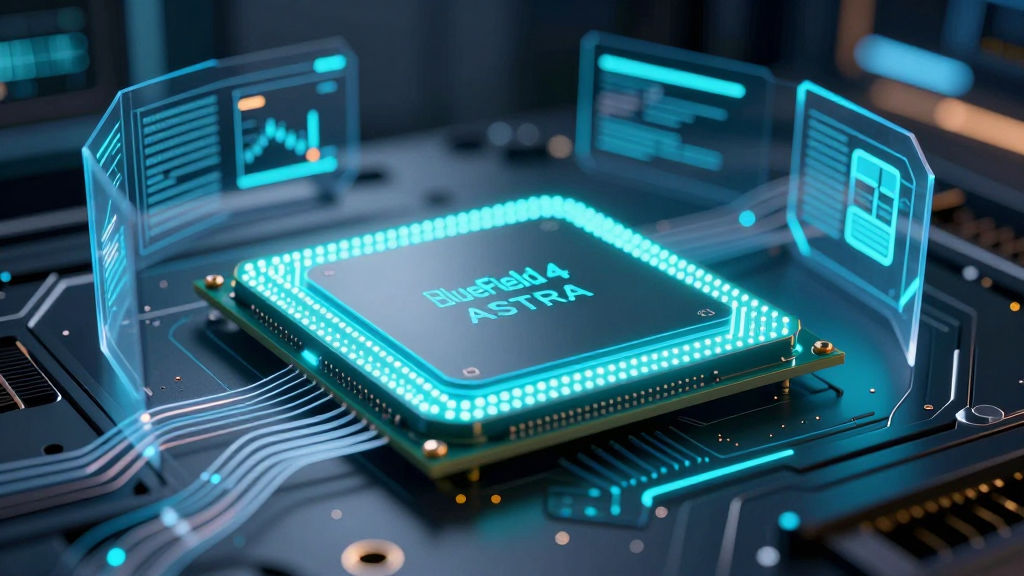
The Rubin platform is built around six core chips. These include the Rubin GPU, the Vera CPU, and the ConnectX-9 SuperNIC. However, the most critical piece for enterprise security is the BlueField-4 Data Processing Unit (DPU). This unit powers the ASTRA architecture. ASTRA stands for Advanced Secure Trusted Resource Architecture. It acts as a trusted control point for the entire system.
By offloading security tasks from the main processor, ASTRA ensures that performance remains high. For example, it handles encryption and isolation at the hardware level. This means your AI models run at full speed while remaining completely isolated from other users in the same data center.
Understanding BlueField-4 ASTRA
BlueField-4 ASTRA represents a significant leap over previous DPU generations. It is designed specifically to handle the complexities of agentic AI and Mixture-of-Experts (MoE) models. These models require massive amounts of data to move between GPUs rapidly. Without a secure control point, this data movement could become a vulnerability.
ASTRA solves this by creating hardware-enforced boundaries. It manages the provisioning of isolated environments without adding latency. Furthermore, it integrates directly with Rubin confidential computing protocols. This ensures that data is encrypted not just at rest or in transit, but also during computation.
The architecture also supports the next generation of Private AI Agents that require long-context memory. In the past, sharing memory across different users was a major security risk. Now, ASTRA allows for secure, multi-tenant scaling. It manages the Inference Context Memory Storage, ensuring that one tenant’s “memory” never leaks into another’s workspace.
The Role of Vera Rubin Samples
The industry is already seeing the first signs of this hardware in the wild. NVIDIA recently began shipping the first Vera Rubin samples to key partners. These early units allow cloud providers to test the integration of ASTRA in real-world scenarios. Partners like CoreWeave and Microsoft Azure are currently optimizing their stacks for these chips.
The VR200 compute trays come pre-assembled and modular. This design reduces assembly time by nearly 18 times compared to older generations. Because the trays are cable-free, they also improve reliability. When a component fails, the system can hot-swap parts without taking the entire rack offline. This is a massive win for NVIDIA Powering Industrial AI Automation where uptime is critical.
Solving the Multi-Tenant Problem
For years, the biggest hurdle for enterprise AI adoption has been multi-tenancy. Companies want the cost benefits of shared cloud resources. However, they cannot risk their proprietary training data or model weights. Traditional software-based isolation is often too slow or prone to exploits.
BlueField-4 ASTRA moves the isolation layer into the hardware itself. It creates “vaults” for each workload. These vaults are invisible to other users and even to the cloud provider’s administrative software. This level of security is essential for industries like finance, healthcare, and defense.
Moreover, ASTRA handles the complex networking tasks required for MoE models. When a model needs to pull data from multiple GPUs, ASTRA manages the traffic. It uses the ConnectX-9 SuperNIC to ensure that data flows through the most secure and efficient paths. This prevents “noisy neighbor” syndrome, where one user’s heavy workload slows down everyone else.
Enhancing NVLink 6 Bandwidth Security
Data movement is the lifeblood of AI. The Rubin platform utilizes NVLink 6, which offers staggering levels of bandwidth. Specifically, it provides up to 3.6 TB/s per GPU. However, moving data at these speeds creates a massive attack surface.
ASTRA monitors this traffic in real-time. It uses the second-generation RAS (Reliability, Availability, and Serviceability) Engine to detect anomalies. If the system detects a potential breach or a hardware failure, it can reroute traffic instantly. Consequently, the system maintains both security and performance simultaneously.
This integration is part of what NVIDIA calls the NVIDIA Rubin Technologies. By tying the networking directly to the security layer, NVIDIA has eliminated many of the bottlenecks found in traditional data center designs.
Technical Deep Dive: HBM4 and Memory Isolation
The memory architecture of the Rubin GPU is another area where ASTRA shines. Each GPU features 288 GB of HBM4 memory. This high-bandwidth memory is essential for running the world’s largest AI models. However, managing this much memory in a multi-tenant environment is a logistical nightmare.
BlueField-4 ASTRA manages the memory controller’s security policies. It ensures that memory addresses are strictly partitioned between tenants. This prevents a “side-channel” attack where one user might try to read the memory of another.
The transition to HBM4 also allows for much higher efficiency. Combined with the 88-core Vera CPU, the system can handle complex reasoning tasks with 10x lower inference costs. ASTRA ensures that these cost savings do not come at the expense of security. It manages the AI-native Inference Context Memory Storage, which allows for efficient reuse of data across long-running agentic workflows.
Spectrum-X Ethernet Photonics Integration
Beyond the rack, security must extend to the entire data center fabric. The Rubin platform utilizes Spectrum-X Ethernet Photonics to connect different racks. This technology uses light instead of electricity to move data over longer distances.
ASTRA works in tandem with the Spectrum-6 Ethernet Switch to maintain security across these optical links. It encrypts the data before it enters the fiber-optic network. As a result, even if an attacker were to intercept the light signal, the data would remain unreadable. This end-to-end encryption is a cornerstone of the Rubin security model.
Operational Efficiency and Uptime
Security is often seen as a trade-off for efficiency. However, BlueField-4 ASTRA actually improves operational uptime. By offloading security and networking tasks, it reduces the load on the Vera CPU. This allows the CPU to focus entirely on managing the AI workloads.
The second-gen RAS Engine also plays a vital role here. It provides proactive maintenance alerts before a component fails. For instance, it can detect if a specific NVLink connection is degrading. ASTRA can then shift the workload to a healthy part of the cluster. This “self-healing” capability is what allows for the creation of stable, million-GPU factories.
Furthermore, the modular nature of the Rubin platform makes it easier to manage. Since the compute trays are cable-free, technicians can replace them in minutes. This reduces the human error often associated with complex wiring in traditional data centers.
The Impact on ROI for Enterprises
Investing in AI infrastructure is a major capital expenditure. CTOs need to know that their investment will remain relevant for years. The Rubin platform is designed with this longevity in mind. By providing a secure, multi-tenant environment, it allows companies to monetize their hardware more effectively.
Companies can host multiple departments or even external clients on the same cluster. Because ASTRA guarantees isolation, there is no risk of cross-contamination. This maximizes the utilization rates of the hardware. Higher utilization leads directly to a faster return on investment.
Additionally, the efficiency of the Rubin architecture reduces energy costs. The platform delivers 4x fewer GPUs for MoE training compared to the previous Blackwell generation. When you factor in the 5x power efficiency gains, the total cost of ownership drops significantly. Security, in this case, acts as an enabler for scale rather than a barrier.
Future-Proofing with Confidential Computing
The world of AI regulations is evolving rapidly. Soon, hardware-level security may not just be a preference; it may be a legal requirement. Rubin confidential computing positions enterprises to stay ahead of these regulations.
By implementing ASTRA today, organizations are future-proofing their AI strategy. They are building on a platform that respects data sovereignty and privacy by design. Whether you are building a small reasoning model for internal use or a massive public-facing agent, security must be the starting point.
The arrival of the first Vera Rubin samples marks the beginning of this new chapter. As these systems move into full production in H2 2026, we will see a surge in secure, private AI applications. The “black box” of the cloud is finally becoming a transparent, trusted environment.
Conclusion
The NVIDIA Rubin platform is a masterclass in extreme codesign. While the raw specs of the Rubin GPU and Vera CPU are impressive, the real hero for the enterprise is BlueField-4 ASTRA. This architecture finally solves the multi-tenant security problem that has plagued AI infrastructure for years.
By integrating hardware-level isolation, confidential computing, and advanced networking, ASTRA allows companies to scale with confidence. It ensures that the million-GPU factories of the future are not just fast, but also secure. As we look toward the 2026 rollout, the focus will remain on how these technologies enable the next generation of Private AI Agents to operate safely in a shared world.
The move toward more secure, efficient, and modular infrastructure is inevitable. BlueField-4 ASTRA is the bridge that gets us there.
Subscribe for weekly AI insights and stay ahead of the changing infrastructure landscape.
FAQ
- What is BlueField-4 ASTRA?
- BlueField-4 ASTRA is a security architecture within the NVIDIA Rubin platform. It stands for Advanced Secure Trusted Resource Architecture. It provides hardware-based isolation and encryption for multi-tenant AI environments.
- How does Rubin improve multi-tenancy?
- It uses the BlueField-4 DPU to create secure, isolated “vaults” for different users on the same hardware. This prevents data leakage and ensures that one user’s workload does not affect another’s performance.
- Why is HBM4 important for secure AI?
- HBM4 provides the high bandwidth necessary for massive AI models. In the Rubin platform, ASTRA manages this memory to ensure that data is strictly partitioned and encrypted between different tenants.
- When will Rubin infrastructure be available?
- NVIDIA has already begun shipping Vera Rubin samples to partners. Full integration into AI clouds like Microsoft Azure and CoreWeave is expected in the second half of 2026.
Sources
- NVIDIA Rubin Platform AI Supercomputer
- NVIDIA Rubin Technologies
- Vera Rubin AI GPU Samples Ship to Customers
- NVIDIA’s Vera Rubin Platform Could Ignite Next AI Supercycle
- NVIDIA 2026 CES Special Presentation
- 2026 NVIDIA 6 Chips for the Next
- Vera Rubin Extreme Co-design An Evolution
- NVIDIA Rubin Platform Launch Video