
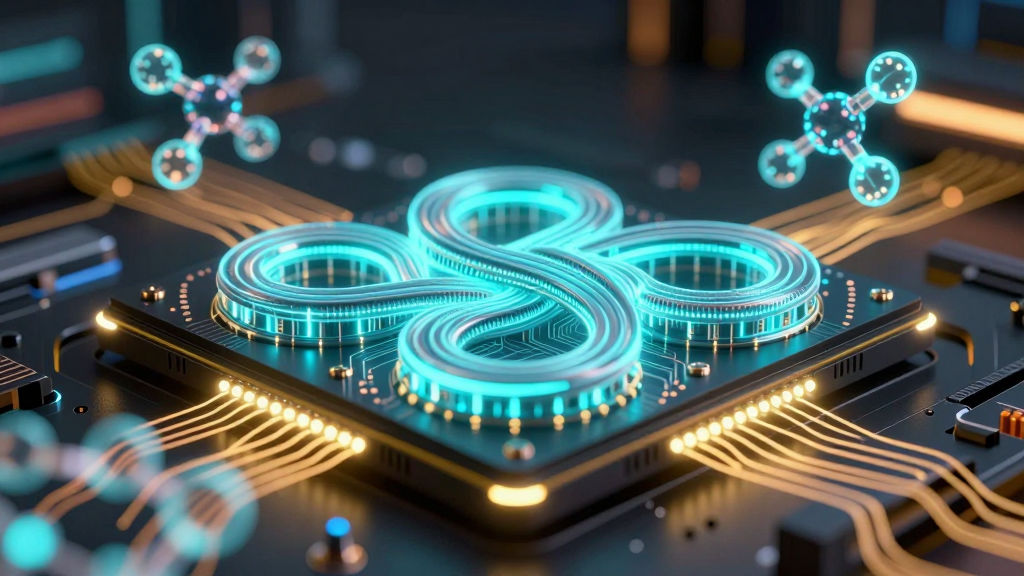
Majorana 1 Quantum Chip: The New Era of Hybrid AI
Estimated reading time: 7 minutes
- Introduction of topological qubits for enhanced hardware stability and error correction.
- The rise of hybrid AI-quantum architectures to solve high-dimensional data problems.
- Revolutionizing molecular discovery, materials science, and protein folding at scale.
- The critical importance of private quantum infrastructure for enterprise security in 2026.
- The Quantum Solution to Classical AI Limits
- Understanding Topological Protection in Majorana 1
- Hybrid AI-Quantum Architectures
- The Role of Qiskit Code Assistant
- Molecular Discovery and Materials Science
- Accelerating Generative Protein Design
- Why Private Quantum Infrastructure Matters
- Comparing Majorana 1 to Existing Quantum Chips
- The Future of Multi-Sensory AI
- Conclusion: Preparing for the Quantum Era
- Frequently Asked Questions
- Sources
The computational demands of modern artificial intelligence have finally hit a physical wall. While traditional silicon chips continue to shrink, the energy and heat constraints of classical architectures limit the next generation of massive model training. Consequently, the industry has turned its eyes toward a revolutionary solution: the Majorana 1 quantum chip. This technology represents a fundamental shift in how we process complex data structures and molecular simulations.
By integrating quantum mechanics directly into the AI development stack, researchers are unlocking capabilities that were previously impossible. The Majorana 1 quantum chip is not just another processor; it is the cornerstone of a new hybrid computing paradigm. In this article, we will explore how this hardware redefines the boundaries of private infrastructure and generative discovery.
The Quantum Solution to Classical AI Limits
Classical computers process information in bits, representing either a zero or a one. While this logic powers our current digital world, it struggles with the sheer complexity of high-dimensional AI problems. For example, simulating a single complex molecule can take years on even the fastest supercomputers. However, the Majorana 1 quantum chip utilizes qubits, which can exist in multiple states simultaneously.
This “superposition” allows the chip to evaluate millions of possibilities at once. Furthermore, the Majorana 1 specifically utilizes topological qubits. These qubits are far more stable than the traditional superconducting versions used by competitors. As a result, they offer a path to error-corrected quantum computing that can actually scale.
Microsoft highlights these advancements in their latest report on What’s next in AI: 7 Trends to Watch in 2026. This shift toward stability is critical for enterprises that require reliable, long-term computational power. Without stable hardware, quantum remains a laboratory curiosity rather than a business tool.
Understanding Topological Protection in Majorana 1
Most quantum systems are incredibly fragile. A tiny change in temperature or a stray magnetic field can cause “decoherence,” destroying the calculation. In contrast, the Majorana 1 quantum chip uses topological protection to safeguard information. This method stores data in the physical arrangement of the system rather than in the state of a single particle.
Think of it like a knot in a rope. You can pull the rope or twist it, but the knot remains until you intentionally untie it. Consequently, this architecture allows for much longer coherence times. This stability is essential for the deep reasoning tasks required by advanced AI models.
Synthetic Labs focuses on building private AI infrastructure that prioritizes this level of reliability. When you move away from experimental setups toward production-grade systems, stability becomes your most valuable asset. The Majorana 1 provides the hardware foundation for this high-uptime future.
Hybrid AI-Quantum Architectures
We are not replacing classical computers entirely just yet. Instead, the most effective implementations involve a hybrid model. In this setup, a classical CPU or GPU handles standard data processing, while the Majorana 1 quantum chip manages the most complex optimization tasks. This division of labor maximizes efficiency while reducing overall energy consumption.
For instance, a generative AI model might use a classical GPU for its user interface and basic text generation. However, it will offload the complex pattern recognition and molecular folding simulations to the quantum processor. This synergy creates a massive performance multiplier for specialized industries.
The transition to hybrid systems also addresses the growing AI energy infrastructure challenges facing modern data centers. Quantum processors can solve specific problems using a fraction of the power required by traditional server farms. Therefore, sustainability and performance finally align in a single roadmap.
The Role of Qiskit Code Assistant
To bridge the gap between quantum hardware and human developers, software tools are evolving rapidly. IBM and Microsoft are both investing heavily in “AI for Quantum” tools. Specifically, the Qiskit Code Assistant helps engineers write quantum-ready code using natural language prompts.
This tool simplifies the process of translating classical algorithms into quantum circuits. As a result, developers do not need a PhD in physics to leverage the power of the Majorana 1 quantum chip. Instead, they can focus on high-level logic and business applications. This democratization of quantum power is a key trend for the 2026 landscape.
Molecular Discovery and Materials Science
One of the most immediate applications for the Majorana 1 quantum chip is in the field of chemistry. Simulating atomic bonding under high pressure is a task that overwhelms classical architectures. However, quantum systems thrive in these environments because they share the same underlying physics as the molecules they simulate.
Scientists are already using these chips to predict new high-density alloys for aerospace. Furthermore, these simulations are happening at speeds that are 10,000 times faster than previous methods. This acceleration allows for “digital labs” where thousands of materials are tested before a single physical sample is ever created.
This approach mirrors earlier shifts in AI hardware trends where specialized silicon began to outperform general-purpose chips. Just as GPUs revolutionized deep learning, the Majorana 1 is set to revolutionize material science and drug discovery.
Accelerating Generative Protein Design
In the pharmaceutical sector, the Majorana 1 quantum chip is a game-changer for protein folding. Generative AI models can suggest millions of potential protein structures to fight specific diseases. However, verifying the stability of these structures requires immense computational power.
Quantum chips provide the “ground truth” for these models. They can simulate the intricate interactions of amino acids with near-perfect accuracy. Consequently, the time required to bring a new life-saving drug to market could drop from decades to months. This impact on global health cannot be overstated.
Why Private Quantum Infrastructure Matters
As AI becomes the core IP of every major corporation, where that AI runs is a vital security concern. Moving quantum workloads to a public cloud introduces risks related to data sovereignty and industrial espionage. This is why many leaders are looking toward private quantum-classical hybrids.
The Majorana 1 quantum chip is designed to integrate into high-security data centers. By keeping the quantum compute local, companies can ensure their proprietary molecular designs or financial models never leave their control. This level of privacy is a requirement for sectors like defense, finance, and advanced manufacturing.
At Synthetic Labs, we advocate for these localized, high-performance systems. A private infrastructure allows you to experiment with cutting-edge hardware like the Majorana 1 without exposing your roadmap to competitors. In the 2026 market, data privacy is synonymous with competitive advantage.
Comparing Majorana 1 to Existing Quantum Chips
While Google and IBM have made significant strides, the Majorana 1 quantum chip represents a different philosophy. Most other systems use “transmon” qubits. While powerful, these qubits are very susceptible to noise and require massive amounts of error-correction overhead.
The Majorana 1’s topological qubits require much less error correction because they are inherently more robust. This means a chip with 1,000 topological qubits might outperform a 10,000-qubit transmon system. Efficiency is the new metric for success in the quantum supremacy race.
Moreover, the Majorana 1 is built with a focus on “logical qubits.” These are groups of physical qubits that work together to eliminate errors entirely. Reaching the milestone of reliable logical qubits is the final hurdle before quantum computers become truly universal.
The Future of Multi-Sensory AI
As we integrate quantum power into our systems, the AI itself is becoming more “human” in its perception. Multimodal AI models are now moving toward multisensory inputs, including audio, vision, and even tactile signals from robotics. The Majorana 1 quantum chip provides the backend power needed to fuse these disparate data streams in real-time.
For example, a robot in a complex warehouse needs to process its surroundings instantly. It must recognize objects, hear verbal commands, and feel the pressure of its grip. Classical chips often struggle with the latency of this multisensory fusion. Quantum-enhanced AI can process these parallel inputs simultaneously, leading to much smoother and safer automation.
This evolution is particularly visible in sports and healthcare, where AI must interpret human movement with extreme precision. We are moving from AI that merely “thinks” to AI that truly “perceives” the physical world.
Conclusion: Preparing for the Quantum Era
The Majorana 1 quantum chip marks the transition of quantum technology from a theoretical dream to a practical enterprise tool. By solving the stability issues that plagued earlier systems, Microsoft and its partners have opened the door to a new era of discovery. Whether you are in drug development, materials science, or high-frequency finance, the impact will be felt across every sector.
Synthetic Labs continues to monitor these developments to ensure our clients remain at the forefront of the AI revolution. The integration of the Majorana 1 quantum chip into private infrastructure is no longer a “future” plan—it is a current necessity for those who wish to lead. As we move further into 2026, the gap between those with quantum capabilities and those without will only widen.
Subscribe for weekly AI insights to stay ahead of the hardware curve and master the next generation of automation.
FAQ
- What makes the Majorana 1 quantum chip different from other chips?
- The Majorana 1 uses topological qubits, which are physically more stable than standard qubits. This reduces the need for massive error correction and allows the chip to be more compact and efficient.
- Can I run standard AI models on a quantum chip?
- Currently, most models run on a hybrid system. The classical GPU handles the general processing, while the Majorana 1 quantum chip manages the most complex mathematical optimizations and simulations.
- When will the Majorana 1 be available for enterprise use?
- Early access programs are already rolling out in 2026 for specialized industries like pharmaceuticals and aerospace. Wider availability in private data centers is expected to follow as the manufacturing scales.
- Is quantum computing safe for my data?
- Yes, especially when deployed in private infrastructure. Quantum systems can actually enhance security through quantum-resistant encryption, though the initial focus is on computational power.