
AI Economics: NVIDIA Rubin and Inference Token Costs
Estimated reading time: 6 minutes
- The NVIDIA Rubin platform aims for a 10x reduction in resource requirements for complex AI reasoning tasks.
- Enterprise focus is shifting from model training costs to the long-term economic burden of inference token costs.
- New hardware innovations like the Vera CPU and NVLink 6 are designed to eliminate data bottlenecks in agentic workflows.
- The NVFP4 precision format enables 50 petaflops of performance while maintaining high accuracy and lower energy consumption.
- The Shift From Model Training to Inference Economics
- How the NVIDIA Rubin Platform Redefines Efficiency
- Vera CPU Data Movement and the End of Bottlenecks
- NVLink 6 Interconnect Bandwidth and Rack-Scale Scaling
- The NVFP4 Precision Format: Balancing Speed and Accuracy
- Confidential Computing GPU: Securing the Economics of IP
- The Business Case for Rubin in 2026
- Conclusion
- Frequently Asked Questions
The era of AI experimentation has officially transitioned into the era of AI execution. For years, enterprises focused on the sheer capability of Large Language Models (LLMs), often ignoring the staggering price tag attached to every query. However, as we move into 2026, the conversation has shifted from “what can AI do” to “how much does it cost to run.” The most critical metric in this new landscape is inference token costs, representing the lifeblood of sustainable AI business models.
NVIDIA recently unveiled its Rubin platform, promising a radical shift in how we calculate the return on investment for generative media and agentic automation. This new architecture does not just offer more raw power; it redefines the unit economics of intelligence. Specifically, the Rubin platform targets a 10x reduction in the resources required to process complex reasoning tasks. Consequently, companies that previously struggled with high operational overhead can now look toward high-margin AI products.
The Shift From Model Training to Inference Economics
During the initial AI gold rush, the industry fixled on the cost of training. Organizations spent hundreds of millions of dollars to build foundational models. However, the true long-term financial burden lies in inference—the act of using the model to generate responses for users. As AI agents become more integrated into daily workflows, the sheer volume of tokens processed is exploding. Therefore, reducing inference token costs has become a survival imperative for startups and established giants alike.
High inference costs act as a “success tax” on growing companies. In the past, the more users you had, the more money you lost on compute overhead. This reality stifled innovation and forced many developers to limit the complexity of their agents. Fortunately, the cost-efficient AI deployment strategies we have seen in previous years are now being supercharged by hardware-level breakthroughs. NVIDIA’s Rubin platform directly addresses this by optimizing the way data flows through the silicon, ensuring that every watt of power translates into more tokens.
Moreover, the transition to reasoning-heavy models—like those requiring Chain-of-Thought processing—demands significantly more compute per user request. These models do not just predict the next word; they “think” through multiple steps before delivering an answer. While this improves accuracy, it also traditionally skyrockets the cost per interaction. The Rubin architecture mitigates this by using specialized hardware acceleration for these specific reasoning patterns. As a result, the “thinking” time of an AI no longer equates to a bankrupting expense.
How the NVIDIA Rubin Platform Redefines Efficiency
The NVIDIA Rubin platform represents a holistic redesign of the data center. It is not just a faster GPU; it is a synchronized ecosystem of compute, memory, and networking. At the heart of this system is the Vera Rubin Superchip, which combines the Rubin GPU with the all-new Vera CPU. This tight integration allows for unprecedented efficiency in managing the massive datasets required for modern AI workloads.
By leveraging the HBM4 memory standard, Rubin provides the massive bandwidth necessary to keep the GPU cores fed with data. This is crucial because memory bottlenecks are often the primary cause of wasted compute cycles. When a GPU sits idle waiting for data, your inference token costs rise without providing any value. Rubin’s memory subsystem ensures that data moves at lightning speed, maximizing the utilization of every transistor. Consequently, the cost per token drops because the hardware works harder in less time.
Furthermore, the introduction of the third-generation Transformer Engine allows the platform to adapt its precision dynamically. In the past, developers often had to choose between high-precision compute (which is expensive) and low-precision compute (which can be inaccurate). The Rubin platform bridges this gap, offering the best of both worlds. It ensures that the model uses only the necessary amount of energy for each specific calculation. This “just-in-time” approach to compute precision is a major factor in the 10x efficiency gains promised by NVIDIA.
Vera CPU Data Movement and the End of Bottlenecks
A significant portion of AI latency and cost stems from the handoff between the CPU and the GPU. In traditional systems, the CPU often acts as a slow gatekeeper, managing data before the GPU can process it. The Vera CPU data movement capabilities change this dynamic entirely. NVIDIA designed the Vera CPU specifically to handle the high-throughput requirements of agentic AI and multi-modal data streams.
Specifically, the Vera CPU excels at “pre-processing” and “post-processing” tasks that would otherwise slow down the main inference engine. By offloading these tasks to a specialized processor, the GPU can focus entirely on high-density math. In addition, the Vera CPU manages the complex data orchestration required for RAG (Retrieval-Augmented Generation) systems. This is vital for enterprises building private AI infrastructure where security and speed must coexist.
Additionally, the Vera CPU features optimized instruction sets for data movement and agentic processing. This means it can handle the “logic” of an AI agent—deciding which tool to call or how to route a request—while the GPU handles the heavy lifting of the neural network. This division of labor reduces the “wait time” between steps in an autonomous workflow. Consequently, users experience faster response times while the provider pays less for the compute time utilized.
NVLink 6 Interconnect Bandwidth and Rack-Scale Scaling
In the world of million-GPU environments, the speed of the individual chip is only half the story. The real secret to lowering inference token costs at scale is how those chips talk to one another. The NVLink 6 interconnect bandwidth provides a staggering 3.6 terabytes per second (TB/s) per GPU. This is a massive leap forward that allows multiple GPUs to function as a single, giant processor.
When you scale a model across a cluster, the “communication overhead” often eats up a large percentage of your performance. If GPUs spend 30% of their time talking to each other and only 70% of their time calculating, you are effectively wasting 30% of your budget. NVLink 6 reduces this overhead to negligible levels. Therefore, large-scale reasoning models can run across hundreds of chips with nearly linear scaling efficiency.
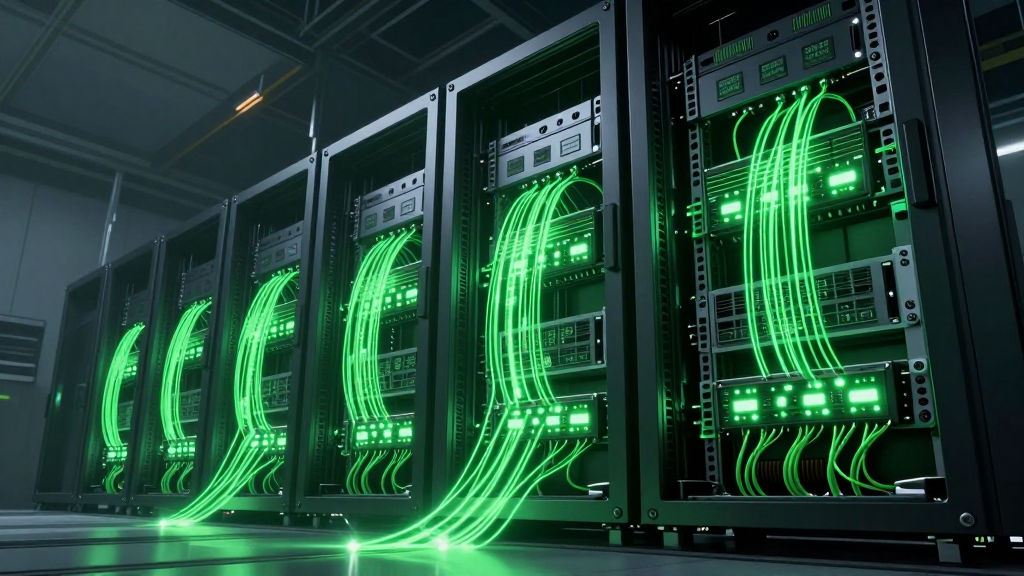
Furthermore, the rack-scale integration of the Rubin NVL72 system uses a cable-free design. This modular approach allows for 18x faster assembly and servicing compared to previous generations. For a data center operator, this means less downtime and lower maintenance costs. When the infrastructure is easier to manage, those savings eventually trickle down to the end-user in the form of cheaper tokens. The ability to swap trays and upgrade components without complex rewiring is a game-changer for industrial-scale AI.
The NVFP4 Precision Format: Balancing Speed and Accuracy
One of the most technical but impactful innovations in the Rubin platform is the NVFP4 precision format. This new data format allows for hardware-accelerated adaptive compression. Essentially, it enables the system to perform calculations using 4-bit floating-point numbers without the significant accuracy loss that usually plagues low-precision math. This allows the system to reach a mind-blowing 50 petaflops of compute performance.
By using NVFP4, the Rubin platform can fit more of a model’s parameters into the fast, on-chip memory. This reduces the need to constantly fetch data from slower external storage. As a result, the energy required for a single inference step is drastically reduced. In an era where energy costs are a primary driver of AI pricing, this hardware-level compression is essential. It allows developers to deploy small reasoning AI models with even greater efficiency.
Moreover, the third-generation Transformer Engine manages the NVFP4 format automatically. Developers do not need to rewrite their code from scratch to take advantage of these savings. The hardware intelligently decides when to use lower precision for speed and when to switch to higher precision for accuracy. This “smart scaling” ensures that the quality of the AI’s output remains high while the cost of generating that output remains low.
Confidential Computing GPU: Securing the Economics of IP
Efficiency means nothing if your most valuable intellectual property is at risk. For many enterprises, the barrier to AI adoption is not just cost, but security. The Rubin platform introduces the third generation of the Confidential Computing GPU ecosystem. This technology ensures that data remains encrypted even while it is being processed by the GPU. In the past, data had to be decrypted to be “read” by the processor, creating a window of vulnerability.
With Vera Rubin, the encryption domain extends across the CPU, GPU, and NVLink interconnects. This creates a “Trusted Execution Environment” (TEE) that protects proprietary models and sensitive customer data. Consequently, industries like finance, healthcare, and defense can finally leverage the Rubin platform’s 10x efficiency without compromising on compliance. This level of security is a massive competitive moat for companies operating in highly regulated markets.
Additionally, the BlueField-4 DPU (Data Processing Unit) supports this security model through the ASTRA architecture. ASTRA provides a single control point for provisioning and isolation in multi-tenant environments. This means a cloud provider can host multiple companies on the same Rubin rack while guaranteeing that their data and models are completely isolated. This multi-tenancy is another driver for lowering costs, as it allows for better resource utilization across the board.
The Business Case for Rubin in 2026
When we look at the total cost of ownership (TCO) for AI, we must consider power, cooling, space, and hardware. The Rubin platform addresses all four. Because it is 10x more efficient at inference, a company can theoretically do the same amount of work with 1/10th of the hardware. This reduces the physical footprint in the data center and slashes the power bill. For a company like Microsoft, which is building “Fairwater” superfactories, these gains represent billions of dollars in saved operational expenditure.
Furthermore, the speed of deployment is a hidden economic factor. The modular, cable-free design mentioned earlier allows companies to stand up new AI capacity in a fraction of the time. In a market that moves as fast as AI, being the first to market with a new reasoning agent can be the difference between dominance and obsolescence. The Rubin platform is built for this speed, both in terms of nanosecond-level compute and week-level facility deployment.
Finally, we must consider the “democratization” aspect. As CoreWeave and other specialized cloud providers begin offering Rubin instances in the second half of 2026, mid-market companies will gain access to this efficiency. You no longer need to be a hyperscaler to enjoy low inference token costs. This level playing field will likely trigger a new wave of innovation, as smaller teams can afford to run the high-complexity models that were previously reserved for the tech elite.
Conclusion
The NVIDIA Rubin platform is a decisive response to the “profitability problem” in AI. By focusing on inference token costs, NVIDIA has moved beyond raw performance to address the actual business needs of the enterprise. Through innovations like the Vera CPU data movement, NVLink 6, and the NVFP4 precision format, Rubin creates a world where sophisticated AI is not just possible, but affordable.
As we look toward the end of 2026, the companies that succeed will be those that master the economics of their infrastructure. Whether you are building private agents or global generative platforms, the efficiency of your compute layer will define your margins. The era of wasteful AI is over. The era of efficient, profitable, and secure intelligence has begun.
Subscribe for weekly AI insights and stay ahead of the curve in the rapidly evolving world of synthetic intelligence and private infrastructure.
Frequently Asked Questions
- What is the main benefit of the NVIDIA Rubin platform for businesses?
- The primary benefit is a 10x increase in inference efficiency. This significantly lowers the cost of running AI models, allowing for higher profit margins and more complex AI agents.
- How does the Vera CPU improve AI performance?
- The Vera CPU is optimized for data movement and agentic processing. It handles the logic and data orchestration, freeing up the Rubin GPU to focus entirely on high-speed mathematical calculations.
- What is the significance of the NVFP4 precision format?
- NVFP4 allows for 4-bit floating-point calculations with hardware-accelerated compression. This allows the system to achieve 50 petaflops of compute while using less memory and energy, keeping costs low.
- When will the Rubin platform be available for general use?
- NVIDIA has indicated that Rubin-based systems will begin appearing in data centers in the second half of 2026, with providers like CoreWeave among the first to offer access.
Sources
- NVIDIA Rubin Platform and Production Hardware Advances
- NVIDIA Rubin platform
- NVIDIA CES 2026 Special Presentation
- NVIDIA Rubin Platform Details
- NVIDIA Rubin Brings 5x Inference Gains for Video
- NVIDIA Rubin Architecture Overview
- Meta Builds AI Infrastructure with NVIDIA
- NVIDIA Star Attraction at CES 2026
- CES 2026 AI Highlights: NVIDIA Rubin
- NVIDIA Rubin Deal: Meta Assessing Infrastructure