
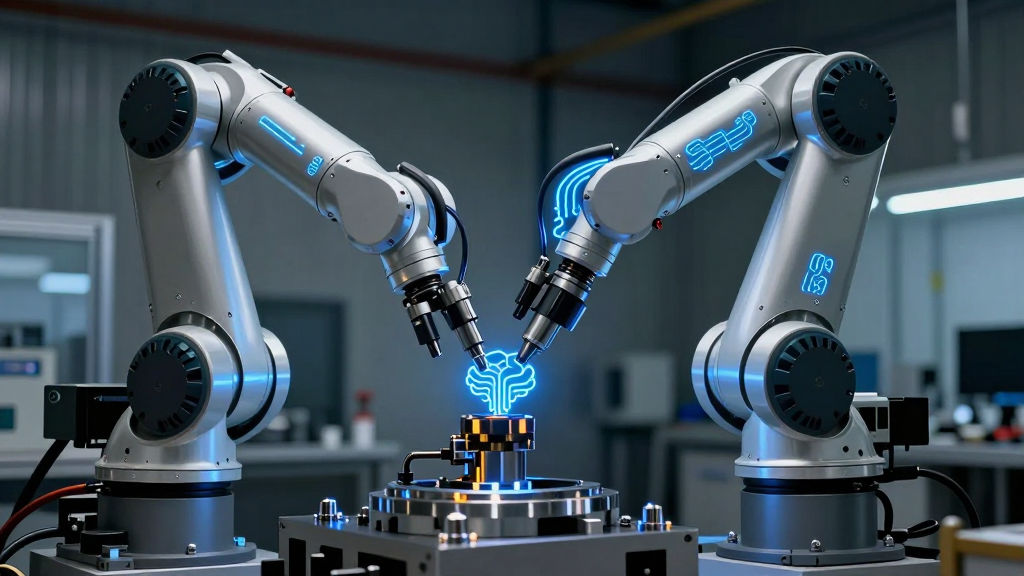
Industrial AI Automation: The Rise of Adaptive Robotics
Estimated reading time: 7 minutes
- Transition from rigid, pre-programmed instructions to adaptive, self-optimizing systems.
- The role of Google, FANUC, and Siemens in reshaping factory floor logic.
- Importance of private AI infrastructure for security, latency, and data sovereignty.
- Shift toward “complementary automation” where AI augments rather than replaces human expertise.
- The Google and FANUC Alliance: Self-Optimizing Robots
- Moving Toward High-Mix, Low-Volume Production
- From Ladder Logic to Language Models: The Siemens Eigen Agent
- How Closed-Loop Agents Transform Engineering
- Breaking the Automation Ceiling with AI-Driven Orchestration
- Transitioning from Static to Adaptive Workflows
- Why Private AI Infrastructure is Vital for Industry
- The Role of Digital Twins in Private Infrastructure
- The Economics of Complementary Automation
- Redefining the Industrial Workforce
- Practical Steps for Implementing Industrial AI
- Summary: The Future is Adaptive
- FAQ
- Sources
The manufacturing world is currently witnessing a massive shift in how machines operate. For decades, factory robots followed rigid, pre-programmed instructions with zero room for error or variation. However, the emergence of advanced industrial AI automation is changing the fundamental nature of the factory floor. We are moving from a world of “set and forget” machinery to a future defined by adaptive, self-optimizing systems.
Recent partnerships between tech giants and industrial leaders signal that this transition is accelerating. This evolution is not just about faster hardware or cheaper sensors. Instead, it represents a complete overhaul of the logic that governs industrial processes. By integrating foundation models and generative agents, companies are finally breaking through the technical barriers that have limited automation for years.
The Google and FANUC Alliance: Self-Optimizing Robots
A major milestone in this journey occurred recently when FANUC and Google announced a strategic partnership. This deal aims to bring Google’s sophisticated AI models directly into FANUC’s industrial robots. Traditionally, a robot would stop if a part was slightly out of alignment. Consequently, human intervention was required to reset the line or adjust the programming.
Through this collaboration, robots will utilize vision models and reinforcement learning to adapt in real-time. For example, if a component is positioned incorrectly, the robot can recognize the variance. It will then adjust its grip or path without needing a human to rewrite its code. This marks a shift toward “self-optimizing” systems that learn from data rather than just following coordinates.
According to reports on how FANUC and Google advance industrial robotics, the focus is on making robots smarter and more adaptive. This move follows a broader industry trend where hyperscalers like Google and NVIDIA compete to become the AI layer for global manufacturing. These cloud-connected systems allow data from thousands of robots to feed into centralized models, creating a continuous feedback loop of improvement.
Moving Toward High-Mix, Low-Volume Production
The true value of adaptive robots lies in their flexibility. Most traditional automation thrives in high-volume, low-mix environments where the same task is repeated millions of times. However, modern consumer demand often requires high-mix, low-volume production. This requires production lines that can change configurations rapidly.
In the past, reconfiguring a line took weeks of engineering effort. Adaptive AI reduces this timeframe significantly. Because the AI understands the “intent” of the task, it can apply its learned skills to new parts or products. As a result, manufacturers can stay competitive in volatile markets without incurring massive downtime for reprogramming.
From Ladder Logic to Language Models: The Siemens Eigen Agent
While Google and FANUC focus on physical movement, Siemens is revolutionizing the software that controls the factory. Siemens recently unveiled the Eigen Engineering Agent. This is a domain-specific AI designed to write industrial automation code and configure control systems. For decades, engineers have relied on “ladder logic” to program PLCs (Programmable Logic Controllers).
The Eigen agent represents a massive leap forward by translating high-level requirements into functional code. It does not just act as a simple autocomplete tool. Instead, it functions as a full-cycle agent that can validate its own outputs. This transition is a core part of the ongoing Siemens AI automation evolution that is reshaping how OT (operational technology) is managed.
How Closed-Loop Agents Transform Engineering
The Siemens Eigen agent operates within a closed-loop system. Specifically, the AI generates code, runs it through a digital twin or simulation, and interprets the results. If the code fails to meet the specified parameters, the agent refines its logic and tries again. This iterative process happens in seconds, a task that would take a human engineer hours or days.
Furthermore, this tool addresses the growing talent gap in industrial engineering. Many seasoned PLC programmers are retiring, and fewer young engineers are entering the field. By using AI to handle the foundational coding, organizations can empower their existing staff to focus on higher-level system design. This ensures that technical knowledge remains accessible and actionable within the enterprise.
Breaking the Automation Ceiling with AI-Driven Orchestration
Many enterprises have discovered that adding more bots and scripts does not always lead to higher productivity. This phenomenon is known as the “automation ceiling.” Traditional RPA (Robotic Process Automation) is often brittle and fails when it encounters unexpected data. To overcome this, companies are turning toward agentic AI workflow orchestration to manage complex end-to-end processes.
Industrial AI automation is now moving beyond single-task optimization. Instead, it is focusing on orchestration across the entire supply chain. This means AI isn’t just running a robot; it is predicting maintenance needs, adjusting schedules, and rerouting materials. According to experts at Nintex, this level of orchestration is required to connect disparate systems and data silos.
Transitioning from Static to Adaptive Workflows
Static workflows are programmed with “if-then” logic. While effective for simple tasks, they cannot handle the complexity of a modern factory. In contrast, adaptive flows use machine learning to route work based on real-time context. For instance, if a sensor detects a vibration in a motor, the AI orchestrator can automatically lower the line speed.
Simultaneously, it can order a replacement part and reschedule the production run. This level of autonomy ensures that the factory continues to operate efficiently even when disruptions occur. By layering AI over existing MES (Manufacturing Execution Systems), companies can modernize their operations without a full “rip and replace” of legacy hardware.
Why Private AI Infrastructure is Vital for Industry
As factories become more data-driven, the question of where that data lives becomes critical. Many industrial leaders are hesitant to send sensitive telemetry and intellectual property to the public cloud. This is why we are seeing a surge in demand for on-premise and edge-based AI solutions. Building a robust AI automation manufacturing gap strategy requires thinking about the physical location of the compute.
Private infrastructure offers several advantages for industrial settings:
- Latency: Critical safety systems require millisecond response times that the cloud cannot provide.
- Security: Keeping data inside a private network reduces the attack surface for industrial espionage.
- Data Sovereignty: Many countries have strict rules about where industrial data can be stored and processed.
- Reliability: A factory must continue to run even if its internet connection goes down.
Synthetic Labs focuses on helping companies deploy these private stacks. By running AI models on local inference servers, manufacturers can enjoy the benefits of advanced industrial AI automation while maintaining total control over their environment. This “sovereign AI” approach is becoming the standard for regulated industries and high-stakes manufacturing.
The Role of Digital Twins in Private Infrastructure
A digital twin is a virtual representation of a physical asset or system. In a private AI environment, these twins serve as the training ground for new models. Before a single piece of equipment moves on the factory floor, the AI tests its decisions in the virtual world. This minimizes risk and ensures that the transition from digital logic to physical action is seamless.
The Economics of Complementary Automation
A common fear is that industrial AI automation will lead to massive job losses. However, many economists argue that the future lies in “complementary automation.” MIT professor Simon Johnson highlights that the design of the technology matters more than the technology itself. If we design AI to replace humans, we lose human expertise. If we design AI to augment humans, we increase total productivity.
In the industrial sector, this often looks like an AI assistant that provides “superpowers” to an operator. For example, an AI might highlight a subtle defect that a human eye would miss. Or, it might suggest a more efficient way to load a pallet. In these scenarios, the AI handles the repetitive data processing, while the human focuses on exception handling and creative problem-solving.
Redefining the Industrial Workforce
As AI takes over the manual and repetitive aspects of industrial work, the required skill set for workers will shift. We will see a greater need for “AI supervisors”—individuals who understand the process and can guide the AI’s learning. This shift creates new opportunities for higher-wage, more engaging work.
Successful companies will be those that invest in training their workforce to collaborate with autonomous systems. Rather than viewing AI as a replacement for labor, forward-thinking leaders view it as a tool to unlock the full potential of their human capital. This balanced approach reduces organizational friction and speeds up the adoption of new technologies.
Practical Steps for Implementing Industrial AI
Starting a journey into industrial AI automation can feel overwhelming. However, the most successful implementations follow a phased approach. You do not need to automate the entire factory on day one. Instead, focus on high-impact, low-complexity use cases that provide immediate ROI.
- Identify Bottlenecks: Look for areas where your current automation hits a “ceiling” or requires constant human intervention.
- Audit Your Data: Ensure your machines are generating clean, usable telemetry. AI is only as good as the data it consumes.
- Choose Your Infrastructure: Decide whether you need the scale of the cloud or the security of a private, on-premise stack.
- Pilot a Single Agent: Deploy a tool like an engineering agent or a vision-based inspection system to prove the concept.
- Scale and Orchestrate: Once individual components are working, use an AI orchestrator to connect them into a unified system.
By following this roadmap, organizations can build a foundation for long-term success. The goal is to create a “living” factory that adapts to its environment, learns from its mistakes, and grows more efficient every day.
Summary: The Future is Adaptive
The era of rigid, programmable logic is ending. In its place, industrial AI automation is ushering in a new age of adaptive robotics and intelligent agents. From the Google-FANUC partnership to the Siemens Eigen agent, the tools available to manufacturers are more powerful than ever. These systems promise to solve the talent gap, increase flexibility, and push productivity to new heights.
However, the success of these initiatives depends on more than just the software. It requires a thoughtful approach to infrastructure, data security, and workforce integration. By prioritizing private AI environments and complementary automation strategies, companies can lead the next industrial revolution.
Subscribe for weekly AI insights from Synthetic Labs to stay ahead of these trends.
FAQ
- What is industrial AI automation?
- Industrial AI automation refers to the integration of machine learning, foundation models, and generative AI into manufacturing and operational processes. Unlike traditional automation, which follows fixed scripts, industrial AI can adapt to changing conditions and learn from data.
- How does the Google-FANUC partnership change robotics?
- The partnership brings Google’s advanced AI models to FANUC’s industrial robots. This allows the robots to use computer vision and reinforcement learning to handle variations in parts and tasks without manual reprogramming.
- What is an engineering agent like Siemens Eigen?
- An engineering agent is a specialized AI that writes and validates industrial control code. It can translate high-level design goals into PLC logic, significantly speeding up the commissioning of new factory lines.
- Why is private infrastructure important for industrial AI?
- Private infrastructure ensures that sensitive factory data stays on-premise. It also provides the low latency and high reliability required for critical safety systems that cannot rely on a public cloud connection.
- Does AI automation mean human workers will lose their jobs?
- While AI will automate repetitive tasks, many experts believe it will complement human work. By handling data-heavy and dangerous tasks, AI allows human workers to focus on higher-value supervision and problem-solving.
Sources
- FANUC and Google advance industrial robotics deals
- Why Industrial AI is Rising Now – Siemens
- Breaking the Automation Ceiling with AI – Nintex
- AI that Writes Automation Code – AMT Report
- Autonomous Systems Everywhere – Burrus
- AI and the Future of Work – Bloomberg Video
- AI and the Future of Work – YouTube