Building the Future with Local Cloud Hybrid LLM Desktops
Estimated reading time: 7 minutes
- Hybrid LLM architectures combine local privacy with cloud-based reasoning power.
- Data sovereignty is driving the shift toward private AI infrastructure and sovereign computing.
- Orchestration layers like Hermes Desktop allow users to create task-specific AI profiles.
- Local models reduce latency and operational costs while cloud models handle complex “System 2” thinking.
- The Rise of Sovereign AI Computing
- Why SaaS Alone No Longer Suffices
- Understanding the Local Cloud Hybrid LLM Model
- Balancing Latency and Intelligence
- Case Study: The Hermes Agent Ecosystem
- Creating Task-Specific Profiles
- Technical Implementation of Hybrid AI Desktops
- Local Models vs. Cloud API Routing
- Private Infrastructure and Data Sovereignty
- The Role of Air-Gapped Environments
- Human Language as the New Programming Language
- Automation and Repeatable Workflows
- The Future of the AI-Native Desktop
- Integrating Generative Media
- Conclusion
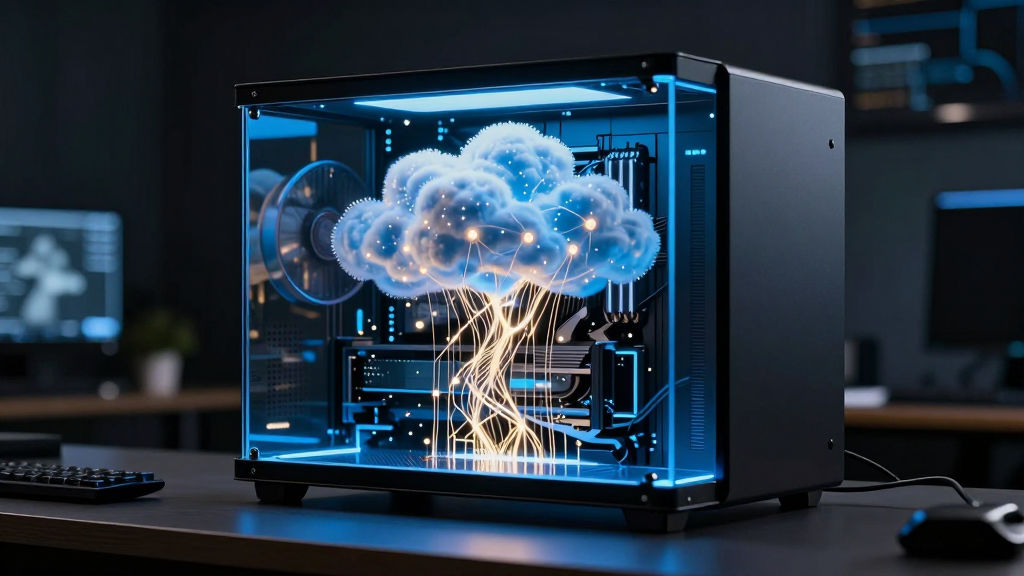
The landscape of artificial intelligence is shifting rapidly. For years, users relied solely on massive cloud providers for their computing needs. However, a new paradigm is emerging. Today, power users and developers are embracing a local cloud hybrid LLM approach to reclaim control over their digital lives. At Synthetic Labs, we believe this hybrid model represents the next frontier of personal and enterprise productivity. By combining the privacy of local hardware with the raw power of frontier models, individuals are building what can only be described as personal AI operating systems.
The Rise of Sovereign AI Computing
We are witnessing a significant move away from purely SaaS-based AI models. Many users now realize that sending every sensitive thought to a central server carries risks. Consequently, the demand for data sovereignty has never been higher. People want the speed and privacy of local execution. Yet, they still require the reasoning capabilities that only massive cloud clusters can provide.
This tension created the perfect environment for the local cloud hybrid LLM architecture. Specifically, this setup allows a user to run smaller, efficient models on their own machine. These local models handle routine tasks, sensitive data processing, and basic drafting. When a task requires immense reasoning power or a massive knowledge base, the system automatically routes the request to a cloud provider.
Why SaaS Alone No Longer Suffices
Standard AI subscriptions often feel like a “black box.” You have little control over how the model processes your data. Furthermore, latency can become a major bottleneck for real-time workflows. If your internet connection drops, your productivity halts.
In contrast, a hybrid desktop ensures you are never truly offline. You can continue working on code or documents using local models like Llama or Mistral. Similarly, you avoid the recurring costs of high-token usage for simple tasks. By building private AI infrastructure at the desktop level, you create a resilient environment that scales with your specific needs.
Understanding the Local Cloud Hybrid LLM Model
The hybrid model works as an orchestration layer. It sits between your user interface and various “intelligence engines.” Think of it as a smart router for your thoughts. The system evaluates each prompt you enter. Then, it decides which model is best suited for the job based on complexity, cost, and privacy requirements.
For example, if you ask for a summary of a local text file, the system uses a local model. This keeps your data on your device. However, if you need to analyze a complex legal document and compare it to global case law, the system pings a frontier model like Claude or GPT-4. This seamless transition is the hallmark of a high-quality hybrid environment.
Balancing Latency and Intelligence
Latency is a silent killer of creative flow. Local models provide near-instantaneous responses. This is perfect for autocomplete, brainstorming, and basic formatting. Indeed, the “intelligence per second” on a local machine with a modern GPU is staggering.
On the other hand, cloud models offer deep reasoning. They excel at “System 2” thinking, which involves slow, deliberate logic. A local cloud hybrid LLM setup gives you the best of both worlds. You get the snappy feel of a local app with the “big brain” capabilities of the cloud when you hit a wall. As a result, your workflow remains fluid and uninterrupted.
Case Study: The Hermes Agent Ecosystem
The open-source community is leading the way in this space. One of the most exciting developments is the Hermes agent ecosystem. Frequently discussed in specialized forums, this project provides a blueprint for what a personal AI OS looks like. It is not just a chat interface; it is a comprehensive framework for local and cloud orchestration.
Users of Hermes Desktop can create sophisticated profiles for different tasks. For instance, you might have a “Coding Profile” that defaults to a local fine-tuned model for syntax. Simultaneously, you might have a “Research Profile” that utilizes cloud APIs to scan the web and synthesize information. This level of customization is far beyond what standard commercial AI tools offer.
Creating Task-Specific Profiles
The ability to switch profiles is a game-changer for productivity. In a standard setup, you use the same model for everything. This is inefficient. Why use a trillion-parameter model to fix a typo? Conversely, why use a small model to architect a microservices system?
With a Hermes Desktop setup guide, users learn to map specific workflows to the most efficient model. This involves:
- Assigning “System Prompts” to different personas.
- Setting temperature and top-p values per task.
- Routing data through local vector databases for “Long-Term Memory.”
- Automating multi-step sequences where a local model “pre-processes” data for a cloud model.
Technical Implementation of Hybrid AI Desktops
Setting up a local cloud hybrid LLM requires some technical groundwork, but it is becoming increasingly accessible. The core component is an inference engine that can run on your local hardware. Tools like Ollama or LM Studio have simplified this process immensely. You can now perform a local setup with Ollama in minutes.
Once your local models are running, you need a “Control Plane.” This is the software that communicates with both your local inference engine and external APIs. This Control Plane manages your context window, handles RAG (Retrieval-Augmented Generation), and ensures that API keys are stored securely.
Local Models vs. Cloud API Routing
The decision-making logic of the Control Plane is crucial. Advanced users often write custom scripts to handle this routing. For example, a script might check the character count of a prompt. If it is under 1,000 characters, it stays local. If it exceeds that, it goes to the cloud.
Additionally, many hybrid setups use local models for “Context Pruning.” A small local model reads a large dataset and extracts only the relevant snippets. Then, only those snippets are sent to the cloud. This saves money and protects privacy. Consequently, you get high-quality results without uploading your entire database to a third party.
Private Infrastructure and Data Sovereignty
For enterprises, the local cloud hybrid LLM approach is a matter of compliance. Many industries cannot legally upload customer data to public clouds. Therefore, they must rely on private infrastructure. A hybrid desktop allows employees to use AI tools while keeping sensitive data within the corporate firewall.
Synthetic Labs focuses on helping organizations bridge this gap. We believe that “Agentic AI” will only thrive if it respects the boundaries of data sovereignty. By deploying local models on secure workstations, companies can automate internal processes without risking data leaks. This is especially important as models become more capable of taking actions on behalf of the user.
The Role of Air-Gapped Environments
In high-security sectors, air-gapped environments are the standard. In the past, this meant no AI assistance at all. However, the rise of powerful, small-footprint models has changed the game. You can now run a highly capable LLM on a machine with no internet connection.
Furthermore, a hybrid setup can work in “Semi-Gapped” modes. In this scenario, the machine only connects to the cloud for specific, audited transactions. Every external call is logged and inspected. This provides a level of security that a standard browser-based AI can never match. Indeed, this is the future of secure government and financial computing.
Human Language as the New Programming Language
NVIDIA CEO Jensen Huang recently made a bold claim. He argued that human language is becoming the primary programming language of the future. This shift is clearly visible in the way we interact with hybrid AI desktops. We are no longer just “using” software; we are “instructing” it.
In a local cloud hybrid LLM environment, you can use natural language to create automations. You don’t need to write complex Python scripts to move files or summarize emails. Instead, you prompt your local agent to “Watch my downloads folder and summarize any new PDFs.” The agent handles the logic, uses the local model for the summary, and notifies you when it is done.
Automation and Repeatable Workflows
The real power of a hybrid desktop lies in repeatable workflows. Once you find a prompt sequence that works, you can save it as a “Skill.” This turns your AI from a chatbot into a functional tool. Specifically, you are building a library of capabilities that are unique to your workflow.
For example, a content creator might build a skill that:
- Transcribes a local video file (Local Model).
- Identifies key themes and timestamps (Local Model).
- Generates high-quality social media hooks based on those themes (Cloud Model).
- Formats the output for different platforms (Local Model).
By distributing the work this way, the creator saves on API costs while maintaining high quality. This is the essence of “PromptOps”—the operationalization of AI prompts into durable business value.
The Future of the AI-Native Desktop
As we look toward the next few years, the line between the operating system and the AI will blur. We expect to see “AI-Native” hardware designed specifically for the local cloud hybrid LLM workflow. These machines will feature massive amounts of unified memory to support large local models alongside traditional applications.
Moreover, the software will become more proactive. Instead of waiting for a prompt, your hybrid agent will observe your actions and offer suggestions. It might notice you are struggling with a spreadsheet and offer to write a complex formula. Because it is a hybrid system, it will know whether it can solve the problem locally or if it needs to consult a specialized “Expert Model” in the cloud.
Integrating Generative Media
The hybrid model is also transforming generative media. Tasks like image generation or video editing are computationally expensive. Running them entirely in the cloud is costly. However, running them entirely locally can be slow.
A hybrid approach allows for “Low-Res” local previews. You can iterate on a concept using a local Stable Diffusion instance. Once you are happy with the composition, you send the final “Seed” and prompt to a high-end cloud GPU for the final render. This workflow maximizes creativity while minimizing wait times and expenses.
Conclusion
The transition to a local cloud hybrid LLM architecture is a fundamental shift in how we interact with technology. It represents a move toward autonomy, privacy, and efficiency. By balancing local speed with cloud intelligence, we can create AI environments that are truly personal and secure.
At Synthetic Labs, we are committed to building the tools and infrastructure that make this hybrid future possible. Whether you are an individual developer or a large enterprise, the time to start building your private AI stack is now. The “Human Language” era is here, and the hybrid desktop is your primary interface for navigating it.
Subscribe for weekly AI insights to stay ahead of the curve.
FAQ
- What is a local cloud hybrid LLM?
- It is an AI setup that combines local models running on your own hardware with cloud-based APIs. The system routes tasks to the most appropriate model based on privacy, cost, and complexity.
- Do I need a powerful GPU for a local LLM?
- While a powerful GPU (like an NVIDIA RTX series) is ideal for speed, many smaller models can run on modern CPUs or integrated graphics. For a smooth hybrid experience, a dedicated GPU with at least 8GB of VRAM is recommended.
- Is my data safer in a hybrid setup?
- Yes. You can choose to process all sensitive data locally. Only non-sensitive or high-complexity tasks are sent to the cloud, significantly reducing your data footprint on external servers.
- Can I use a hybrid LLM without an internet connection?
- You can use the local portion of the system offline. However, the cloud-based “frontier” features will require an active internet connection to function.
Sources
- How to set up Hermes Desktop Local Cloud LLM
- Building Private AI Infrastructure
- GPT OSS Local Setup Ollama
- WSJ Tech – AI Developments
- AI and Automation News
- Instagram Post (Synthetic Labs)
- YouTube – AI Hybrid Local Setup
- YouTube – Local LLM Efficiency
- YouTube – Private AI Infrastructure
- Instagram Reel – Sovereign AI
- Instagram Reel – Hybrid Desktops
- Instagram Reel – LLM Workflows