
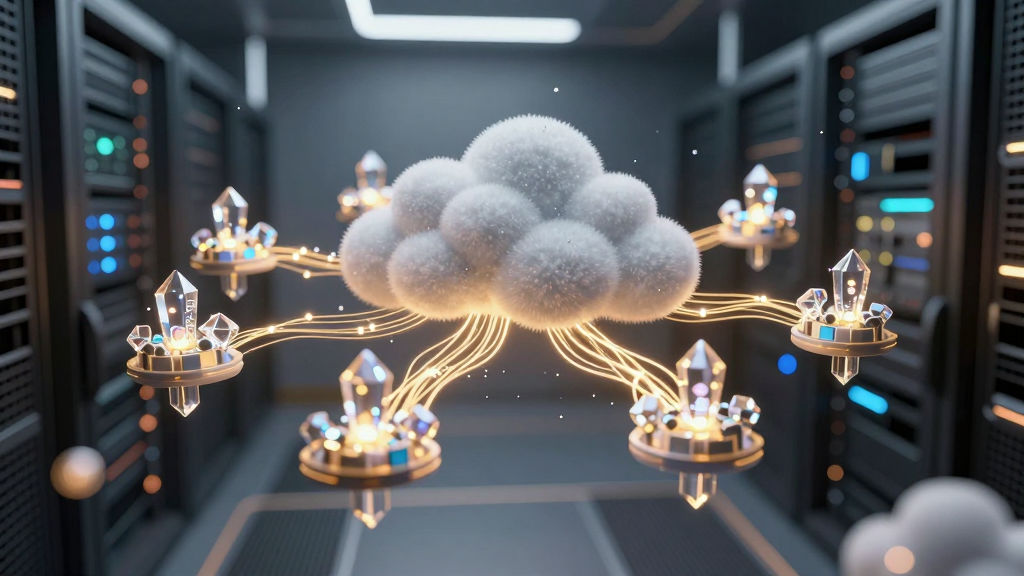
Why Agent-Native Cloud Architecture is the New Enterprise Standard
Estimated reading time: 7 minutes
- The shift from simple chatbots to autonomous agent-native cloud architectures that think, plan, and execute.
- The necessity of private AI infrastructure to maintain data security and provide low-latency environments for agentic workflows.
- A move toward “intelligence per dollar” as the primary economic metric for evaluating AI ROI.
- The critical role of runtime governance and real-time guardrails in managing autonomous enterprise systems.
- Defining the Agent-Native Cloud Architecture
- The Role of Private AI Infrastructure for Enterprises
- Moving Beyond Tokens: The New Economics of AI
- Real-Time Guardrails and Runtime AI Governance
- The Rise of Intelligence Operating Systems (AIOS)
- Industrial AI Agents: Manufacturing the Future
- Regulation and the Future of AI Watchdogs
- Conclusion
- Frequently Asked Questions
The era of simple chatbots is quickly ending. For the last two years, enterprises focused on integrating large language models into existing software. However, we are now entering a new phase where AI does not just talk; it acts. This shift requires a fundamental change in how we build and deploy technology. Specifically, organizations are moving toward agent-native cloud architecture to support autonomous systems that can think, plan, and execute tasks independently.
This new architectural framework moves beyond the traditional “model-first” approach. In the past, developers built applications around a single model. Today, the focus is on creating a robust ecosystem where multiple specialized agents collaborate. This evolution ensures that AI can handle complex, multi-step workflows without constant human intervention. Consequently, founders and CTOs must understand these changes to remain competitive in a rapidly evolving market.
Defining the Agent-Native Cloud Architecture
At the recent World Artificial Intelligence Conference, Alibaba Cloud introduced a groundbreaking concept. They unveiled their agent-native cloud architecture, signaling a massive shift for enterprise AI infrastructure. This design acknowledges that agents have different needs than standard web applications. For example, agents require secure environments to execute code and specialized layers to coordinate with other agents.
Traditional cloud infrastructure treats AI as just another workload. In contrast, an agent-native stack prioritizes the unique requirements of autonomous entities. It provides the necessary plumbing for “AgentTeams,” where different models work together on a single goal. One agent might handle data retrieval, while another focuses on logical reasoning or final execution. This modularity allows for greater flexibility and scalability within the enterprise.
Furthermore, this architecture introduces the concept of an “Agentic Computer.” This is a secure execution layer designed for sandboxing. When an agent needs to call an API or run a script, it does so in an isolated environment. This prevents the model from directly exposing the underlying infrastructure to potential threats. As a result, companies can deploy autonomous agents with much higher confidence in their overall security posture.
The Role of Private AI Infrastructure for Enterprises
As agents become more autonomous, they require deeper access to sensitive company data. This makes the move toward private AI infrastructure for enterprises an absolute necessity. Organizations cannot afford to send proprietary intellectual property to public APIs for every agentic action. Instead, they need a “private stack” that keeps data and execution within their own controlled perimeter.
A private infrastructure setup provides the low-latency environment that agents need to function effectively. When an agent must iterate through a task dozens of times, any network delay can break the workflow. By hosting models and agentic controllers locally or in a private cloud, companies ensure maximum performance. Additionally, private setups allow for better customization of the identity and skills layer.
Managing these private environments requires new tools. For instance, teams must treat agent “skills” like reusable microservices. Once an agent learns how to navigate a specific ERP system, that skill should be available to other agents in the organization. This creates a library of capabilities that grows over time. Eventually, this repository becomes a core asset for the business, much like its codebase or customer database.
Moving Beyond Tokens: The New Economics of AI
For a long time, the industry measured AI success by the cost per token. However, NVIDIA is now promoting a much more relevant metric: intelligence per dollar. This shift is crucial because agentic systems often require multiple loops and post-training cycles to achieve a result. Simply looking at the price of a single inference call does not tell the full story of the investment’s value.
In the agentic era, post-training becomes the central workload. This process involves continuous, task-driven refinement of the model to improve its performance on specific business goals. Therefore, the goal is no longer just “cheap text.” Instead, the goal is “reliable outcomes.” If an agent costs ten dollars to complete a task but does it with 99% accuracy, the ROI is much higher than a human worker or a cheaper, less capable model.
This new economic framework changes how CTOs plan their budgets. They must account for the ongoing cost of refining agents through reinforcement learning. Additionally, they need to optimize for GPU utilization during these post-training cycles. As companies scale their agentic fleets, the “intelligence per dollar” metric will dictate which platforms and models win the market. It shifts the conversation from operational expense to a strategic capital investment.
Real-Time Guardrails and Runtime AI Governance
Autonomy brings significant risks. When an agent has the power to move money or delete files, it needs “seatbelts.” This is where runtime AI governance becomes critical. Modern tools like Alterion’s Draco are now providing a control plane that observes every action an agent takes in real time. This ensures that no agent can stray outside of its predefined boundaries.
These guardrails act as a programmable safety layer between the agent and the world. For example, a policy might state that an agent can draft an invoice but cannot send it if the amount exceeds $5,000. These rules are enforced at the runtime level, meaning they don’t rely on the model’s “intent.” Even if the model makes a mistake, the control plane blocks the unauthorized action. This is a fundamental component of a mature agent-native cloud architecture.
Furthermore, these systems provide detailed logging and auditability. In regulated industries like finance or healthcare, this is a non-negotiable requirement. Regulators need to see why an agent made a specific decision. By capturing the prompt stream and the resulting tool calls, companies can provide a full forensic trail of every automated action. This level of transparency is essential for building trust with both internal stakeholders and external governing bodies.
The Rise of Intelligence Operating Systems (AIOS)
We are seeing a move away from standalone AI tools toward what some call an “Intelligence Operating System” (AIOS). Platforms like Alation and Frigade are leading this charge by linking data, context, and agents into a single environment. An AIOS does more than just run a model; it provides the “operating environment” where agents can access governed datasets with full lineage and freshness checks.
This is a massive leap forward for agentic AI enterprise automation. In a traditional setup, an agent might pull data from a stale spreadsheet. In an AIOS, the agent knows exactly where the data came from and when it was last updated. If the data quality is low, the agent can refuse to act. This “data-aware” intelligence ensures that automation is not just fast, but accurate.
Similarly, these operating systems allow for “no-code” agent deployment. Product teams can now add assistants to their applications that perform actions directly through internal APIs. These assistants learn from user behavior over time, improving their efficiency without manual coding. This democratizes the creation of agents, allowing business units to build their own automations within a safe, governed framework provided by the central IT team.
Industrial AI Agents: Manufacturing the Future
While office automation gets a lot of headlines, the real revolution is happening on the factory floor. Companies like Black Lake Technologies are demonstrating how industrial AI agents can manage complex manufacturing workflows. These agents do not just predict when a machine will break; they actively manage CAD-to-process translations and production scheduling.
In an industrial setting, the demands on an agent-native cloud architecture are even higher. These systems must operate at the “edge,” often in environments with limited connectivity. Therefore, they rely heavily on private, on-prem infrastructure. These agents handle order decomposition and quality inspection by fusing computer vision data with sensor inputs in real time.
The economic impact of this shift is staggering. New projections suggest that the market for agentic supply chain management software will grow from $2B to over $53B by 2030. This growth is driven by the massive efficiency gains found in autonomous logistics. For instance, companies like UPS and Amazon already use AI to process billions of micro-decisions every day. This creates a more resilient supply chain that can adapt to disruptions instantly.
Regulation and the Future of AI Watchdogs
As agents take over more of the world’s critical infrastructure, the call for regulation is growing louder. Demis Hassabis of Google DeepMind has recently advocated for a FINRA-style watchdog for AI. This would be an industry-funded, government-overseen body that could audit frontier models and enforce safety standards. Such a move would bring AI governance in line with the financial services industry.
For enterprises, this means that compliance will soon be a major part of the AI stack. You will likely need to prove that your agents follow specific ethical and safety guidelines. This is another reason why having a robust control plane and private infrastructure is so important. It allows you to implement “compliance by design” before the regulators even knock on your door.
This regulatory environment will likely favor organizations that have invested in auditable, transparent systems. If your agents are running in a “black box” public cloud with no oversight, you may face significant legal risks. However, if you are using an agent-native cloud architecture with built-in guardrails, you will be well-positioned to meet new standards. Transparency is no longer just a “nice to have”; it is a business imperative.
Conclusion
The transition to agent-native cloud architecture represents the next great frontier in enterprise computing. By moving beyond simple models and focusing on coordinated, autonomous agents, companies can unlock unprecedented levels of productivity. This journey requires a focus on private infrastructure, new economic metrics like intelligence per dollar, and robust runtime governance to manage the inherent risks of autonomy.
Ultimately, the goal is to create an “Intelligence Operating System” that empowers every part of the organization. Whether you are managing a global supply chain or automating internal workflows, the agentic stack is the key to scaling your impact. We are moving toward a world where AI is not just a tool we talk to, but a partner that works alongside us. To stay ahead, start building your private agentic foundation today.
Subscribe for weekly AI insights and stay updated on the latest in private infrastructure and automation.
FAQ
- What is the main difference between a chatbot and an AI agent?
- A chatbot primarily focuses on conversation and answering questions based on text. An AI agent is designed to take actions, use tools, and complete multi-step workflows autonomously to achieve a specific goal.
- Why is “intelligence per dollar” a better metric than “cost per token”?
- Cost per token only measures the price of generating text. Intelligence per dollar measures the value and accuracy of the final outcome, accounting for the complex loops and refinements an agent needs to perform a job correctly.
- How does sandboxing improve agent security?
- Sandboxing, or using an “Agentic Computer” layer, isolates the agent’s code execution from the rest of the network. This prevents a model from accidentally or maliciously accessing sensitive system files or damaging the infrastructure.
- Can small companies afford agent-native cloud architecture?
- Yes. While large enterprises may build massive private stacks, smaller companies can use modular platforms and “no-code” agent tools to implement these architectures at a smaller scale, focusing on specific high-ROI tasks.