
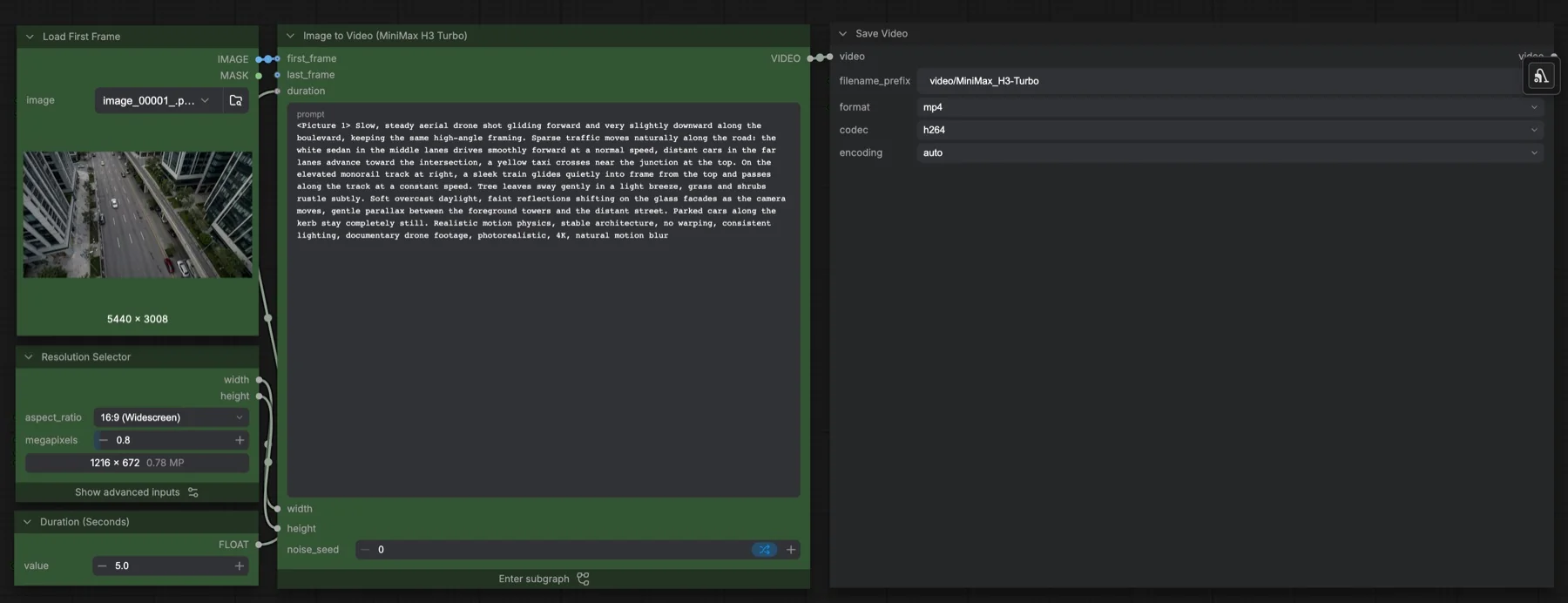
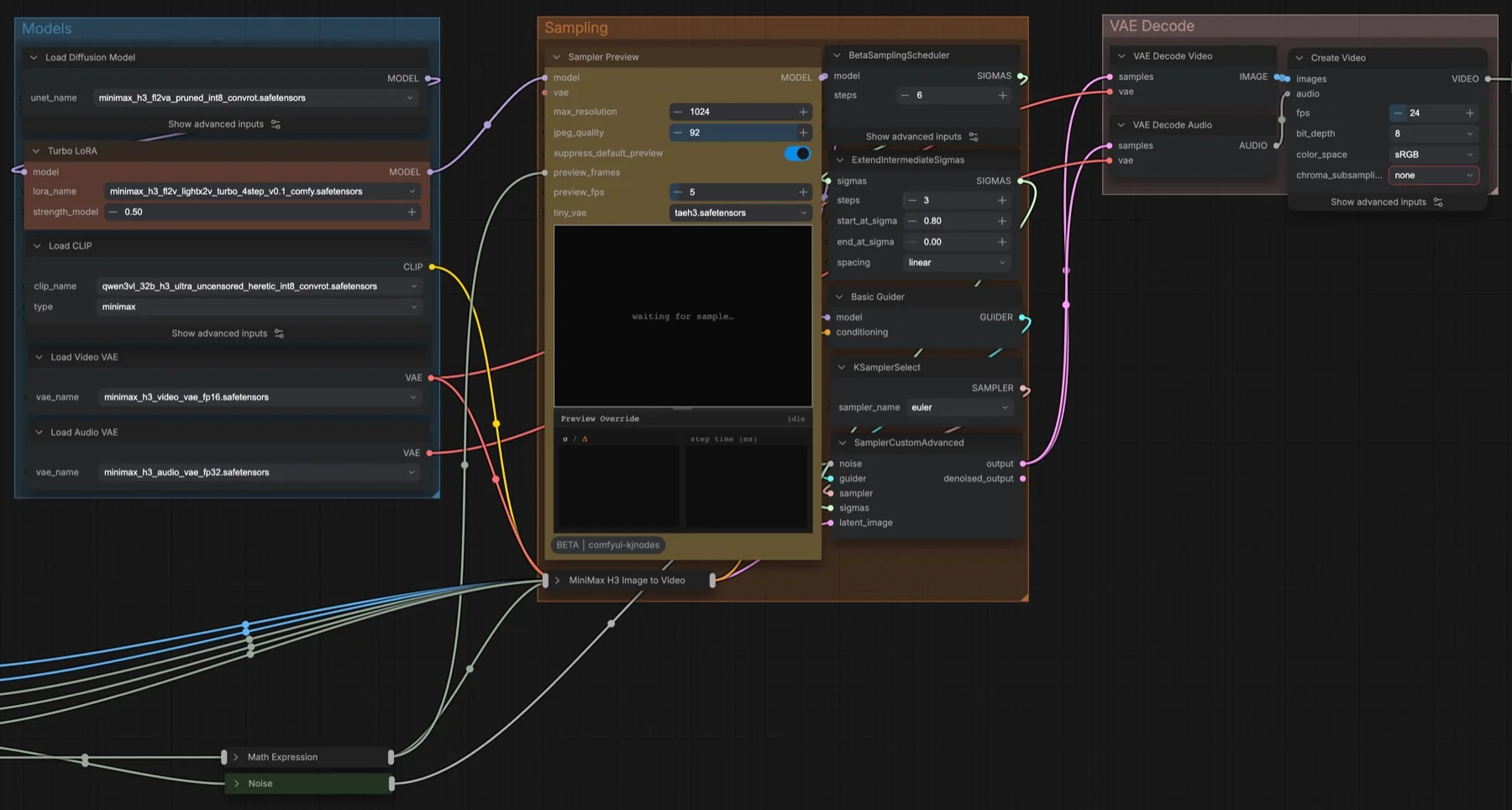
Short answer: this is our own MiniMax H3 image-to-video build. It adds a LightX2V 4-step Turbo LoRA at strength 0.5, a 6-step beta schedule with 3 extra low-noise steps, the Euler sampler and a live preview. It renders 5 seconds at 1216 × 672 and 24 fps by default. As shipped, the files total about 55.1 GB (about 44.5 GB with the standard text encoder). The MiniMax H3 weights use the MiniMax H3 Community License Agreement, which has conditions.
Output example
This workflow was run on a PC with an RTX 3090. We downloaded the saved output and inspected sampled video frames. It is one prompt and seed, not a general quality benchmark.
Audio stream checks confirm technical presence only. We have not verified sound quality, speech accuracy or lip sync by listening.
Input references

Original synthetic Pika H3 Flex scene generated in this batch. FFmpeg extraction of first decoded frame; no real identity, logo or external source recording.
Prompt used for this example
For the target video, at 0.00 seconds into the target video, <Picture 1> (from [Shot 1]) is fully referenced.

integrated_multimodal_description: [Shot 1] Photorealistic macro product cinematography of the cobalt-blue ceramic tea cup on a walnut table beside a rainy window. Rain trickles down the window as steam rises gently from the blue cup. The camera slowly pulls back with small amplitude, revealing a little more of the dark walnut tabletop while maintaining the warm side light. The cup remains planted on the tabletop, its handle and rim keep the same shape, and no liquid spills. Preserve the framing relationship and warm lighting of the source. End with the camera still moving very gently. One continuous shot, no cuts, no people or lettering.

overall_soundscape: Rain tapping gently on window glass, quiet indoor room tone and faint distant street noise. No speech.

non_diegetic_music: N/A
Observed limits: One fixture does not exercise optional inputs or establish general reliability. Audio stream presence does not establish speech accuracy, sound quality or lip sync.
Download and load the workflow
Drag the downloaded JSON file onto the ComfyUI canvas to load it.
Install the model files and any custom nodes listed below. If the workflow uses input images, video or audio, select your own files in the input nodes before running it.
Which files go where
| Part | File | Size | Folder |
|---|---|---|---|
| Diffusion model | minimax_h3_fl2va_pruned_int8_convrot.safetensors | 20.97 GB | models/diffusion_models |
| Text encoder (community build) | qwen3vl_32b_h3_ultra_uncensored_heretic_int8_convrot.safetensors | 26.36 GB | models/text_encoders |
| Text encoder (standard alternative) | qwen3vl_32b_minimax_h3_nvfp4_awq.safetensors | 15.69 GB | models/text_encoders |
| Turbo LoRA | minimax_h3_fl2v_lightx2v_turbo_4step_v0.1_comfy.safetensors | 1.96 GB | models/loras |
| Video VAE | minimax_h3_video_vae_fp16.safetensors | 5.21 GB | models/vae |
| Audio VAE | minimax_h3_audio_vae_fp32.safetensors | 0.61 GB | models/vae |
| Preview decoder (optional) | taeh3.safetensors | 0.02 GB | models/vae_approx |
You need one text encoder, not both. Our build loads a community-made INT8 build of the Qwen3-VL-32B encoder. The standard encoder used by the other MiniMax H3 workflows is a drop-in alternative: select it in Load CLIP and keep the type set to minimax. Totals: about 55.1 GB with the community encoder, about 44.5 GB with the standard one. None of these repositories is gated.
We found the Turbo LoRA link ourselves; it is Kijai's ComfyUI copy of LightX2V's v0.1 file. Newer official versions are in lightx2v/Minimax-h3-Turbo, for example minimax_h3_fl2v_turbo_4step_v1.3_768p_comfyui_bf16.safetensors. The taeh3 file only drives the live preview; it does not change the video.
Custom nodes: install comfyui-kjnodes from ComfyUI Manager (Custom Nodes Manager, search "KJNodes"), then restart.
Settings in this workflow
| Setting | Value |
|---|---|
| Turbo LoRA strength | 0.5 |
| Beta schedule | 6 steps, alpha 0.79, beta 0.5 |
| Extra steps | 3, from sigma 0.8 to 0, linear spacing |
| Sampler / guider | euler / Basic Guider (no CFG value) |
| Resolution | 16:9 at 0.8 megapixels (1216 × 672) |
| Duration | 5 seconds (124 frames), 24 fps |
| Live preview | Max 1024 px, JPEG quality 92, 120 frames at 5 fps, default preview hidden |
| Output | MP4, H.264, prefix video/MiniMax_H3-Turbo |
How to use it
- Choose your picture in Load First Frame.
- Set the aspect ratio and megapixels in Resolution Selector, and the length in Duration (Seconds).
- Write the prompt in the subgraph. Start with
<Picture 1>, then describe the camera, the motion and the sound. - Run it. Watch the Sampler Preview panel inside the subgraph to check the motion early.
What to change first
The LoRA name says 4 steps, but our build runs it at half strength on a 6-step beta schedule plus 3 extra low-noise steps. If you swap in a newer LoRA from LightX2V, keep everything else the same and change one value at a time: LoRA strength first, then the beta step count.
Licence
The Comfy-Org/MiniMax-H3 repository lists the MiniMax H3 Community License Agreement. It has conditions: read it before commercial use. The community text encoder repository lists Apache-2.0, and taeh3 lists MIT, but the MiniMax H3 terms still apply to the model. The Turbo LoRA repository lists no licence. See our licence tracker.
Troubleshooting
| Problem | Likely cause | Fix |
|---|---|---|
| Model Preview Override is missing | KJNodes is not installed | Install comfyui-kjnodes and restart, or delete the preview node. |
| Preview shows nothing useful | taeh3.safetensors is missing | Put it in models/vae_approx. The video is not affected. |
| Text encoder file not found | You downloaded the standard encoder | Select qwen3vl_32b_minimax_h3_nvfp4_awq.safetensors in Load CLIP. |
| Out-of-memory or disk space errors | The 26 GB community encoder | Use the 15.69 GB standard encoder, or lower the megapixels. |
Where to go next
- Start from the official template: MiniMax H3 image to video.
- Pin several images in time: MiniMax H3 multi-keyframe video.
- Compare with LTX-2.5 image to video.
FAQ
Is MiniMax H3 Turbo an official template?
No. It is our edit of the MiniMax H3: Image to Video template, with a Turbo LoRA and a shorter schedule.
Do I need the community text encoder?
No. The standard Comfy-Org encoder is a drop-in alternative and is about 10 GB smaller.
Does the live preview change the result?
No. It only shows frames while the sampler runs.
Sources
- Comfy-Org/MiniMax-H3: model, VAEs, standard encoder and licence
- Kijai/MiniMax-H3_comfy: the v0.1 Turbo LoRA in ComfyUI format
- lightx2v/Minimax-h3-Turbo: newer official Turbo LoRA versions
- Community INT8 text encoder repository: the encoder our build loads
- OzzyGT/taeh3: tiny preview decoder