
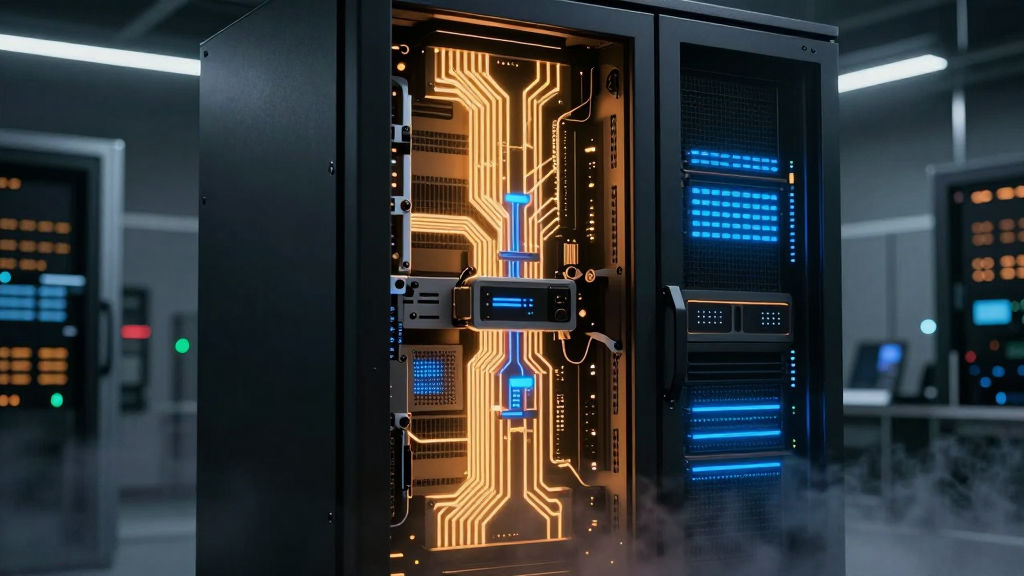
NVIDIA Rubin Platform: Reshaping the AI Token Economy
Estimated reading time: 7 minutes
Key Takeaways
- The Rubin platform achieves a 10x reduction in cost per token compared to previous generations.
- Transition to HBM4 memory delivers a massive 22 TB/s of bandwidth to solve the “memory wall.”
- New NVFP4 precision math enables a 5x increase in inference performance.
- Vertical integration of the Vera CPU and Rubin GPU optimizes hardware for “agentic reasoning.”
- Confidential computing is now available at rack-scale for secure, private AI deployments.
Table of Contents
- The Shift to an Agentic AI Architecture
- Solving the Memory Wall with HBM4 Memory Bandwidth
- NVFP4 Inference Performance and Low-Bit Math
- Redefining the AI Cost Per Token
- NVLink 6 Bandwidth: The Fabric of the Supercomputer
- Confidential Computing Rack-Scale: Security for Private AI
- The Vera CPU Olympus Cores and Vertical Integration
- Operations and Maintenance: The Liquid-Cooled Advantage
- Conclusion: Preparing for the Rubin Era
The launch of the NVIDIA Rubin platform at CES 2026 marks a pivotal shift in the artificial intelligence landscape. This architecture does not merely offer a standard incremental update to hardware speeds. Instead, it introduces a fundamental change in how enterprises calculate the return on investment for generative models. By focusing on massive throughput and efficient data movement, NVIDIA is targeting the “memory wall” that has long hindered the scaling of complex agentic systems.
The NVIDIA Rubin platform represents a unified vision for the next generation of data center infrastructure. It integrates six distinct chips into a single, cohesive fabric designed to handle the most demanding workloads. For founders and CTOs, the transition to this new architecture is about more than just raw power. It is about drastically reducing the cost per token while enabling real-time reasoning capabilities that were previously impossible at scale.
The Shift to an Agentic AI Architecture
Modern AI is moving away from simple prompt-and-response interactions toward complex, multi-step reasoning loops. These agentic AI systems require hardware that can handle continuous context updates without latency spikes. The Rubin architecture addresses this need by optimizing for “agentic reasoning” rather than just dense floating-point operations. Consequently, developers can now build autonomous systems that think, plan, and execute tasks in real time.
The Vera CPU plays a critical role in this shift toward agentic workflows. By utilizing custom Olympus cores, NVIDIA has built a processor specifically for data orchestration. Traditional CPUs often struggle to move data fast enough to keep high-end GPUs saturated. However, the Vera CPU ensures that the Rubin GPUs never wait for information. This synchronization is vital for private AI infrastructure where efficiency determines the feasibility of self-hosted models.
Furthermore, the integration of these components allows for sophisticated “state management.” Agents must remember previous steps and adjust their goals based on new information. The Rubin platform provides the memory bandwidth necessary to keep these states active. As a result, businesses can deploy more reliable autonomous agents across their entire operations.
Solving the Memory Wall with HBM4 Memory Bandwidth
One of the greatest bottlenecks in modern AI development is the “memory wall.” This term refers to the disparity between how fast a processor can compute and how fast it can access data. The Rubin platform tackles this issue head-on by utilizing high-capacity HBM4 memory bandwidth. Each Rubin GPU features 288 GB of HBM4, providing a staggering 22 TB/s of bandwidth.
This massive increase in memory speed changes the economics of Large Language Models (LLMs). For example, Mixture of Experts (MoE) models rely on switching between different “expert” layers quickly. When memory bandwidth is low, this switching creates significant lag. By using HBM4, the Rubin platform allows for near-instantaneous layer switching. Therefore, enterprises can run much larger models on fewer physical nodes.
Additionally, the increased bandwidth supports longer context windows. Businesses often need to process thousands of pages of documentation or massive codebases. Previously, this required complex memory management tricks. Now, the hardware itself supports the high-speed data retrieval necessary for long-context reasoning. This improvement makes cost-efficient AI deployment a reality for organizations with massive datasets.
NVFP4 Inference Performance and Low-Bit Math
Inference is the stage where AI models generate responses for users. The cost of this process is a major line item for any tech company. The NVIDIA Rubin platform introduces the third-generation Transformer Engine, which leverages NVFP4 inference performance. This new 4-bit floating-point precision allows for 50 PFLOPS of inference power per rack.
Using lower precision math like NVFP4 allows models to run much faster without losing significant accuracy. For instance, the transition from Blackwell’s FP8 to Rubin’s NVFP4 delivers a 5x increase in performance. This means that a single server can handle five times the amount of user traffic. Consequently, the capital expenditure required to support a growing user base drops significantly.
Furthermore, these low-bit formats reduce the amount of energy required per calculation. Sustainability is becoming a primary concern for data center operators. By optimizing the “math” of the model, NVIDIA helps companies scale their AI initiatives while keeping power consumption under control. This is a critical factor for companies focusing on NVIDIA’s role in industrial AI automation.
The Business Case for NVFP4
- Higher throughput per square foot of data center space.
- Lower power requirements per generated token.
- Reduced latency for real-time customer-facing applications.
- Improved ability to run heavy models on compact hardware.
Redefining the AI Cost Per Token
For most enterprises, the most important metric is the AI cost per token. A token is roughly equivalent to a word or a part of a word. If it costs too much to generate a token, many AI use cases become unprofitable. NVIDIA claims that the Rubin platform offers a 10x lower cost per token compared to the previous Blackwell generation.
This reduction is not the result of a single feature. Instead, it comes from the combination of HBM4, the Vera CPU, and the Rubin GPU. By making every part of the system more efficient, NVIDIA has created a platform that makes “expensive” models affordable. For example, a company might have avoided using a high-parameter model for customer service because of the price. With Rubin, that same model becomes economically viable.
Lowering the cost of tokens also encourages experimentation. Developers can run more tests and iterate on their prompts without worrying about the bill. As the price of intelligence drops, we will see a surge in innovative applications that were previously restricted by budget. This shift will fundamentally change how software is built and sold in the coming years.
NVLink 6 Bandwidth: The Fabric of the Supercomputer
Individual chips are powerful, but the true strength of the Rubin platform lies in how those chips communicate. The new NVLink 6 bandwidth provides a massive 1.8 TB/s of interconnect speed between GPUs. This allows a rack of 72 GPUs to act as a single, massive processor. In a world where models are too large to fit on one chip, this interconnect speed is everything.
Without high-speed connections, the system spends more time moving data between chips than actually calculating results. NVLink 6 eliminates these delays. This enables “rack-scale” computing where the entire server rack functions as one coherent unit. For a CTO, this simplifies the software stack significantly. You no longer have to worry as much about the complexities of distributed computing.
Furthermore, the platform includes the Spectrum-6 Ethernet switch and the BlueField-4 SuperNIC. These components ensure that data moves quickly even between different server racks. This “scale-out” capability is essential for training the world’s largest models. It allows researchers to connect thousands of GPUs together with minimal performance loss.
Benefits of NVLink 6 Scaling
- Reduced complexity in model partitioning.
- Faster training times for multi-trillion parameter models.
- Seamless integration across hundreds of server nodes.
- Improved reliability during heavy workloads.
Confidential Computing Rack-Scale: Security for Private AI
Security is a major hurdle for enterprises adopting generative AI. Many companies are hesitant to send their proprietary data to cloud providers. The Vera Rubin NVL72 addresses this by offering confidential computing rack-scale capabilities. This is the first platform to provide hardware-based encryption for data in transit and data in use across the entire rack.
Confidential computing ensures that even the data center administrator cannot see your data or your model weights. This level of protection is vital for highly regulated industries like finance and healthcare. For example, a bank can now train a model on sensitive transaction data without risking a data breach. This makes the NVIDIA Rubin platform the gold standard for secure, private AI deployments.
Moreover, this security extends to the CPU, GPU, and the NVLink connections between them. Because the encryption happens at the hardware level, it has a minimal impact on performance. Companies no longer have to choose between speed and security. They can have both, allowing them to innovate faster while maintaining strict compliance standards.
The Vera CPU Olympus Cores and Vertical Integration
The decision to build the Vera CPU with custom Olympus cores highlights NVIDIA’s strategy of vertical integration. Most data centers use general-purpose CPUs from other manufacturers. However, these chips were not designed specifically for the era of AI. NVIDIA’s Vera CPU is built to act as the ultimate “director” for the Rubin GPUs.
The Vera CPU features 88 cores and 176 threads. These cores are optimized for high-bandwidth data movement rather than just generic office tasks. By controlling the design of both the CPU and the GPU, NVIDIA can ensure they work together perfectly. This “coherent design” allows for shared memory pools where the CPU and GPU can access the same data simultaneously.
As a result, the overhead of moving data back and forth is virtually eliminated. This is particularly important for tasks like data preprocessing and vector database searches. When the CPU can prepare data as fast as the GPU can process it, the entire system reaches its maximum potential. This vertical integration makes it harder for competitors to match NVIDIA’s system-level performance.
Operations and Maintenance: The Liquid-Cooled Advantage
Infrastructure teams often care most about things that don’t show up in a benchmark. Reliability, cooling, and maintenance are the hidden costs of running a data center. The Rubin platform features a redesigned liquid-cooling manifold that makes the system much easier to service. NVIDIA claims that the modular design allows for 18x faster maintenance cycles.
In a traditional air-cooled setup, replacing a faulty component can be a time-consuming process. Liquid cooling is more efficient but often more complex to manage. However, the Rubin NVL72 uses a “quick-disconnect” system that allows technicians to swap parts in minutes. This directly impacts the total cost of ownership by reducing downtime.
Furthermore, the liquid cooling allows the chips to run at higher speeds for longer periods. Heat is the enemy of performance. By keeping the Rubin GPUs and Vera CPUs cool, the system can maintain its peak “boost” clock speeds without throttling. This consistent performance is essential for time-sensitive tasks like real-time fraud detection or live video translation.
Conclusion: Preparing for the Rubin Era
The NVIDIA Rubin platform is set to redefine the boundaries of what is possible in artificial intelligence. By focusing on the token economy, NVIDIA is making intelligence a commodity. The combination of HBM4 memory bandwidth and NVFP4 inference performance creates a machine that is purpose-built for the agentic future.
Enterprises should begin planning their transition to this architecture now. The massive reduction in AI cost per token will reward those who are ready to scale quickly. Whether you are building private AI infrastructure or deploying global-scale agents, the Rubin platform provides the foundation you need. The shift from compute-centric to data-movement-centric design is here, and it will change everything.
Subscribe for weekly AI insights.
FAQ
- What is the primary advantage of the NVIDIA Rubin platform over Blackwell?
- The Rubin platform offers a 10x lower cost per token and 5x greater inference performance. It also introduces HBM4 memory and the custom Vera CPU for better data orchestration.
- When will the NVIDIA Rubin platform be available?
- While the platform was unveiled in early 2026, general availability is expected in the second half of 2026. This allows time for validation and data center preparation.
- Why is HBM4 memory important for AI models?
- HBM4 provides the massive bandwidth needed to move data to the GPU quickly. This is essential for large models and complex “agentic” reasoning tasks that require fast memory access.
- What is NVFP4 precision?
- NVFP4 is a 4-bit floating-point format that allows for faster and more efficient AI inference. It enables a 50 PFLOPS performance level per rack, drastically increasing throughput.
- How does the Vera CPU improve performance?
- The Vera CPU uses custom Olympus cores to move data more efficiently than general-purpose processors. It ensures the Rubin GPUs are always supplied with the data they need to stay busy.