
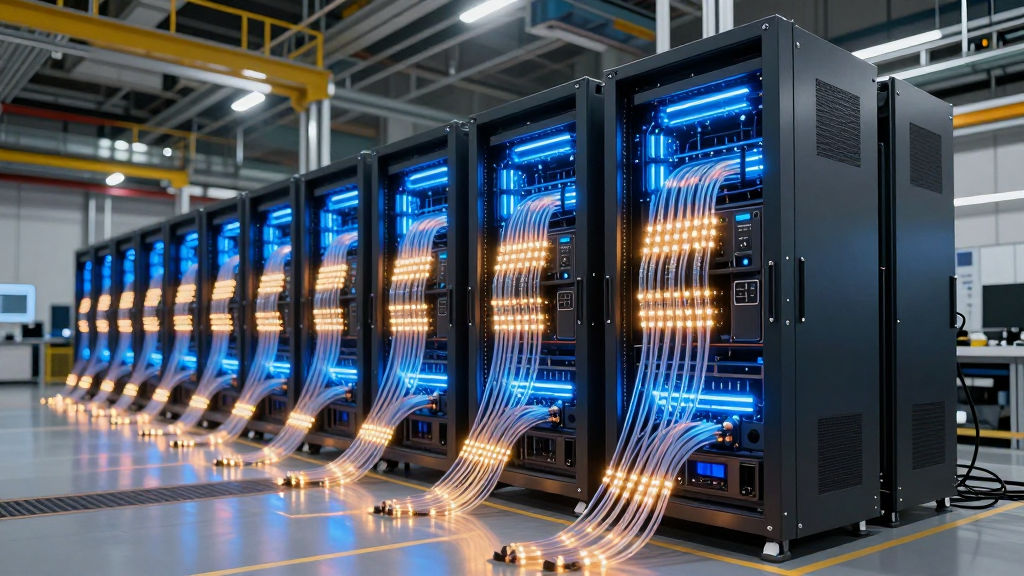
NVIDIA Rubin Production: Powering the Next AI Revolution
Estimated reading time: 7 minutes
- The NVIDIA Rubin platform introduces a unified architecture integrating the Vera CPU and Rubin GPU for trillion-parameter model efficiency.
- Next-generation HBM4 memory delivers 22 TB/s of bandwidth, a significant 2.75x increase over previous Blackwell hardware.
- New Spectrum-X Ethernet Photonics technology utilizes light for data transmission, achieving a 5x gain in networking power efficiency.
- The platform aims to reduce AI inference costs by up to 10x, making complex agentic workflows economically viable for enterprises.
- The Vera CPU: Redefining the Heart of the AI Factory
- Olympus Cores and Multi-Tenant Scaling
- Conquering the 1T-Parameter Inference Barrier
- NVFP4 Tensor Cores and Agentic Reasoning
- Alpamayo Open Models and the Future of Autonomy
- Generating Multi-Camera Driving Scenarios
- Spectrum-X Ethernet Photonics: Solving the Energy Crisis
- ConnectX-9 SuperNIC and Continuous Throughput
- BlueField-4 DPU and the ASTRA Security Framework
- Secure Multi-Tenant Environments
- Cloud-Scale Deployment: Azure and CoreWeave Partnerships
- The Shift to Architecture-Agnostic Platforms
- The Economic Impact of Reduced Token Costs
- Making Long-Context Inference Affordable
- Conclusion: Preparing for the Rubin Era
- FAQ
- Sources
The arrival of the NVIDIA Rubin platform marks a definitive shift in the global race for artificial intelligence supremacy. Announced in full production at CES 2026, this ecosystem represents more than a simple hardware upgrade. It is a comprehensive architectural overhaul designed to sustain the next decade of agentic reasoning and trillion-parameter models.
By integrating the Vera CPU with the Rubin GPU, NVIDIA has created a unified AI factory blueprint. This strategy effectively addresses the growing bottlenecks in data movement and power consumption. For enterprises, the start of NVIDIA Rubin production signifies that the tools for true Level 4 autonomy and real-time reasoning are finally within reach.
The Vera CPU: Redefining the Heart of the AI Factory
At the center of this new era is the Vera CPU. This processor features 88 high-performance Olympus cores built on a specialized Arm-compatible architecture. Unlike traditional server CPUs, NVIDIA designed Vera specifically to handle the massive data orchestration required by modern AI workloads.
Efficiency is the primary goal of this new silicon. The Vera CPU connects to Rubin GPUs via NVLink 6, which delivers a staggering 3.6 TB/s of bandwidth per GPU. This massive throughput ensures that the processor never becomes a bottleneck during complex training runs. Furthermore, the Arm-compatible nature of the chip provides a flexible environment for hybrid workloads.
Many organizations currently struggle with Private AI Infrastructure that relies on aging x86 architectures. Vera offers a path forward by optimizing energy use without sacrificing raw compute power. Consequently, data centers can host more intelligence within the same physical footprint.
Olympus Cores and Multi-Tenant Scaling
The 88 Olympus cores are not just about raw speed. They are engineered for multi-tenant environments where several different AI agents might be running simultaneously. This design allows for seamless scale-up in massive “AI factories” without the typical performance degradation seen in shared hardware.
As a result, service providers can offer more granular resources to their clients. For instance, a single rack can now support hundreds of isolated reasoning tasks. This level of density is critical as the industry moves toward pervasive, always-on AI assistants that require dedicated background processing.
Conquering the 1T-Parameter Inference Barrier
Large language models are getting bigger, but the hardware to run them efficiently has often lagged behind. The Rubin GPU addresses this by introducing HBM4 memory with an incredible 22 TB/s of bandwidth. This represents a 2.75x increase over the previous Blackwell generation.
Bandwidth is the lifeblood of high-speed inference. When a model reaches the one-trillion parameter mark, the speed at which data moves from memory to the processor determines the user experience. With Rubin, NVIDIA has effectively solved the latency problem for even the most demanding reasoning models.
NVFP4 Tensor Cores and Agentic Reasoning
The platform introduces NVFP4 Tensor Cores, which provide 50 petaFLOPS of performance per GPU. These cores are specifically optimized for “agentic” workflows. These are tasks where an AI must plan, reason, and execute a sequence of actions rather than just generating text.
This leap in performance allows for more complex Small Reasoning AI Models to run locally or in private clouds. By utilizing fourth-generation Transformer Engines, Rubin can dynamically scale between FP4 and FP8 precision. This flexibility reduces energy consumption while maintaining the high accuracy needed for sensitive enterprise applications.
Alpamayo Open Models and the Future of Autonomy
One of the most surprising announcements alongside the hardware was the Alpamayo family of open models. These are vision-language-action (VLA) models designed specifically for Level 4 autonomous vehicles (AV). By releasing these models as open weights, NVIDIA is democratizing access to cutting-edge driving technology.
Historically, L4 AV technology has been locked behind proprietary silos. Startups and independent developers often lacked the billions of dollars required to train such models from scratch. Alpamayo changes this dynamic by providing a high-quality foundation for physical reasoning and edge-case simulation.
Generating Multi-Camera Driving Scenarios
The Alpamayo ecosystem includes tools for generating complex, multi-camera driving scenarios from a single image. This capability is vital for “closed-loop” testing, where an AI must react to a simulated environment that changes based on its own actions.
Furthermore, these models help bridge the gap between digital simulation and real-world performance. Developers can use Rubin-powered clusters to run thousands of parallel simulations. This process identifies potential safety issues before a vehicle ever touches the pavement. It is a massive win for safety and innovation in the transportation sector.
Spectrum-X Ethernet Photonics: Solving the Energy Crisis
As AI clusters grow to include millions of GPUs, the power required for networking becomes a major hurdle. The industry is currently facing significant AI Energy Infrastructure Challenges that threaten to slow down progress. NVIDIA’s answer is Spectrum-X Ethernet Photonics.
By integrating photonics—using light instead of electricity for data transmission—into the Spectrum-6 switches, NVIDIA has achieved a 5x gain in power efficiency. This technology allows for “scale-out” Ethernet networking that can support million-GPU superclusters.
ConnectX-9 SuperNIC and Continuous Throughput
The ConnectX-9 SuperNIC works in tandem with these switches to ensure continuous AI throughput. In older systems, GPUs often sit idle while waiting for data to arrive over the network. This “idle time” is an expensive waste of resources.
However, the new 3.6 TB/s NVLink 6 switches minimize these delays. By keeping the silicon productive at all times, enterprises can reduce their total cost of ownership. The system ensures that every watt of power consumed contributes directly to the training or inference process.
BlueField-4 DPU and the ASTRA Security Framework
In a multi-tenant world, security is not optional. The BlueField-4 DPU introduces the Advanced Secure Trusted Resource Architecture (ASTRA). This framework provides system-level trust by isolating software-defined AI provisioning from the underlying hardware.
The DPU handles all the networking, storage, and security tasks, leaving the GPU free to focus entirely on math. Specifically, BlueField-4 enables key-value cache sharing across the network. This feature is essential for long-context inference, where the AI needs to remember vast amounts of information from previous interactions.
Secure Multi-Tenant Environments
For companies operating in regulated sectors, ASTRA is a game-changer. It allows for the creation of “sovereign AI” clouds where data residency and security are guaranteed at the hardware level. Even in a shared data center, your models and data remain cryptographically isolated from other users.
This level of protection is necessary for the next wave of corporate adoption. As companies integrate AI into their core operations, they must know that their intellectual property is safe. Rubin’s hardware-enforced security provides that peace of mind.
Cloud-Scale Deployment: Azure and CoreWeave Partnerships
Hardware is only useful if it is accessible. NVIDIA has partnered with Microsoft Azure and CoreWeave to ensure that the Rubin platform is available for cloud-scale deployments by the second half of 2026.
Microsoft has already begun optimizing its data center layouts to accommodate the Vera Rubin NVL72 racks. These racks use a modular, cable-free design that allows for 18x faster servicing compared to previous generations. This focus on “serviceability” ensures that cloud providers can maintain high uptime for their customers.
The Shift to Architecture-Agnostic Platforms
CoreWeave’s integration of Rubin highlights a broader trend toward architecture-agnostic AI clouds. By offering a mix of Blackwell and Rubin architectures, they allow developers to choose the best price-to-performance ratio for their specific task.
For example, a startup might use Blackwell for initial prototyping and then migrate to Rubin for high-scale inference to take advantage of the 10x lower token costs. This flexibility is essential for managing the volatile economics of the modern AI market.
The Economic Impact of Reduced Token Costs
The most significant takeaway for business leaders is the massive reduction in inference costs. NVIDIA estimates that the Rubin platform can deliver up to 10x lower token costs compared to previous systems.
In the past, high costs made it difficult to deploy “agentic” workflows at scale. If every step of a reasoning process costs several cents, a complex multi-step task becomes prohibitively expensive. By slashing these costs, Rubin makes it viable for an AI to “think” for longer periods.
Making Long-Context Inference Affordable
With 288 GB of HBM4 memory per GPU, Rubin can handle massive context windows. This means you can feed an entire library of technical manuals or legal documents into the model and get instant, accurate answers.
Previously, this required expensive “RAG” (Retrieval-Augmented Generation) setups or model sharding across multiple GPUs. Now, a single Rubin-powered node can handle tasks that used to require a whole cluster. The economic implications for law firms, medical researchers, and engineering groups are profound.
Conclusion: Preparing for the Rubin Era
The NVIDIA Rubin production cycle represents a milestone in the history of computing. By unifying the CPU, GPU, and networking into a single, light-speed ecosystem, NVIDIA has cleared the path for the next generation of artificial intelligence. From the 88-core Vera CPU to the photonics-powered Spectrum-X switches, every component is designed to maximize intelligence while minimizing energy.
For enterprises, the message is clear: the infrastructure for Level 4 autonomy and trillion-parameter reasoning is here. Organizations that embrace these high-efficiency architectures will be well-positioned to lead in an increasingly automated world. The Rubin platform is not just a faster chip; it is the foundation of the modern AI factory.
Subscribe for weekly AI insights to stay ahead of the hardware curve and optimize your private infrastructure.
FAQ
- What is the main difference between NVIDIA Blackwell and Rubin?
- Rubin introduces the Vera CPU (Arm-based), HBM4 memory with 22 TB/s bandwidth, and 10x lower inference costs. It focuses on “agentic” reasoning and trillion-parameter models that Blackwell struggled to run efficiently at scale.
- When will NVIDIA Rubin be available for purchase?
- Full production was announced at CES 2026, with cloud-scale deployments at partners like Microsoft Azure and CoreWeave expected to begin in the second half of 2026.
- What are Alpamayo models?
- Alpamayo is a family of open vision-language-action (VLA) models designed for Level 4 autonomous vehicles. They provide a foundation for startups to build driving systems without relying on proprietary, closed-source software.
- How does Rubin improve data center energy efficiency?
- The platform uses Spectrum-X Ethernet Photonics, which utilizes light instead of electricity for networking. This results in a 5x power saving for large-scale AI clusters.
Sources
- Inside the NVIDIA Rubin Platform
- NVIDIA Touts Rubin Platform Production
- Microsoft Strategic AI Datacenter Planning for Rubin
- NVIDIA News: Rubin Platform AI Supercomputer
- NVIDIA Rubin: Full Production at CES 2026
- NVIDIA CES 2026 Special Presentation
- NVIDIA Rubin Platform: Powering the Next AI Revolution (video)
- CES 2026 AI Highlights: NVIDIA Rubin
- NVIDIA DGX SuperPOD with Rubin