
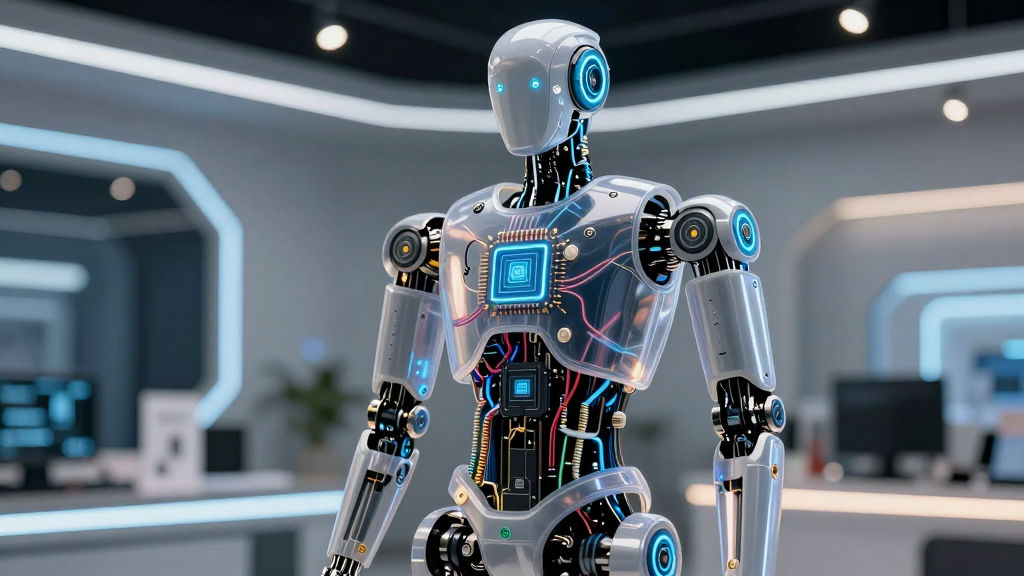
The Silicon Revolution: Scaling Physical AI CES 2026 Insights
Estimated reading time: 7 minutes
- Physical AI marks the definitive transition from cloud-based chatbots to embodied intelligence that interacts with the physical world in real-time.
- New silicon architectures from Qualcomm, AMD, and Intel are enabling edge-based reasoning, removing the latency bottlenecks of the cloud.
- Safety protocols and private infrastructure have become the top priority for enterprises deploying autonomous systems in high-stakes environments like healthcare and manufacturing.
- The rise of “kinesthetic data” is creating a new economy where robotic movement and tactile interactions are the primary assets for training industry-specific models.
- The Silicon Foundation: Powering Physical AI CES 2026
- Tactile Intelligence and the Generative Bionics GENE.01
- Healthcare at the Edge: Intel Core Ultra Series 3
- Precision Surgery with Nvidia Alpamayo Models
- From Demos to the Factory Floor: The Hyundai Atlas Robot
- Physical AI Safety Safeguards and Corporate Governance
- The New Data Economy for Physical Intelligence
- How Founders Should Prepare for the Physical Shift
- Conclusion
- FAQ
The digital world and the physical world have finally merged into a single, cohesive unit. This year, the technology landscape underwent a massive shift as we moved beyond chatbots and screen-based interactions. The primary catalyst for this change was the explosive growth of Physical AI CES 2026 developments. These innovations have moved artificial intelligence from the cloud into the very machines that inhabit our offices, hospitals, and factories.
Today, we see hardware that can actually reason and react in real-time. This transition represents the “ChatGPT moment” for robotics and embodied intelligence. However, this progress relies heavily on a new generation of silicon designed specifically for edge-based reasoning. As a result, businesses are now looking at how to integrate these physical agents into their existing private infrastructure.
The Silicon Foundation: Powering Physical AI CES 2026
The era of relying on slow cloud connections for robotic movement is officially over. At the heart of this revolution lies a massive leap in processing power from the world’s leading chipmakers. Companies like Qualcomm, AMD, and Intel have unveiled silicon that treats physical movement as a primary compute task.
The Qualcomm Dragonwing IQ10 has emerged as a frontrunner in this space. This chip features an Oryon 18-core CPU and a powerful Hexagon NPU. Consequently, it delivers five times the CPU gains compared to previous generations. This speed allows humanoid robots to react to dynamic environments in milliseconds. For example, a robot can now catch a falling object or navigate a crowded hallway without any lag.
Similarly, the AMD P100 and X100 processors are pushing the boundaries of what embedded AI can achieve. These chips focus on multimodal sensory processing. They allow robots to process sight, sound, and touch simultaneously. This capability is essential for creating machines that can handle unpredictable tasks in hazardous industrial settings.
Tactile Intelligence and the Generative Bionics GENE.01
Hardware is nothing without a way to sense the world. This year, the focus has shifted toward “tactile skin” technology. The Generative Bionics GENE.01 is a prime example of this trend. It utilizes AMD’s AI processors to power thousands of full-body sensors.
These sensors allow the GENE.01 to feel pressure and texture much like a human does. Therefore, the robot can adjust its grip strength when handling delicate components or assisting a person. This development significantly reduces the risk of accidents in manufacturing environments. Furthermore, it allows for more natural human-robot collaboration on the factory floor.
The move toward better tactile feedback is a major part of the Physical AI CES 2026 narrative. It proves that AI is no longer just about seeing pixels. It is now about understanding the physics of the real world. By integrating these systems, companies can build more resilient supply chains that rely on precise, automated handling.
Healthcare at the Edge: Intel Core Ultra Series 3
Medical technology has also seen a significant upgrade through physical intelligence. The Intel Core Ultra Series 3 is currently powering the Oversonic RoBee humanoid. This robot is designed specifically for neurological patient care and adaptive therapies.
The most important feature here is on-device processing. In a healthcare setting, cloud latency can be dangerous. Consequently, the RoBee handles all its decision-making locally. This ensures that the robot can react instantly to a patient’s movements or medical emergencies. By using small reasoning AI models, these robots provide high-level care without compromising data privacy.
Moreover, these systems are designed to operate in structured environments like hospitals with extreme reliability. They bypass the need for constant internet connectivity. As a result, they offer a level of safety and consistency that was previously impossible. This shift allows human nurses to focus on complex emotional care while the AI handles repetitive monitoring.
Precision Surgery with Nvidia Alpamayo Models
The surgical suite is perhaps the most demanding environment for any AI system. This year, Nvidia introduced the Alpamayo family of models to meet this challenge. These models work alongside LEM Surgical’s Dynamis system to provide autonomous surgical assistance.
Nvidia uses its Cosmos simulations to train these surgical arms in virtual environments. This training allows the AI to practice thousands of operations before ever touching a patient. Consequently, the Dynamis system can perform precision tasks with sub-millimeter accuracy. This reduces human error and shortens recovery times for patients.
The use of these advanced models highlights a broader trend in Physical AI CES 2026. We are seeing a move toward industry-specific models that are fine-tuned for high-stakes tasks. This is a far cry from the general-purpose models of the past. These specialized systems require robust private AI infrastructure to manage the massive datasets they generate during operations.
From Demos to the Factory Floor: The Hyundai Atlas Robot
One of the most talked-about reveals this year was the production-ready Hyundai Atlas robot. While previous years featured prototypes, 2026 marks the year of mass deployment. The Atlas is no longer just a demo; it is a tool for the modern manufacturing plant.
This robot represents a shift toward “general-purpose” physical intelligence. It can walk, lift, and reason through complex logistics tasks. According to industry experts, 2026 marks shift from virtual to physical AI as companies move these machines onto the assembly line.
The Atlas uses advanced planning algorithms to work alongside human crews. It does not just follow a pre-programmed path. Instead, it observes its surroundings and makes decisions based on the current workflow. This level of autonomy is what makes the current wave of robotics so transformative for the global economy.
Physical AI Safety Safeguards and Corporate Governance
As robots enter our physical spaces, safety has become the primary concern for CTOs and founders. We cannot treat a 200-pound robot the same way we treat a software script. Therefore, companies are now implementing rigorous Physical AI safety safeguards.
Deloitte has recently highlighted the need for “light curtains” and digital audit trails. These systems act as invisible barriers that stop a robot if a human gets too close. Furthermore, audit trails allow companies to review every decision a robot makes. This is crucial for insurance purposes and regulatory compliance.
To maintain safety, organizations must also secure their internal networks. Cyber defenses are now a physical necessity. If a robot’s reasoning model is compromised, it could cause real-world damage. Consequently, we recommend that all industrial AI deployments happen within a locked-down, private environment. This prevents external actors from interfering with the robot’s behavior or accessing sensitive sensor data.
The New Data Economy for Physical Intelligence
The rise of Physical AI CES 2026 has created a new kind of economy. It is no longer just about text data; it is about “kinesthetic data.” This involves recording how robots move and interact with the world. Companies are now trading these datasets to train better models.
Universal Robots has predicted that industry-specific data marketplaces will soon become the norm. A company that has perfected a specific robotic movement can license that data to others. This creates a feedback loop that accelerates the development of all physical agents.
However, this data is incredibly valuable and sensitive. It contains blueprints of factories and proprietary workflows. Therefore, managing this data requires a sophisticated approach to storage and processing. This is why we advocate for decentralized AI architectures where data stays close to the source.
How Founders Should Prepare for the Physical Shift
If you are a leader in the tech space, the time to plan for physical automation is now. You should not wait for your competitors to deploy their first humanoid fleet. Start by auditing your current workflows to see where physical intelligence can add the most value.
First, identify tasks that are repetitive, dangerous, or require high precision. These are the prime candidates for robots powered by the Qualcomm Dragonwing IQ10 or Intel Core Ultra Series 3. Second, ensure your infrastructure can handle the bandwidth and compute requirements of these machines.
Finally, focus on the human element. Physical AI is not about replacing people. It is about creating human-machine teams that can achieve more together. By training your staff to work alongside these new agents, you can increase productivity while maintaining high morale. This balanced approach is the key to long-term success in the era of embodied AI.
Conclusion
The breakthroughs in Physical AI CES 2026 have fundamentally changed our relationship with technology. We have moved from a world where AI lived in a box to a world where AI walks among us. With the power of the Qualcomm Dragonwing IQ10 and Nvidia Alpamayo models, the limitations of the past have vanished.
However, the success of these systems depends on how we implement them. Safety, privacy, and infrastructure are more important than ever. Companies that embrace these physical agents while maintaining strict safeguards will lead the next industrial revolution. As we move forward, the focus will remain on making these machines smarter, safer, and more integrated into our daily lives.
Subscribe for weekly AI insights to stay ahead of the curve in this fast-moving landscape.
FAQ
- What is the main difference between digital AI and Physical AI?
- Digital AI lives in software and processes text or images. Physical AI has a body, such as a robot or wearable, and can sense and interact with the real world in real-time.
- Why is the Qualcomm Dragonwing IQ10 significant?
- The IQ10 provides the low-latency processing power needed for robots to react to their environment instantly. It allows for complex reasoning without needing a cloud connection.
- Are these robots safe to work around humans?
- Yes, modern robots use Physical AI safety safeguards like light curtains and tactile sensors. These technologies ensure the robot stops or adjusts its movement if a human is in its path.
- How does private infrastructure benefit robotics?
- Private infrastructure ensures that the data collected by a robot’s sensors stays within the company. It also reduces latency, allowing for faster and more reliable decision-making.
Sources
- CES 2026: The Year Physical AI Was Born
- Industrial AI Highlights from CES 2026
- Deloitte: Pulse Check on New AI Breakthroughs
- Physical AI was everywhere at CES 26, but what happens next?
- Physical AI and Automation Trends 2026
- 2026 marks shift from virtual to physical AI
- Universal Robots: Four Predictions for 2026