
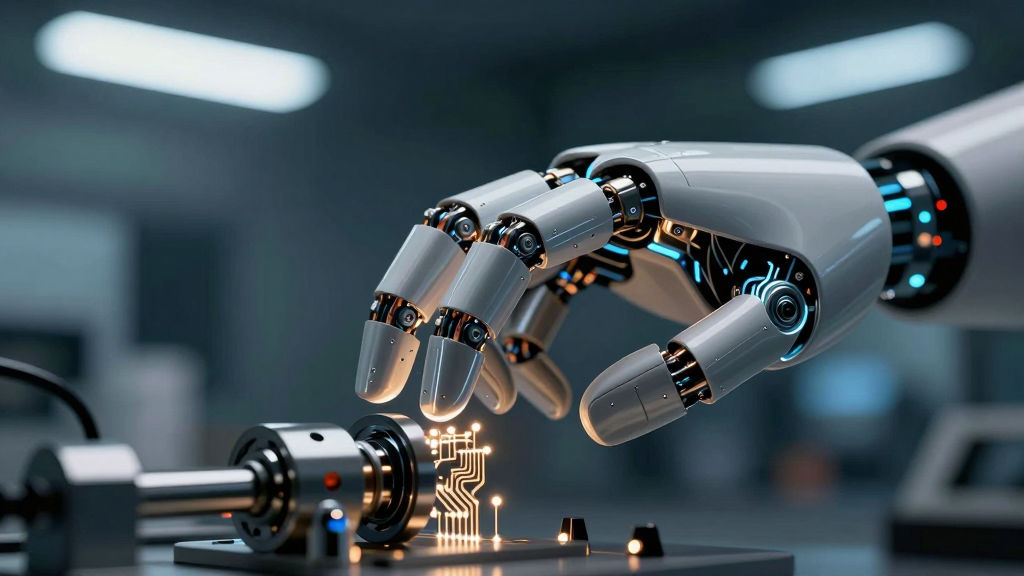
The 2026 Physical AI Productivity Shift: Beyond the Screen
Estimated reading time: 7 minutes
- Transition from digital-only models to “Physical AI” systems that interact with the 3D world.
- New hardware from AMD, Intel, and NVIDIA is enabling real-time edge processing for robotics.
- Tactile skin technology and VLA models are closing the gap in humanoid dexterity and reasoning.
- Autonomous surgical robots and Level 4 vehicle autonomy represent the high-stakes future of the shift.
- The Dawn of Embodied Intelligence
- AMD and Intel: Powering the New Edge
- Tactile Skin and the Quest for Humanoid Dexterity
- High-Stakes Autonomy: Autonomous Surgical Robots
- Automotive Evolution: NVIDIA Alpamayo VLA Models
- The Economic Impact of Vertical AI
- Future Outlook: The World in 2027 and Beyond
- Conclusion
- FAQ
- Sources
The era of digital-only artificial intelligence has reached its peak, giving way to a new frontier. At the start of 2026, we are witnessing a fundamental physical AI productivity shift that moves intelligence from chat interfaces into the tangible world. This transition marks the moment when AI stops merely suggesting ideas and starts performing physical labor alongside humans.
While previous years focused on large language models (LLMs) and generative media, this year belongs to “Physical AI.” This refers to systems that perceive, reason about, and interact with the three-dimensional world. Consequently, businesses are moving away from virtual assistants toward autonomous systems capable of manipulating objects, performing surgery, and navigating complex industrial environments.
The Dawn of Embodied Intelligence
Physical AI represents the marriage of advanced neural networks with sophisticated robotics and sensor hardware. For years, robots were confined to repetitive, pre-programmed tasks in controlled factory settings. However, the introduction of multimodal foundation models has changed the equation entirely. These systems can now understand natural language instructions and translate them into precise physical movements.
This shift is driven by a massive increase in compute power at the edge. We are no longer reliant on massive cloud data centers for every robotic decision. Instead, localized processing allows for real-time responsiveness. As a result, robots can now react to unexpected changes in their environment within milliseconds. This capability is essential for safety and efficiency in shared human-robot workspaces.
Furthermore, the economic implications are staggering. Companies are beginning to see a massive return on investment as physical AI reduces rework and increases throughput. We are moving toward a future where “labor” is no longer a bottleneck for industrial growth. This evolution requires a robust Private AI Infrastructure to ensure that sensitive operational data remains secure within corporate walls.
AMD and Intel: Powering the New Edge
While NVIDIA has historically dominated the AI chip market, 2026 has introduced formidable challengers. The rise of AMD P100 X100 robotics processors has provided a new alternative for industrial humanoid manufacturers. These embedded chips are specifically designed to handle the massive data throughput required for full-body tactile sensing.
In addition to AMD, the Intel Core Ultra Series 3 edge AI processors are making waves in the medical sector. These chips excel at low-latency processing, which is critical for robots operating in high-stakes environments. For example, the Oversonic RoBee utilizes these processors to provide real-time patient assistance without the lag associated with cloud connectivity.
Why Edge Computing Matters for Physical AI
- Reduced Latency: Decisions happen on-device, allowing for immediate reactions.
- Enhanced Privacy: Sensitive environmental data never leaves the local network.
- Reliability: Robots continue to function even if the internet connection drops.
- Energy Efficiency: Localized NPUs (Neural Processing Units) consume less power than constant cloud streaming.
By utilizing these advanced chips, developers can create more agile and responsive machines. This hardware evolution is a primary driver behind the physical AI productivity shift, as it makes sophisticated automation accessible to a wider range of industries.
Tactile Skin and the Quest for Humanoid Dexterity
One of the greatest hurdles in robotics has always been fine motor control. Human hands are incredibly complex, and replicating that dexterity requires more than just vision. This has led to the development of tactile skin humanoids, which use thousands of tiny sensors to “feel” pressure, texture, and temperature.
The Generative Bionics GENE.01 is a prime example of this technology in action. By utilizing AMD processors to handle touch data, these machines can handle delicate objects like glassware or electronic components with ease. Consequently, industries like electronics assembly and laboratory research are seeing a surge in automation.
Moreover, these humanoids use reinforcement learning to optimize their movements over time. They learn from their mistakes just as humans do. If a robot drops an object, it adjusts its grip strength for the next attempt. This iterative learning process is rapidly closing the gap between robotic and human capability in manufacturing.
High-Stakes Autonomy: Autonomous Surgical Robots
The medical field is perhaps the most exciting arena for the physical AI productivity shift. We are seeing the rise of autonomous surgical robots that can perform complex procedures with sub-millimeter precision. The LEM Surgical Dynamis system is at the forefront of this movement.
These systems do not replace surgeons but rather act as highly intelligent tools. They can compensate for a surgeon’s hand tremors or navigate around delicate nerves that are invisible to the naked eye. By integrating multimodal reasoning, these robots can even predict potential complications before they occur.
Benefits of AI in the Operating Room
- Higher Accuracy: Reducing human error in delicate incisions.
- Faster Recovery: Smaller, more precise movements lead to less tissue damage.
- Data Integration: Real-time analysis of patient vitals during the procedure.
- Consistency: Delivering the same high level of care regardless of surgeon fatigue.
According to a recent report from SEB, 2026 Marks Shift from Virtual to Physical AI, particularly in sectors requiring high precision. This transition is fostering a new era of “precision medicine” that was previously thought to be decades away.
Automotive Evolution: NVIDIA Alpamayo VLA Models
The automotive industry is also undergoing a massive transformation. The introduction of NVIDIA Alpamayo VLA models (Vision-Language-Action) has accelerated the path to Level 4 autonomy. These models allow vehicles to “reason” about their surroundings in a way that previous systems could not.
Instead of just following pre-mapped routes, Alpamayo-powered vehicles can interpret complex social cues. For instance, they can recognize a construction worker waving them through an intersection or understand that a ball rolling into the street might be followed by a child. This level of reasoning is essential for safe urban driving.
Furthermore, these models are being trained in hyper-realistic simulations. This allows them to experience millions of miles of diverse driving scenarios in a fraction of the time. As a result, the reliability of autonomous fleets is reaching parity with human drivers. This progress builds on the foundation of NVIDIA Powering Industrial AI Automation that we have tracked over the past several years.
The Economic Impact of Vertical AI
As physical AI matures, we are seeing the rise of “Vertical AI.” This refers to AI systems designed for very specific industrial tasks, such as welding, painting, or precision finishing. Universal Robots and other leaders in the cobot (collaborative robot) space are focusing on these niche applications to drive immediate value.
These vertical models create a “physical data economy.” As robots perform tasks, they collect data that can be used to train even more efficient models. Consequently, a company that deploys a welding robot today is effectively building an asset that becomes more intelligent every day.
This data-driven approach is a key component of the physical AI productivity shift. It allows companies to achieve a level of Cost-Efficient AI Deployment that was previously impossible. By focusing on specific, high-value tasks, businesses can see immediate improvements in their bottom line.
Challenges to Widespread Adoption
- Hardware Bottlenecks: Demand for advanced NPUs continues to outstrip supply.
- Data Quality: Training physical AI requires high-fidelity sensor data.
- Safety Regulations: Governments are still catching up with the rapid pace of robotic autonomy.
- Workforce Transition: Employees need new skills to work alongside intelligent machines.
Despite these challenges, the momentum behind physical AI is undeniable. The focus has shifted from “Can a robot do this?” to “How quickly can we scale this robot?” This change in mindset is driving massive investments in semiconductor manufacturing and robotic engineering.
Future Outlook: The World in 2027 and Beyond
Looking ahead, the physical AI productivity shift will only accelerate. We expect to see a proliferation of “micro-factories” where localized, autonomous systems produce goods on demand. This will drastically reduce the carbon footprint of global shipping and allow for unprecedented customization.
Additionally, the integration of physical AI into the home is just beginning. While the “robot butler” remains a trope of the future, specialized home assistants for elderly care and household chores are already entering trials. These machines will use the same tactile sensing and VLA models developed for industry to navigate the unpredictable environment of a family home.
The boundary between the digital and physical worlds is blurring. In this new landscape, the most successful organizations will be those that can effectively integrate intelligence into their physical operations. Synthetic Labs remains committed to helping our clients navigate this complex transition by providing the infrastructure and expertise needed to thrive.
Conclusion
The physical AI productivity shift is not just a technological trend; it is a fundamental restructuring of how we interact with the world. From the precision of autonomous surgical robots to the dexterity of tactile skin humanoids, the impact of embodied intelligence is visible everywhere. By leveraging advanced hardware like the Intel Core Ultra Series 3 and NVIDIA Alpamayo models, we are unlocking levels of efficiency that were once the stuff of fiction.
As we move deeper into 2026, the focus must remain on building secure, scalable, and ethical physical AI systems. The transition from virtual screens to physical reality offers immense opportunities for those prepared to lead. Stay informed on these developments and ensure your organization is ready for the next wave of automation.
Subscribe for weekly AI insights and stay ahead of the curve in the rapidly evolving world of Synthetic Labs.
FAQ
- What exactly is Physical AI?
- Physical AI refers to artificial intelligence systems that are embedded in physical hardware, such as robots or vehicles. Unlike digital AI (like chatbots), physical AI can perceive and interact with the physical world in real-time.
- How does the Intel Core Ultra Series 3 impact robotics?
- The Intel Core Ultra Series 3 provides high-performance edge computing. This allows robots to process sensor data locally, reducing latency and making them more responsive and safer for use in medical and industrial environments.
- What is the “productivity shift” mentioned?
- The productivity shift refers to the transition where AI moves from assisting with cognitive tasks (writing, coding) to performing physical labor. This shift is expected to significantly increase industrial output and efficiency.
- Are autonomous surgical robots safe?
- Yes, they are designed to enhance a surgeon’s capabilities. Systems like the LEM Surgical Dynamis use advanced sensors and AI to provide greater precision and consistency than a human can achieve alone.
Sources
- CES 2026 Signals the Year Physical AI Was Born
- CES 2026 Highlights: Industrial AI
- Physical AI was Everywhere at CES 26
- Physical AI Craze: 2026 Automation Trends to Watch
- 2026 Marks Shift from Virtual to Physical AI
- Four Physical AI Predictions: 2026 & Beyond (Universal Robots)
- Four Physical AI Predictions: 2026 & Beyond