
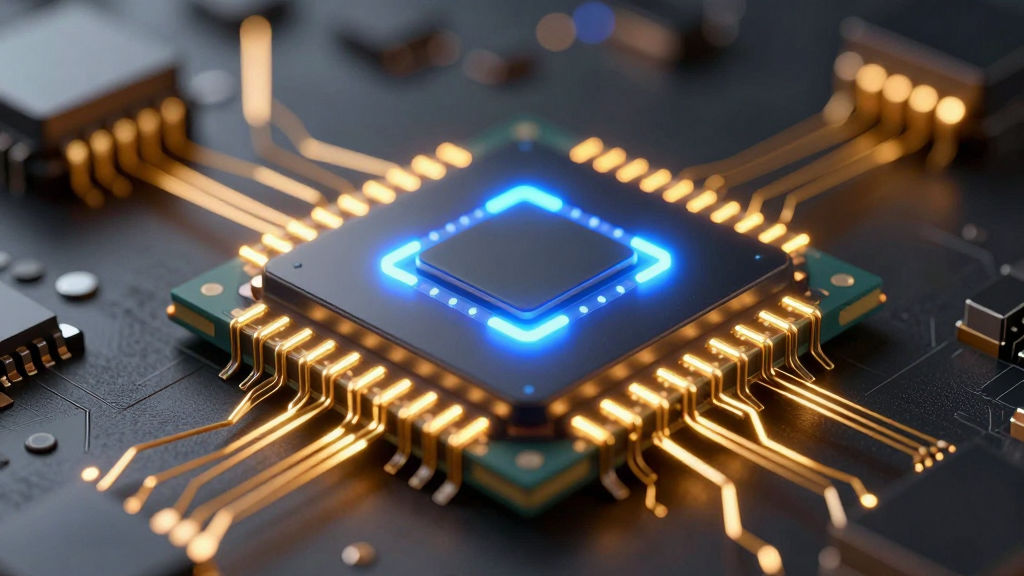
ASIC Accelerators: Redefining Edge AI Efficiency in 2026
Estimated reading time: 7 minutes
- Specialized ASIC silicon is replacing general-purpose GPUs to provide higher performance per watt at the edge.
- The adoption of chiplet designs and quantum-assisted optimizers is drastically reducing hardware overhead and operational costs.
- Multi-agent systems (MAS) are revolutionizing high-stakes sectors like healthcare by enabling collaborative, localized AI workflows.
- Edge-based “super agents” are emerging as a private, low-latency alternative to cloud-dependent AI tools.
- The Shift from General Purpose to Specialized Silicon
- Why AI Edge Efficiency is the New Strategic Priority
- Quantum-Assisted Optimizers and the Future of Compute
- The Rise of Super Agents in Everyday Tools
- Multi-Agent Systems (MAS) and Healthcare Transformation
- Building Trustworthy Automation for 2026
- The Impact of High-Efficiency Hardware on SMBs
- Orchestrating Complexity with Multi-Agent Systems
- Conclusion: The Road to Efficient Intelligence
- Frequently Asked Questions
- Sources
The era of massive, energy-hungry data centers driving every AI interaction is beginning to fade. As we move through 2026, the industry is shifting its focus from raw scale to localized performance. Organizations now prioritize ASIC accelerators to handle complex workloads at the edge without the astronomical costs of traditional GPU clusters. This transition marks a fundamental change in how businesses deploy and scale their intelligence layers.
For years, the narrative suggested that larger models were always superior. However, recent breakthroughs in hardware architecture and model optimization have proven otherwise. Modern enterprises now demand privacy, speed, and cost-efficiency. By moving away from general-purpose hardware, companies are discovering that specialized silicon provides a more sustainable path for long-term growth.
The Shift from General Purpose to Specialized Silicon
The dominance of the general-purpose GPU is facing a significant challenge from specialized hardware. While GPUs were essential for the initial generative AI explosion, they often carry unnecessary overhead for specific tasks. Engineers are now turning to ASIC accelerators (Application-Specific Integrated Circuits) to achieve higher performance per watt. These chips are designed for one purpose: running neural networks with maximum efficiency.
This specialization allows for much higher throughput in environments where power and space are limited. For example, a dedicated AI chip can outperform a high-end GPU in specific inference tasks while consuming a fraction of the electricity. Consequently, developers can deploy more sophisticated models directly onto local devices. This shift is essential for the next generation of autonomous systems that cannot rely on a constant cloud connection.
Hardware manufacturers are also embracing chiplet designs to overcome the physical limits of traditional processor manufacturing. Instead of building one massive, complex chip, designers combine several smaller “chiplets” into a single package. This modular approach improves manufacturing yields and reduces costs significantly. It also allows companies to mix and match different types of processors to create a custom solution for their specific AI needs.
Why AI Edge Efficiency is the New Strategic Priority
In the current landscape, AI edge efficiency has become a competitive advantage for forward-thinking firms. Processing data at the source reduces latency and eliminates the need for expensive bandwidth. Furthermore, edge computing naturally aligns with the growing demand for data sovereignty. When you process information locally, you reduce the risk of data leaks and ensure compliance with strict privacy regulations.
Many organizations are finding that small reasoning AI models for private enterprise use offer better ROI than their larger counterparts. These models are optimized to run on modest hardware while maintaining high levels of accuracy. As a result, even small teams can now afford to run powerful automation tools without a massive infrastructure budget. This democratization of technology is leveling the playing field across various industries.
Transitioning to the edge requires a rethink of how we build software. Developers must now consider the hardware constraints from the very beginning of the project. However, the benefits of this approach are undeniable. Systems that run locally are more resilient to network outages and offer a snappier user experience. In 2026, the speed of an interface is often the deciding factor in user adoption.
Quantum-Assisted Optimizers and the Future of Compute
We are witnessing the emergence of quantum-assisted optimizers to help manage the complexity of modern neural networks. These tools use quantum principles to find the most efficient way to arrange parameters within a model. By optimizing the structure of the AI, researchers can reduce the total amount of compute required for training and inference. This leads to faster deployment cycles and lower operational costs.
According to recent reports from industry leaders like IBM, these advancements are critical for the evolution of agentic workloads. In fact, many experts predict that GPUs will eventually cede significant ground to these more efficient architectures. You can read more about these forecasts in the latest AI tech trends and predictions for 2026. This shift will enable sophisticated agents to run on mobile devices and IoT sensors that were previously too weak for AI.
Analog inference is another exciting field gaining traction this year. Unlike digital processors that use binary logic, analog chips use varying electrical voltages to perform calculations. This method mimics the way the human brain processes information. Therefore, it is incredibly efficient for the matrix multiplications that power deep learning. While still in the early stages of commercial adoption, analog chips represent the next frontier of extreme efficiency.
The Rise of Super Agents in Everyday Tools
The concept of the “super agent” is transforming how we interact with technology. Instead of using separate apps for email, scheduling, and research, users are adopting unified agent control planes. These super agents act as an orchestration layer that manages multiple specialized bots on your behalf. They can browse the web, edit documents, and manage your inbox simultaneously to complete complex goals.
This evolution turns the average user into an AI composer. You no longer need to know how to code to build a sophisticated workflow. Instead, you describe the desired outcome, and the super agent coordinates the necessary steps. This shift moves us away from being tool managers and toward being strategic directors of digital labor. As these agents become more intuitive, they will anticipate our needs before we even express them.
For this vision to work, the underlying hardware must be capable of running several models at once. This is where chiplet designs and specialized memory architectures become vital. By providing the necessary “headroom” on local devices, these hardware improvements make the super agent experience seamless. Users can enjoy high-speed, private assistance without waiting for a cloud server to respond.
Multi-Agent Systems (MAS) and Healthcare Transformation
One of the most impactful applications of this tech is in the medical field. We are seeing multi-agent systems MAS take over complex administrative and clinical tasks. In a typical hospital setting, hundreds of specialized agents might work together to manage patient care. One agent might handle symptom triage, while another reviews medical history and a third checks for drug interactions.
These agentic workflows healthcare professionals use are not just about speed; they are about accuracy and safety. By having multiple agents cross-reference each other, the system can catch errors that a single human or a single chatbot might miss. Furthermore, because these systems can run on private AI infrastructure, patient data remains secure within the hospital’s network.
The deployment of MAS in healthcare serves as a blueprint for other high-stakes industries. When the cost of failure is high, you need redundant systems and transparent decision-making processes. Multi-agent architectures provide this by allowing different bots to “debate” a solution before presenting it to a human. This collaborative approach builds a level of trust that single-model systems simply cannot match.
Building Trustworthy Automation for 2026
As automation becomes more pervasive, the focus has shifted from mere speed to reliability. Businesses are now prioritizing trustworthy automation 2026 standards to ensure their AI systems behave predictably. This involves implementing clear ownership structures and robust monitoring tools. If an agent makes a mistake, the system must be able to explain why it took that specific action.
Small teams are finding that they can achieve significant results by automating end-to-end workflows. However, this requires a solid data foundation and a commitment to transparency. Many organizations are utilizing cost-efficient AI deployment strategies to test these systems in low-risk environments first. Once the logic is proven, they scale the automation across the entire company.
Building trust also means ensuring that AI acts as a partner rather than a replacement. Successful companies are creating human-robot-AI teams where each member plays to their strengths. Humans provide the creative vision and ethical oversight, while AI handles the data-intensive processing. This synergy leads to higher job satisfaction and better business outcomes. Transparency is the glue that holds these hybrid teams together.
The Impact of High-Efficiency Hardware on SMBs
Small and medium-sized businesses (SMBs) often felt left behind during the initial AI gold rush. The hardware requirements were simply too expensive for most modest budgets. However, the arrival of affordable ASIC accelerators has changed the math entirely. Today, an SMB can run a powerful, localized AI stack for the price of a standard workstation.
This shift allows smaller players to compete with much larger enterprises. They can offer personalized customer service, optimized logistics, and rapid content creation without a massive headcount. By leveraging AI edge efficiency, these companies can operate with a level of agility that was previously impossible. They are no longer dependent on expensive subscription models that eat into their margins.
Moreover, the modular nature of chiplet designs means that hardware can be upgraded incrementally. A business doesn’t need to replace its entire infrastructure to get a performance boost. They can simply add new accelerators as their needs grow. This “pay-as-you-grow” model is much more sustainable for companies with limited capital. It ensures that the benefits of AI are distributed across the entire economy, not just the tech giants.
Orchestrating Complexity with Multi-Agent Systems
Managing a fleet of AI agents requires a new kind of “orchestration” mindset. It is no longer enough to have a single powerful model; you must manage the communication between many smaller ones. Multi-agent systems MAS require sophisticated middleware to ensure that information flows correctly between different bots. This coordination layer is becoming the most important part of the modern enterprise tech stack.
For example, a marketing team might use an agentic workflow where one bot researches trends, another writes copy, and a third creates images. A lead agent then reviews all the work for brand consistency before a human gives the final approval. This assembly-line approach to digital content is incredibly efficient. However, it only works if the agents can share data seamlessly and understand the context of the overall project.
To support these complex interactions, hardware must be able to handle “bursty” workloads. This is where specialized silicon excels. ASIC accelerators can quickly spin up the necessary compute power for a specific task and then power down to save energy. This responsiveness is essential for real-time collaboration between humans and machines. As we refine these systems, the friction between thought and execution will continue to disappear.
Conclusion: The Road to Efficient Intelligence
The transition toward ASIC accelerators and localized compute represents a maturing of the AI industry. We are moving past the “experimental” phase where raw power was the only metric that mattered. In 2026, the winners are those who can deliver intelligence efficiently, privately, and reliably. By focusing on AI edge efficiency, businesses are building a more resilient foundation for the future.
Hardware innovations like chiplet designs and quantum-assisted optimizers are making this possible. These technologies allow us to run multi-agent systems MAS on hardware that fits in a pocket or sits on a desk. Whether it is improving agentic workflows healthcare outcomes or empowering small teams with trustworthy automation 2026, the impact is profound. We are finally entering the era of truly ubiquitous intelligence.
As the landscape continues to evolve, Synthetic Labs remains committed to helping you navigate these changes. From private infrastructure to the latest in generative media, we provide the insights you need to stay ahead. The future of AI isn’t just bigger—it’s smarter and much more efficient.
Subscribe for weekly AI insights to stay ahead of the curve.
Frequently Asked Questions
- What are ASIC accelerators?
- ASIC stands for Application-Specific Integrated Circuit. Unlike general-purpose CPUs or GPUs, these chips are custom-built to perform one specific task, such as AI inference, with maximum speed and energy efficiency.
- How do chiplet designs help with AI?
- Chiplets are smaller, modular components that are combined to create a single processor. This approach allows manufacturers to increase performance and lower costs by mixing different specialized components into one package.
- What is the benefit of a multi-agent system (MAS)?
- A multi-agent system uses several specialized AI bots to solve complex problems. This is often more accurate and flexible than using a single, large model, as agents can check each other’s work and handle specific parts of a workflow.
- Why is AI edge efficiency important for privacy?
- When AI runs at the “edge” (locally on your device), your data doesn’t need to be sent to a cloud server. This significantly reduces the risk of data breaches and helps companies comply with strict privacy laws.
- Are super agents different from standard chatbots?
- Yes. While a chatbot usually just answers questions, a super agent can take actions across multiple applications. It acts as an orchestrator that can manage tasks like scheduling, researching, and communicating on your behalf.
Sources
- AI Tech Trends and Predictions for 2026
- What’s Next in AI: 7 Trends to Watch
- Top AI Trends Shaping 2026
- Automation Trends Report
- The Future of Edge AI and Specialized Silicon
- Intelligent Automation Shaping the Future
- The 6 AI Trends That Will Actually Matter in 2026
- Future Automation Trends and Predictions