
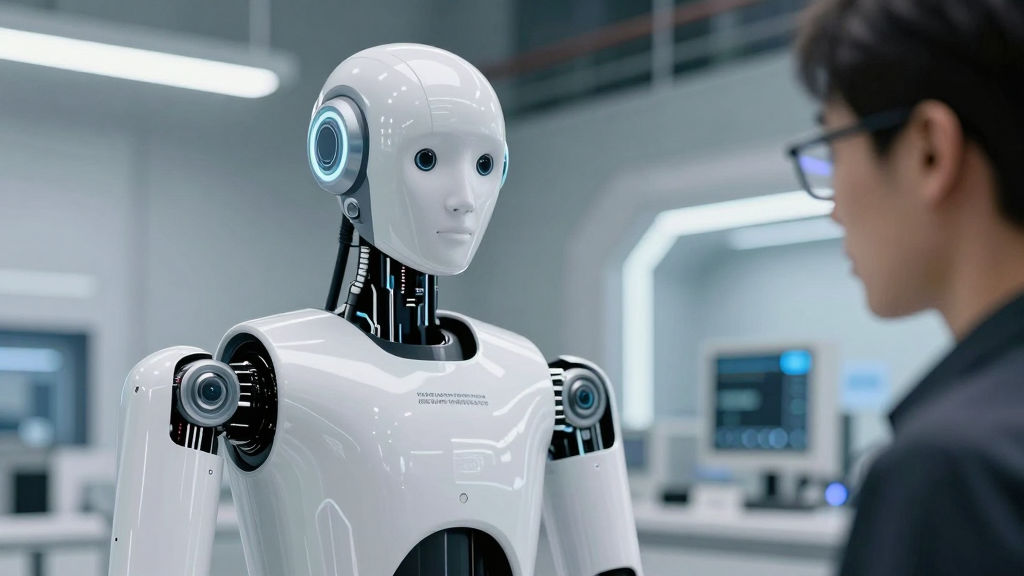
Physical AI 2026: Why Wearables and Robotics are Winning
Estimated reading time: 7 minutes
- The transition from virtual chatbots to embodied intelligence capable of interacting with the physical world.
- Why smart wearables are serving as the initial consumer entry point for advanced AI reasoning.
- The rise of production-ready humanoid robots from leaders like AGIBOT and Hyundai (Atlas).
- How NVIDIA’s VLA models are providing the “brain” for real-time robotic action and safety.
- The Shift from Screen-Based Bots to Physical AI 2026
- Wearables: The Trojan Horse for On-Body Inference
- Ray-Ban Meta AI and the Siemens Partnership
- Scaling Humanoid ROI: AGIBOT and Hyundai Atlas
- AGIBOT Humanoids: Moving Beyond the Pilot Phase
- Hyundai Atlas robot: Production-Ready Power
- The Engine of Intelligence: NVIDIA Alpamayo VLA and Isaac GR00T N1
- Autonomous Vehicle Reasoning in Complex Environments
- Solving the Safety Puzzle: Physical AI Safety Protocols
- The Economic Ripple Effect: Semiconductors and Productivity
- Conclusion: Embracing the Physical Intelligence Era
- Frequently Asked Questions
- Sources
The digital world no longer limits the power of artificial intelligence. We have officially entered the era of Physical AI 2026, where intelligence moves from behind the screen into the tangible world. This shift represents a fundamental change in how we interact with technology. Specifically, AI now powers the machines that move our goods, the glasses on our faces, and the robots in our factories.
Industry leaders are moving past the initial hype of large language models. Instead, they are focusing on pragmatic, hardware-integrated solutions that offer immediate value. This year marks the transition from virtual assistants to physical agents capable of reasoning in real-time. This article explores how wearables and robotics are spearheading this revolution.
The Shift from Screen-Based Bots to Physical AI 2026
For the past few years, AI mostly existed as a chatbot or an image generator. However, the narrative changed rapidly at the start of this year. We are seeing a move from virtual interfaces to embodied intelligence. Experts now refer to this trend as Physical AI 2026, a term that describes AI that interacts directly with the physical environment.
Recent analysis suggests that 2026 is the year AI becomes truly pragmatic. Major companies are no longer just experimenting with “cool” tech. Instead, they are deploying systems that solve labor shortages and improve manufacturing precision. Consequently, the focus has shifted from generative text to physical action. According to industry reports, Pragmatic AI in 2026 as businesses demand real-world returns on their investments.
This evolution requires a different kind of architecture. Virtual AI models run on massive cloud servers with seconds of latency. Physical AI requires edge computing and real-time processing. This necessity has birthed a new generation of hardware designed specifically for on-device reasoning. As a result, the physical world is becoming a massive laboratory for AI innovation.
Wearables: The Trojan Horse for On-Body Inference
While many people imagine giant robots when they hear about Physical AI, the reality is often smaller. Wearables have become the “Trojan Horse” for AI integration. Devices like smart rings, watches, and glasses are normalizing on-body inference. These gadgets allow users to interact with AI without ever looking at a smartphone.
The Ray-Ban Meta AI glasses serve as a prime example of this trend. These glasses do more than just record video or play music. They use multimodal sensors to understand what the user sees in real-time. For instance, a user can look at a foreign menu and receive an instant translation. This seamless interaction builds consumer trust in physical intelligence.
Furthermore, AT&T Ventures and other analysts predict that consumer buy-in for wearables will drive broader adoption. Once people feel comfortable with AI on their faces, they will accept AI in their cars and homes. This “low-cost wedge” is essential for long-term scaling. It allows companies to gather data and refine their models in diverse, everyday settings.
Ray-Ban Meta AI and the Siemens Partnership
The collaboration between Meta and Siemens has taken wearables from the consumer space to the factory floor. This partnership introduces Siemens Industrial AI glasses, a version of the Ray-Ban Meta tech optimized for manufacturing. Workers can now access hands-free diagnostics while repairing complex machinery.
Technical teams use Vision-Language-Action (VLA) models to process visual data on the shop floor. For example, a technician looking at a circuit board can see a generative AI overlay. This overlay highlights potential faults and provides step-by-step repair instructions. As a result, companies are seeing downtime reductions of 20% to 30%. This practical application proves that wearables are not just toys. They are essential tools for the modern blue-collar workforce.
Moreover, these glasses bridge the gap between human intuition and machine precision. Workers no longer need to consult heavy manuals or walk back to a computer terminal. Instead, the intelligence travels with them. This hands-free factory boost is a cornerstone of the Physical AI 2026 landscape.
Scaling Humanoid ROI: AGIBOT and Hyundai Atlas
The robotics sector is also witnessing a massive surge in production-ready hardware. Humanoid robots are finally moving out of the lab and into the warehouse. Two major players leading this charge are AGIBOT and Hyundai. Both companies focus on real-world ROI rather than just impressive demos.
AGIBOT humanoids have already shipped over 5,000 units this year. These robots are not limited to a single task. Instead, they handle everything from security patrols to education and logistics sorting. Their multimodal reasoning allows them to function in unpredictable settings. For instance, an AGIBOT can navigate a crowded hotel lobby without colliding with guests.
This level of deployment signals the end of the humanoid hype cycle. Businesses are seeing actual ROI from these machines. Hotels and warehouses use them to fill labor gaps while maintaining high service standards. These robots succeed because they utilize reinforcement learning to adapt to their environments. Consequently, the focus has shifted from how many motors a robot has to how much value it generates for the client.
AGIBOT Humanoids: Moving Beyond the Pilot Phase
The key to AGIBOT’s success is its onboarding process. The company prioritizes customer metrics over raw hardware specifications. They ensure that their robots integrate seamlessly into existing workflows. This approach is similar to how companies now deploy small reasoning AI models to handle specific tasks rather than generic ones.
When a warehouse adopts AGIBOT units, the robots learn the specific layout and inventory logic. This specialized training allows for higher accuracy than a “one-size-fits-all” model. As a result, these humanoids become an integral part of the team. They handle the repetitive, dull tasks, allowing humans to focus on complex problem-solving.
Hyundai Atlas robot: Production-Ready Power
Parallel to AGIBOT, the Hyundai Atlas robot is making waves in auto manufacturing. Hyundai has designed the latest Atlas model specifically for production deployment. Unlike its predecessors, which were mainly research platforms, the new Atlas is built for durability and speed.
Hyundai uses generative AI for simulation training, which accelerates the robot’s learning process. This means the Atlas can master a new assembly task in virtual space before ever touching a real car. This digital twin approach ensures that the robot is safe and efficient from day one. By integrating the Atlas into global facilities, Hyundai is redefining the concept of a “collaborative robot.”
The Engine of Intelligence: NVIDIA Alpamayo VLA and Isaac GR00T N1
Behind every successful robot or wearable is a powerful AI model. NVIDIA remains at the forefront of this technological shift. Their new NVIDIA Alpamayo VLA models are specifically designed for physical intelligence. VLA stands for Vision-Language-Action, a framework that allows robots to see, understand, and act in one continuous loop.
Similarly, the Isaac GR00T N1 platform provides the foundation for humanoid development. Isaac GR00T N1 enables robots to reason in real-time. This is crucial for autonomous vehicle reasoning and robotics in unstructured environments. A robot needs to know more than just “how to walk.” It needs to understand why it is walking and how to react if someone crosses its path.
These models require massive amounts of data and compute. However, the cost of AI training is falling, making hardware integration more accessible. NVIDIA’s ecosystem allows developers to build sophisticated physical agents without starting from scratch. This standardization is accelerating the rollout of Physical AI 2026 across multiple industries.
Autonomous Vehicle Reasoning in Complex Environments
The same intelligence powering humanoids is also driving the next generation of AVs. Companies like Waymo and Apollo are scaling their fleets rapidly. These vehicles now utilize autonomous vehicle reasoning to navigate complex urban scenarios. For example, the AI can predict the movement of a cyclist or a stray dog with high precision.
NVIDIA’s Alpamayo models process petabytes of sensor data to make split-second decisions. This capability is essential for safety. As these vehicles become more common, the infrastructure surrounding them must also evolve. Many organizations are now investing in private AI infrastructure to process this sensitive data locally, ensuring both speed and security.
Solving the Safety Puzzle: Physical AI Safety Protocols
As machines gain more autonomy, safety becomes a primary concern. You cannot have a 300-pound robot moving around humans without strict safeguards. Therefore, Physical AI safety has become a top priority for developers and regulators alike.
Deloitte recently highlighted the importance of safety-focused adoption. They recommend a multi-layered approach to protection. This includes physical safeguards like “light curtains” that stop a robot if a human enters its workspace. Additionally, it involves software-level defenses. Fail-safe software with IoT integration ensures that robots can shut down instantly if a sensor fails.
Safety protocols also include cybersecurity. A hacked robot or AV is a significant threat. Companies must implement robust shadow AI corporate risk strategies to prevent unauthorized access to their physical systems. Protecting the data flow between the robot and the cloud is just as important as protecting the robot’s physical sensors.
- Collision Sensors: Advanced radar and LiDAR systems prevent accidental contact.
- Cyber Shields: Encryption and private networks protect robots from remote hijacking.
- Audit Trails: Constant logging of AI “decisions” allows for post-incident analysis.
- Zero-Risk Adoption: Gradual rollout phases ensure that safety systems are tested in controlled environments first.
The Economic Ripple Effect: Semiconductors and Productivity
The rise of Physical AI 2026 is creating a massive economic shift. We are moving from a virtual office AI economy to a physical capital goods economy. This transition is fueling a semiconductor boom that surpasses previous cycles. Every drone, robot, and smart ring requires specialized chips to function.
According to SEB, 2026 marks a shift from virtual to physical AI, leading to a surge in semiconductor demand. Investors are moving away from software-only hyperscalers. Instead, they are backing firms that produce the “brains” for the physical world. This shift is boosting global GDP by significantly increasing industrial productivity.
Furthermore, physical AI creates new data economies. Robots operating in warehouses generate valuable data about logistics flows. This data can be monetized or used to further optimize the supply chain. Companies are no longer just selling hardware; they are selling the intelligence and the data that comes with it. This new revenue stream is attracting significant venture capital to the robotics space.
Conclusion: Embracing the Physical Intelligence Era
The arrival of Physical AI 2026 marks a turning point in human history. We are no longer just talking to machines; we are working alongside them. Whether it is through Siemens Industrial AI glasses or the Hyundai Atlas robot, physical intelligence is becoming an everyday reality.
Wearables serve as the entry point, making AI personal and accessible. Meanwhile, humanoids and autonomous vehicles handle the heavy lifting of our global economy. The integration of NVIDIA Alpamayo VLA and Isaac GR00T N1 ensures these machines are smarter and safer than ever before.
As we move forward, the focus must remain on pragmatic deployment and safety. By balancing innovation with responsibility, we can unlock the full potential of embodied AI. This is not just a trend; it is the new foundation of the modern world.
Subscribe for weekly AI insights from Synthetic Labs.
Frequently Asked Questions
- What is Physical AI 2026?
- It refers to the integration of artificial intelligence into physical hardware, such as robots, wearables, and autonomous vehicles, allowing AI to interact directly with the real world.
- How do NVIDIA Alpamayo VLA models work?
- These are Vision-Language-Action models. They allow a system to see an environment, process natural language instructions, and execute physical movements in a single, coordinated loop.
- Why are wearables considered the “Trojan Horse” of AI?
- Wearables like smart glasses normalize the presence of AI in daily life. They are low-cost and easy to use, paving the way for public acceptance of more complex physical AI like humanoids.
- Is physical AI safe for use around humans?
- Yes, companies are implementing rigorous physical AI safety protocols, including collision sensors, fail-safe software, and digital twins for risk-free simulation training.
- Which industries benefit most from physical AI?
- Manufacturing, logistics, healthcare, and hospitality are seeing the most immediate ROI through the deployment of humanoids and AI-enhanced wearables.