
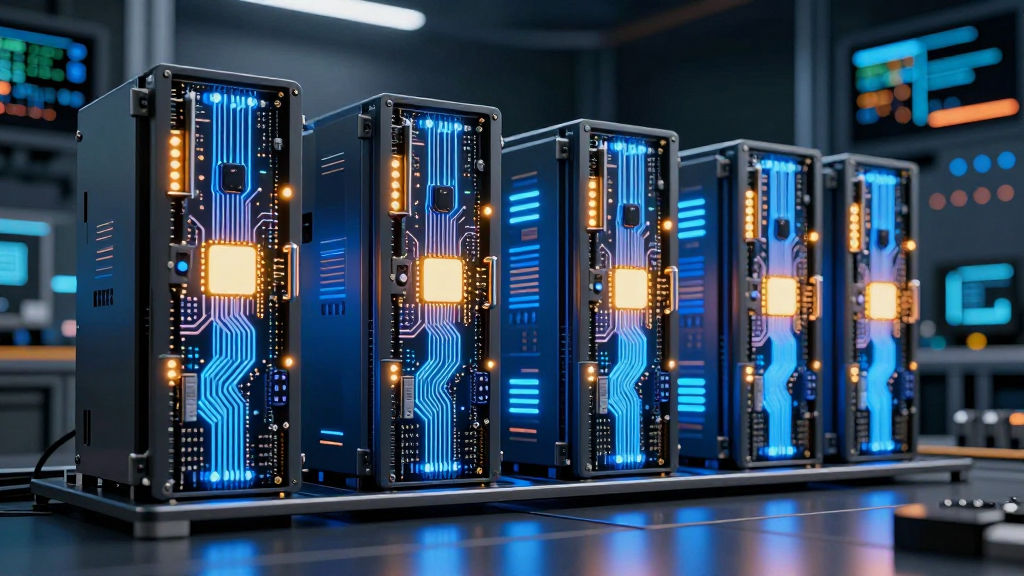
Lowering Inference Token Cost with NVIDIA Rubin Platform
Estimated reading time: 7 minutes
- The NVIDIA Rubin platform promises a 10x reduction in inference token costs compared to previous generations.
- Introduction of the Vera CPU featuring 88 Olympus cores optimized for high-bandwidth data movement.
- A holistic six-chip architecture designed to eliminate bottlenecks in AI data center infrastructure.
- Hardware-level security through ASTRA trusted resource architecture for confidential computing.
- Strategic rollout expected in the second half of 2026 with major cloud partners like Microsoft Azure.
- The Unit Economics of AI Inference
- Extreme Hardware-Software Codesign
- Why the Six-Chip Architecture Matters
- The Power of the Vera CPU AI Architecture
- Redefining AI Data Center Infrastructure for 2026
- Confidential Computing and Data Security
- The Race Among Cloud Providers
- Real-Time Health and the RAS Engine
- Conclusion: Preparing for the Rubin Era
Artificial intelligence has entered a new era where raw performance is no longer the only metric that matters. For enterprises and developers, the primary bottleneck has shifted from “can we build it?” to “can we afford to run it?” The recent unveiling of the NVIDIA Rubin platform addresses this economic challenge head-on by promising a 10x reduction in inference token costs compared to previous generations. This shift fundamentally alters the unit economics of AI deployment, making large-scale agentic workflows accessible to a much broader range of organizations.
In the fast-moving world of generative media and private infrastructure, managing these costs is essential for long-term sustainability. The NVIDIA Rubin platform represents more than just a faster processor; it is a holistic architectural rethink designed to solve the data movement and power efficiency issues that plague modern data centers. By integrating advanced memory, new CPU architectures, and high-speed interconnects, this platform sets the stage for the next decade of AI growth.
The Unit Economics of AI Inference
The most significant takeaway from the Rubin announcement is the dramatic improvement in inference token cost. For the last two years, companies have struggled with the high price of running large language models (LLMs) at scale. High costs often force developers to choose between model intelligence and operational viability. However, the Rubin architecture aims to eliminate this trade-off by optimizing how data flows through the system.
When we talk about the cost-per-token AI metrics, we are looking at the total cost of ownership (TCO) including electricity, cooling, and hardware depreciation. The Rubin platform achieves its 10x reduction by utilizing HBM4 memory and the new Vera CPU. This combination allows for much higher throughput without the proportional increase in power consumption seen in older Blackwell or Hopper setups. For many, this marks the transition from experimental AI budgets to profitable, production-scale deployments.
For organizations already focused on cost-efficient AI deployment, the shift to Rubin represents a massive leap forward. Lowering the barrier to entry means that complex, multi-step AI agents can run thousands of iterations for the price of a single query today. This economic shift is what will finally enable the “agentic” economy where AI handles complex reasoning tasks autonomously.
Extreme Hardware-Software Codesign
The success of the NVIDIA Rubin platform stems from a philosophy of extreme hardware-software codesign. Instead of building a faster GPU and hoping the software catches up, NVIDIA has designed six interconnected chips to function as a single unit. This group includes the Vera CPU, the Rubin GPU, the NVLink 6 Switch, and the ConnectX-9 SuperNIC. By designing these components together, the system avoids the traditional bottlenecks found in “off-the-shelf” data center configurations.
This level of integration is necessary because AI workloads are uniquely demanding. Traditional compute tasks often rely on high single-core performance, but AI requires massive parallelization and incredibly high memory bandwidth. According to reports from NVIDIA’s Next Chip and AI Economics, this specialized hardware could make AI significantly more affordable by reducing the physical footprint required for massive models.
Why the Six-Chip Architecture Matters
- Vera CPU: Optimized for data movement rather than generic compute tasks.
- Rubin GPU: Features next-generation HBM4 memory for massive throughput.
- NVLink 6 Scale-up Fabric: Provides the high-speed “glue” that lets GPUs talk to each other without delay.
- ConnectX-9 SuperNIC: Ensures that data enters and exits the cluster at lightning speeds.
- BlueField-4 DPU: Manages security and networking tasks to offload the main processors.
- Spectrum-6 Ethernet Switch: Connects multiple racks into a giant “AI factory.”
By treating the entire rack as a single computer, NVIDIA minimizes the latency that usually occurs when data travels between different components. This is a critical factor in maintaining a low inference token cost. When data stays within the high-speed fabric of the Rubin system, it consumes less energy and completes tasks faster.
The Power of the Vera CPU AI Architecture
The Vera CPU AI architecture is a departure from traditional server CPUs. In a typical data center, the CPU acts as the “manager” that tells the GPU what to do. However, in many AI workloads, the CPU becomes a bottleneck because it cannot move data fast enough to keep the GPU busy. The Vera CPU solves this by using 88 Olympus cores specifically optimized for the high-bandwidth requirements of agentic processing.
This architectural shift allows for a 4x reduction in GPUs needed for training foundational models. When the CPU can handle data preparation and movement more efficiently, you need fewer total chips to achieve the same result. Consequently, this reduces both the initial capital expenditure and the ongoing electricity costs for the data center operator.
Furthermore, the Vera CPU works in tandem with the NVLink 6 fabric to ensure that memory is shared seamlessly across the entire system. This is particularly important for private AI infrastructure, where organizations need to process massive datasets locally without relying on public cloud bottlenecks. The Vera CPU ensures that even the largest models can stay “hot” in memory, reducing the time it takes to generate a response.
Redefining AI Data Center Infrastructure for 2026
As we look toward AI data center infrastructure 2026, the physical requirements of these facilities are changing. The Vera Rubin NVL72 rack introduces a modular, cable-free tray design. This innovation might sound like a minor logistical detail, but it actually enables 18x faster assembly and servicing compared to previous models. In a world where time-to-market is everything, being able to deploy a cluster in days instead of weeks is a major competitive advantage.
Traditional data centers are often a “rats nest” of copper and fiber optic cables. These cables are prone to failure and difficult to manage at scale. By moving to a cable-free backplane, the Rubin platform improves reliability and airflow. Better airflow leads to better cooling, which in turn allows the chips to run at higher speeds for longer periods.
Key Infrastructure Benefits
- Modular Design: Components can be swapped out quickly without rewiring the entire rack.
- Reliability: Fewer cables mean fewer points of failure in the high-speed data path.
- Scalability: The NVLink 6 scale-up fabric allows multiple racks to act as a single logical unit.
- Maintenance: Real-time health monitoring via the second-generation RAS Engine.
These improvements are vital for companies building small reasoning AI models that require high uptime. If a hardware fault can be predicted and mitigated before it causes a crash, the cost of operating the AI service drops significantly. The Rubin platform’s focus on serviceability shows that NVIDIA is thinking about the “Day 2” operations of AI, not just the initial benchmark scores.
Confidential Computing and Data Security
Security remains the biggest hurdle for enterprise AI adoption. Many founders and CTOs are hesitant to put their proprietary data into shared environments. To address this, the NVIDIA Rubin platform is the first rack-scale solution to deliver Confidential Computing across the entire system. This includes the CPU, the GPU, and even the NVLink connections between them.
A key part of this security stack is the ASTRA trusted resource architecture. ASTRA provides isolated, secure environments for multi-tenant deployments. This means a cloud provider like Microsoft Azure or CoreWeave can run workloads from two competing companies on the same physical rack without any risk of data leakage.
For organizations worried about the risks of shadow AI and corporate data leaks, this hardware-level security is a game changer. It ensures that even if the operating system or the hypervisor is compromised, the actual AI model and the data it processes remain encrypted and inaccessible to unauthorized parties. This level of protection is essential for industries like finance, healthcare, and defense.
The Race Among Cloud Providers
The announcement of the Rubin platform has triggered a new race among cloud infrastructure providers. Microsoft Azure and CoreWeave have already signaled their intent to deploy Rubin-based clusters as soon as they become available in the second half of 2026. This early commitment highlights how critical hardware leadership has become for the major cloud players.
Having the latest hardware isn’t just a matter of prestige; it’s a matter of pricing. If Rubin can truly deliver a 10x reduction in inference token cost, the providers who own that hardware first will be able to undercut their competitors significantly. We are likely to see a shift in the market where “legacy” H100 or Blackwell clusters are relegated to less demanding tasks, while Rubin becomes the standard for high-end reasoning and generative media.
Strategic planning for this transition should start now. Organizations need to evaluate their current cloud contracts and look for “Rubin readiness” in their providers’ roadmaps. Those who move early will benefit from the improved AI factory economics, allowing them to build more complex features while spending less on compute.
Real-Time Health and the RAS Engine
Complexity is the enemy of uptime. As AI clusters grow to include thousands of GPUs, the probability of a hardware failure approaching 100% is high. To combat this, the Rubin platform features a second-generation Reliability, Availability, and Serviceability (RAS) Engine. This system performs real-time health checks and can automatically route data around failing components.
In the past, a single failing chip could bring down an entire training run, costing a company millions of dollars in wasted compute time. The new RAS Engine makes the AI data center infrastructure 2026 much more resilient. It allows for “graceful degradation,” where the system continues to function even if some parts are underperforming.
This focus on reliability is a sign of a maturing industry. We are moving away from the “move fast and break things” era of AI research and into an era of mission-critical enterprise services. For a CTO, knowing that their infrastructure can self-heal is just as important as knowing how many teraflops it can push.
Conclusion: Preparing for the Rubin Era
The NVIDIA Rubin platform is set to redefine the landscape of artificial intelligence by solving the most pressing issue facing the industry today: cost. By achieving a 10x reduction in the inference token cost, this platform makes it possible to deploy highly intelligent, agentic systems at a global scale. Through extreme hardware-software codesign and the introduction of the Vera CPU, NVIDIA has created a blueprint for the future of the AI factory.
For leaders at Synthetic Labs and beyond, the message is clear. The economics of AI are about to change drastically. As we move toward the H2 2026 rollout, organizations should focus on optimizing their software for these next-generation architectures. The transition from Blackwell to Rubin will be more than an incremental upgrade; it will be the catalyst for the next wave of AI innovation.
Subscribe for weekly AI insights to stay ahead of the hardware curve and ensure your infrastructure is ready for the revolution.
FAQ
- What is the NVIDIA Rubin platform?
- It is NVIDIA’s next-generation AI supercomputing platform, succeeding the Blackwell architecture. It features a holistic design including the Vera CPU, Rubin GPU, and HBM4 memory.
- How does Rubin reduce the inference token cost?
- Rubin achieves a 10x reduction in token costs through improved power efficiency, higher memory bandwidth with HBM4, and a “rack-scale” design that eliminates data bottlenecks.
- What is the Vera CPU?
- The Vera CPU is a specialized processor with 88 Olympus cores. It is designed specifically to work alongside GPUs in AI workloads, focusing on high-speed data movement.
- When will the NVIDIA Rubin platform be available?
- The platform is currently in production, with products expected to be available from cloud partners and hardware vendors in the second half of 2026.
- Does Rubin support secure AI deployments?
- Yes, it features the ASTRA trusted resource architecture, providing hardware-level Confidential Computing across the CPU, GPU, and NVLink fabric for secure multi-tenant use.
Sources
- NVIDIA Rubin Platform and AI Supercomputing
- NVIDIA’s Next Chip and AI Economics
- Inside the Rubin Platform: Six New Chips
- NVIDIA touts Rubin platform, production hardware advances
- NVIDIA CES 2026 Special Presentation
- Microsoft’s strategic AI datacenter planning enables seamless large-scale NVIDIA Rubin deployments
- NVIDIA Vera Rubin: Nine Hardware, Cloud Companies Build Out Ecosystem
- NVIDIA Special Address at Computex 2024
- At CES, NVIDIA Rubin and AMD Helios Made Memory the Future of AI