
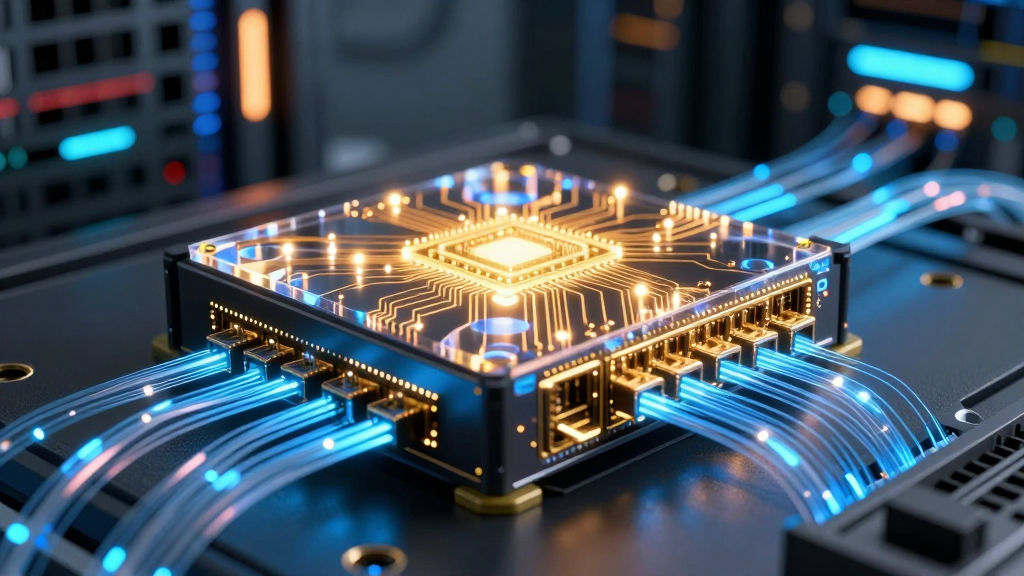
BlueField-4 DPU: Securing Private Agentic AI Infrastructure
Estimated reading time: 7 minutes
- The BlueField-4 DPU serves as a dedicated “computer in front of the computer,” offloading security and networking tasks to double throughput and isolate AI workloads.
- NVIDIA’s ASTRA engine provides hardware-level multi-tenant isolation, enabling secure, shared use of AI factories without data leakage.
- New innovations in KV cache sharing and ConnectX-9 SuperNICs significantly reduce latency and costs, delivering up to 10x lower inference costs.
- The Evolution of the Data Processing Unit
- Securing Multi-Tenant Environments with ASTRA
- Enhancing Agentic AI with Key-Value Cache Sharing
- ConnectX-9: The Backbone of Low-Latency Scale-Out
- Spectrum-X Photonics and Power Efficiency
- The Role of the Vera CPU in Data Movement
- Real-World Impact on Private AI Infrastructure
- Conclusion: A New Standard for AI Factories
The AI landscape shifted permanently at CES 2026. NVIDIA officially unveiled the NVIDIA Rubin platform, marking a transition from isolated GPUs to integrated “AI factories.” While the Rubin GPU and Vera CPU captured the headlines, the real breakthrough for enterprise security lies elsewhere. Specifically, the BlueField-4 DPU (Data Processing Unit) represents the most significant advancement in secure, multi-tenant AI scaling we have seen to date. This chip serves as the foundational gatekeeper for the next generation of agentic workflows.
Modern enterprises face a growing challenge. They must balance the massive compute requirements of trillion-parameter models with the strict demands of data sovereignty. Consequently, the networking layer has become the new frontline for innovation. By offloading security and management tasks from the CPU, the BlueField-4 DPU ensures that private data remains isolated even in massive, shared clusters. This article explores how these networking innovations enable the secure deployment of autonomous agents at an unprecedented scale.
The Evolution of the Data Processing Unit
The introduction of the BlueField-4 DPU signals a departure from traditional networking. Historically, the central processing unit (CPU) handled data movement and security protocols. However, this approach creates bottlenecks as AI models grow in complexity. The BlueField-4 solves this by acting as a “computer in front of the computer.” It manages data traffic, encryption, and storage access independently. As a result, the main compute resources can focus entirely on processing AI logic and inference.
Specifically, the BlueField-4 features a dual-die design that doubles the throughput compared to previous generations. This architecture allows the DPU to handle massive data streams without breaking a sweat. For companies building private AI infrastructure, this separation of concerns is vital. It prevents “noisy neighbor” issues where one intensive task slows down the entire network. Furthermore, the DPU provides a hardware-based root of trust that ensures the integrity of every data packet.
Securing Multi-Tenant Environments with ASTRA
Security remains the primary hurdle for widespread AI adoption in regulated industries. To address this, NVIDIA introduced the ASTRA engine within the BlueField-4 DPU. ASTRA provides secure multi-tenant isolation at the hardware level. This means multiple departments or even different companies can share the same physical Rubin cluster without risking data leaks. Each workload operates in its own encrypted enclave, invisible to other processes running on the same rack.
This level of isolation is crucial for mitigating shadow AI corporate risk. Without robust hardware-level security, sensitive corporate data could accidentally bleed into training sets or shared memory pools. ASTRA solves this by managing encryption keys directly on the DPU. Consequently, even if a malicious actor gains access to the main operating system, they cannot intercept the data moving through the network. This “Zero Trust” architecture is now a standard requirement for any enterprise-grade AI factory.
Enhancing Agentic AI with Key-Value Cache Sharing
Agentic AI models require long-term memory and high-speed reasoning to be effective. However, moving large amounts of context data between GPUs often creates significant latency. The BlueField-4 DPU addresses this through innovative key-value (KV) cache sharing. Specifically, the DPU manages the storage and retrieval of these caches across the entire network. This allows agents to “remember” previous interactions without needing to re-process the entire conversation history from scratch.
By offloading KV cache management to the DPU, the NVIDIA Rubin platform achieves a 3-4x speedup in conversational AI tasks. This hardware acceleration is particularly effective when combined with speculative decoding. Speculative decoding allows the system to predict the next several tokens in a sequence simultaneously. When the DPU handles the underlying data movement, the system can verify these predictions in real-time. Therefore, users experience near-instantaneous responses from even the most complex reasoning models.
ConnectX-9: The Backbone of Low-Latency Scale-Out
While the DPU handles security and management, the ConnectX-9 SuperNIC manages the raw speed of the network. This new SuperNIC provides a massive jump in GPU-to-GPU bandwidth via NVLink 6. In an AI factory, thousands of GPUs must act as a single, cohesive unit. ConnectX-9 facilitates this by providing 1.6 terabits per second of throughput per port. This ensures that data flows between nodes with minimal friction, which is essential for training trillion-parameter models.
The synergy between the ConnectX-9 and BlueField-4 is remarkable. While the SuperNIC pushes data at light speed, the DPU ensures that data is secure and organized. This combination is what allows partners like Microsoft Azure to plan such massive, seamless deployments. For the end-user, this translates to lower costs per token. Specifically, the Rubin platform delivers up to 10x lower inference costs compared to the previous Blackwell architecture.
Spectrum-X Photonics and Power Efficiency
Scale is useless if the power costs are unsustainable. Therefore, the Rubin platform includes the Spectrum-6 Ethernet Switch, part of the Spectrum-X Photonics ecosystem. This technology uses light instead of traditional electrical signals to move data across long distances. Consequently, it achieves 5x better power efficiency when scaling to clusters of a million GPUs. For organizations focused on cost-efficient AI deployment, this energy savings is a game-changer.
Furthermore, the Spectrum-6 switch utilizes advanced congestion control algorithms. These algorithms prevent data “traffic jams” that can occur during intensive training runs. In traditional networks, one slow node can delay the entire cluster. However, Spectrum-6 identifies these bottlenecks in real-time and reroutes traffic accordingly. This ensures that the high-cost GPU resources are never sitting idle, waiting for data to arrive.
The Role of the Vera CPU in Data Movement
The Vera CPU is the final piece of the Rubin data movement puzzle. Featuring 88 Arm-compatible Olympus cores, Vera is designed specifically for the high-throughput requirements of AI factories. Unlike general-purpose x86 CPUs, Vera is optimized for moving data into the Rubin GPU’s massive HBM4 memory. With 22 TB/s of bandwidth, the memory wall that once limited AI performance has effectively been dismantled.
The Vera CPU works in tandem with the BlueField-4 DPU to manage the “agentic processing” layer. While the DPU secures the network, the Vera CPU handles the complex logic required to orchestrate multi-agent workflows. For instance, if one agent needs to call a tool or search a database, the Vera CPU manages that transition with minimal overhead. This tight integration between CPU, GPU, and DPU is why NVIDIA refers to Rubin as a “full-stack” platform rather than just a hardware update.
Real-World Impact on Private AI Infrastructure
For founders and CTOs, the Rubin platform changes the “build vs. buy” calculation. Historically, building private AI infrastructure required a massive team of specialized networking engineers. However, the automated features of the BlueField-4 and ConnectX-9 simplify the deployment process. These chips handle the complexities of load balancing, encryption, and fault tolerance automatically. Consequently, smaller innovation teams can now deploy world-class AI capabilities without a hyperscale budget.
Furthermore, the integration with open stacks like Red Hat OpenShift ensures that these hardware gains are accessible via software. Developers can deploy containers that automatically leverage the hardware-accelerated security of the DPU. This democratization of high-performance networking is essential for the growth of the agentic economy. As more companies move away from public APIs to sovereign, private models, the Rubin networking stack will serve as the invisible foundation of their success.
Conclusion: A New Standard for AI Factories
The NVIDIA Rubin platform is more than just a faster GPU. It is a comprehensive blueprint for the future of enterprise intelligence. By focusing on the “unsung heroes” like the BlueField-4 DPU and ConnectX-9 SuperNIC, NVIDIA has solved the critical bottlenecks of security and latency. These innovations allow organizations to scale their AI ambitions while maintaining total control over their data.
For Synthetic Labs, this hardware evolution confirms our long-standing belief. The most successful AI strategies will be those built on secure, private, and highly efficient infrastructure. As we move into the second half of 2026, the arrival of Rubin will accelerate the transition from simple chatbots to sophisticated, autonomous agentic systems. The era of the AI factory has officially arrived, and it is more secure than ever.
Subscribe for weekly AI insights to stay ahead of the curve as we track the deployment of the Rubin ecosystem.
FAQ
- What makes the BlueField-4 DPU different from a regular network card?
- A regular network card (NIC) only moves data. A BlueField-4 DPU is a “computer in front of the computer” that has its own processor and memory. It offloads security, encryption, and storage management from the main CPU, making the entire system faster and more secure.
- How does the NVIDIA Rubin platform reduce AI costs?
- Rubin reduces costs by delivering 10x lower inference token costs through better efficiency. Specifically, it uses HBM4 memory and the Vera CPU to move data faster, meaning you need 4x fewer GPUs to train large Mixture-of-Experts (MoE) models compared to previous systems.
- What is ASTRA in the context of BlueField-4?
- ASTRA is a specialized engine within the BlueField-4 DPU that provides hardware-level isolation. It allows multiple users or “tenants” to share the same AI hardware securely. This ensures that one user’s data cannot be seen or accessed by another user on the same network.
- When will the Rubin platform be available for purchase?
- NVIDIA has announced that the Rubin platform will enter full production with volume shipments planned for the second half of 2026. Partners like Microsoft Azure and CoreWeave are already planning their datacenter integrations.
Sources
- NVIDIA Rubin Platform News
- NVIDIA Rubin: Full Production at CES 2026 AI Infrastructure
- NVIDIA CES 2026 Special Presentation
- Inside the NVIDIA Rubin Platform: Six New Chips, One AI Supercomputer
- NVIDIA Rubin Reshapes the AI Factory
- NVIDIA Rubin Announcement
- CRN: Vera Rubin Hardware Ecosystem
- At CES, NVIDIA Rubin and AMD Helios Made Memory the Future of AI
- NVIDIA Rubin Platform AI Supercomputer with Six New Chips
- Microsoft Azure Rubin Deployment