
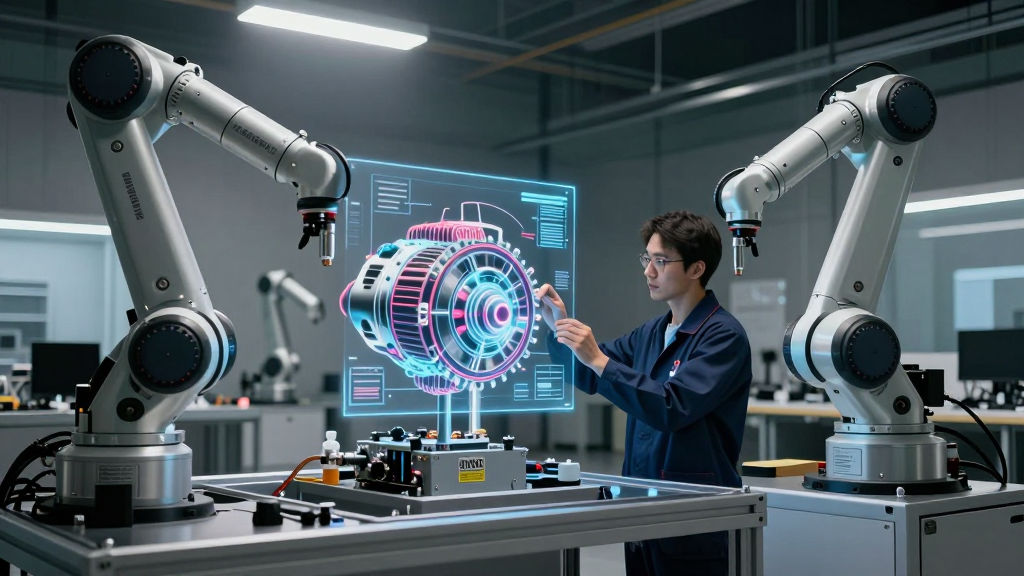
Why Ford Rehired 350 Engineers: Lessons in Ford AI Automation
Estimated reading time: 7 minutes
- Ford’s pivot from total automation back to human expertise highlights the limitations of AI in high-stakes manufacturing environments.
- Industrial AI failures often stem from “noisy” physical data and the lack of explainability required by safety standards like ISO 26262.
- Successful organizations are transitioning to a “human-in-the-loop” model that treats AI as an augmentation tool rather than a replacement.
- Data silos in legacy systems and the need for private AI infrastructure remain significant technical hurdles for enterprise automation.
- The Reality Check for Ford AI Automation
- Why Industrial AI Projects Often Fall Short
- The Challenge of Edge AI in Factories
- Transitioning to Human-in-the-Loop Automation
- Building a Socio-Technical System
- Technical Barriers: Noisy Data and Legacy Systems
- The Role of Private AI Infrastructure
- Lessons for Enterprise AI Adoption
- Moving Beyond the Hype Cycle
- The Future of Engineering Roles
- Strategic Benefits of Human-AI Teams
- Conclusion
- FAQ
- Sources
The narrative of artificial intelligence replacing the human workforce has dominated headlines for years. Many executives believed that “lights-out” manufacturing and fully autonomous engineering were just around the corner. However, recent developments at one of the world’s largest automakers suggest a major shift in this strategy. Ford Motor Company recently made headlines by rehiring approximately 350 engineers after its ambitious bet on total Ford AI automation failed to deliver the expected results.
This move marks a significant turning point in the post-hype phase of enterprise AI deployment. It highlights the growing realization that while AI can optimize tasks, it cannot yet replace the nuanced expertise of a seasoned engineer. In this article, we will explore the technical and strategic reasons behind this decision. We will also discuss how companies can avoid an industrial AI failure case study by focusing on augmentation rather than total replacement.
The Reality Check for Ford AI Automation
Ford’s initial push into aggressive automation was designed to slash costs and accelerate production cycles. The company invested heavily in AI-driven systems to handle complex engineering workflows and predictive maintenance. For a time, it seemed that software agents might handle the bulk of the heavy lifting. Nevertheless, the transition did not go as smoothly as the initial projections suggested.
Reports indicate that the automated systems struggled with the high-stakes variability of automotive manufacturing. Consequently, Ford realized that the lack of human oversight led to bottlenecks that cost more than the original labor expenses. By rehiring 350 engineers, Ford is acknowledging that human expertise remains the bedrock of complex industrial systems. You can see more details on this development in this recent coverage of Ford’s AI pivot.
This situation serves as a perfect example of the AI productivity paradox we have seen across various sectors. Companies often see a dip in efficiency when they replace proven human processes with unproven automated ones. Ford’s decision is not a rejection of AI, but a recalibration of how it is used.
Why Industrial AI Projects Often Fall Short
Building an industrial AI failure case study usually starts with the same mistake: overestimating model reliability in “noisy” environments. Unlike a chatbot that lives in a clean digital interface, industrial AI must interact with the physical world. Factories are filled with heat, vibration, and unpredictable data streams.
Moreover, automotive engineering must adhere to incredibly strict safety standards, such as ISO 26262. Automated systems often struggle to provide the level of “explainability” required by these functional safety protocols. When an AI makes a design choice, engineers must know exactly why it happened to ensure driver safety. If the model is a “black box,” it becomes a liability rather than an asset.
The Challenge of Edge AI in Factories
Deploying edge AI in factories presents unique infrastructure hurdles that many companies underestimate. To achieve real-time responsiveness, models must run locally on the factory floor rather than in a distant cloud. However, local hardware often lacks the massive compute power needed to retrain models on the fly.
As a result, models can suffer from “data drift” where they become less accurate over time as machinery wears down or parts change. Without engineers to tune these models, the automation slowly becomes a source of errors. This is a primary reason why we are seeing a shift toward bridging the manufacturing gap through better human-AI integration.
Transitioning to Human-in-the-Loop Automation
The most successful companies are moving away from total replacement toward human-in-the-loop automation. This strategy treats AI as a sophisticated tool that augments human capability. Instead of asking “How can we remove this engineer?”, leaders are asking “How can we give this engineer superpowers?”
For example, AI is excellent at scanning thousands of lines of sensor data to find anomalies. However, it is poor at determining the root cause of a mechanical failure that has never happened before. In a human-in-the-loop system, the AI flags the problem, and the engineer applies their years of experience to solve it. This approach maintains the high-speed benefits of automation while keeping the safety net of human intuition.
Building a Socio-Technical System
Ford’s rehires suggest that engineering is a socio-technical process. It involves collaboration, ethical judgment, and creative problem-solving that current LLMs cannot replicate. When you remove the humans, you break the feedback loop that drives innovation.
- AI handles repetitive data entry and basic simulations.
- Engineers focus on system architecture and safety-critical design.
- The organization benefits from both speed and reliability.
- Data remains governed and interpreted by experts.
Technical Barriers: Noisy Data and Legacy Systems
A major hurdle for AI in manufacturing engineering is the presence of legacy systems. Most factories run on older MES (Manufacturing Execution Systems) and ERP platforms that were never designed for modern data extraction. Consequently, the “fuel” for AI—clean, structured data—is often missing.
When Ford attempted to automate its workflows, it likely encountered these data silos. Trying to force an AI to understand thirty-year-old PLCs (Programmable Logic Controllers) often leads to system crashes. Engineers are needed to build the middleware and data pipelines that make automation possible in the first place. Without this foundational work, any AI layer will eventually fail.
The Role of Private AI Infrastructure
To succeed where others have failed, many firms are turning to private AI infrastructure. By hosting their models on-premise or in private clouds, they can protect sensitive intellectual property. Furthermore, private infrastructure allows for much tighter integration with local factory hardware.
At Synthetic Labs, we emphasize that future industrial AI automation depends on having a controlled, high-performance stack. This allows for the low latency required for robotics while ensuring that data doesn’t leak to public model providers. Ford’s struggle highlights why a “one-size-fits-all” public AI approach rarely works for complex manufacturing.
Lessons for Enterprise AI Adoption
What can other CTOs and founders learn from the Ford story? The most important lesson is that process mapping must come before model deployment. If you automate a broken process, you simply create a faster way to make mistakes.
- Map your workflows first. Identify where the actual friction lies before buying an AI tool.
- Prioritize augmentation. Look for ways to automate the 20% of work that engineers find tedious.
- Invest in data quality. AI is only as good as the sensors and logs feeding it.
- Keep the experts. The engineers you think you can replace are the ones who will save the project when the AI fails.
Ford’s pivot shows that the goal should not be a “workerless” factory, but an “expert-led” factory powered by intelligent tools. This shift in mindset is essential for any company hoping to scale in 2026 and beyond.
Moving Beyond the Hype Cycle
We are currently exiting the “peak of inflated expectations” regarding AI. We are now entering the “slope of enlightenment,” where we discover what these tools are actually good for. This phase is characterized by a return to fundamentals and a respect for technical craft.
While some might see Ford’s move as a failure, it is actually a sign of maturity. It shows a company willing to admit a mistake and pivot toward a more sustainable, human-centric model. For those of us in the AI space, it provides a clear roadmap: build tools that help people work better, not tools that try to do the work for them.
The Future of Engineering Roles
Engineering roles are evolving, not disappearing. In an AI-augmented world, the most valuable skill is no longer just “knowing the answer.” Instead, it is knowing how to ask the right questions and how to verify the AI’s output.
Engineers at Ford will now likely spend more time managing “AI agents” and “automated workflows.” They will act as the conductors of a digital orchestra. This requires a new set of skills, including prompt engineering, data literacy, and system oversight. However, the core of engineering—building things that work and keep people safe—remains unchanged.
Strategic Benefits of Human-AI Teams
When you combine human ingenuity with AI speed, the competitive advantage is immense. AI can run ten thousand simulations in the time it takes an engineer to drink coffee. But the engineer is the one who notices that the tenth simulation has a flaw that could lead to a recall.
As a result, companies that embrace this hybrid model will likely outperform those that try to go 100% autonomous. They will avoid the massive costs associated with an industrial AI failure case study and build more resilient operations. Ford’s re-hiring of those 350 engineers might be the best investment they make this decade.
Conclusion
The story of Ford AI automation serves as a vital reminder for the entire industry. While artificial intelligence is a generational breakthrough, it is not a magic wand for complex engineering. True progress lies in human-in-the-loop automation and the thoughtful application of edge AI in factories.
By focusing on augmentation and maintaining a robust private AI infrastructure, companies can enjoy the benefits of technology without losing their most valuable asset: human expertise. As we look toward the future, the most successful organizations will be those that empower their engineers rather than looking for the exit.
Subscribe for weekly AI insights and deep dives into the future of private infrastructure.
FAQ
- Why did Ford rehire 350 engineers?
- Ford rehired these engineers after discovering that their aggressive AI and automation push couldn’t match the nuanced problem-solving and safety oversight provided by human experts.
- What is the biggest challenge in industrial AI?
- The biggest challenges are “noisy” data from the physical world, strict safety regulations like ISO 26262, and the difficulty of deploying AI on legacy factory hardware.
- Should companies stop using AI in manufacturing?
- No. Companies should pivot from “replacing” workers to “augmenting” them. AI is best used for data analysis and repetitive tasks, while humans handle architecture and safety.
- What is human-in-the-loop automation?
- It is a design strategy where AI systems are built to assist humans, requiring human intervention or verification at critical decision points to ensure accuracy and safety.
Sources
- Ford AI Automation Failure Analysis
- Atlassian Thought Leadership on Agentic AI
- Why Ford is Rehiring Engineers
- Supreme Court Ruling on Tech Privacy
- Ford Rehires Engineers Short
- Industrial AI Failure Reel
- Democracy Now! June 25, 2026
- Manufacturing AI Challenges Reel
- Ford’s AI Push and Engineering Rehires
- The Future of Industrial Automation